SKELETAL SYSTEM
The skeleton of the rat (Fig. 10.8) lacks any unique adaptations to digging, swimming, or running (King & Constance 1982). Along with hamsters and other small rodents, rats lack Haversian systems so ossification is not completed until 1 year of age (much later in relation to puberty than most mammalian species) (Fallon 1996; Percy & Barthold 2001).
The proximal humeral epiphysis and distal radius and ulna do not fuse until the end of the 2nd year (Hebel & Stromberg 1986a).Skull
The skull has a cartilaginous mandibular symphysis and an extremely mobile temperomandibular joint (Hebel & Stromberg 1986a). This, combined with the chisel-like incisors and powerful jaw muscles, makes the rat ideally adapted to the omnivorous state (Figs. 10.9-10.12).
Axial skeleton
Mammary glands
There are six mammary glands on each side in the rat: three in the thorax, one in the abdomen and two in the inguinal region. Mammary tissue is extensive, reaching from the neck to the elbow and to the inguinal region. At the axilla a portion even extends dorsally to the shoulder. In the lactating There are 7 cervical, 13 thoracic, 6 lumbar, 4 sacral, and 27 to 31 coccygeal vertebrae (Bivin et al. 1979; Hebel & Stromberg 1986a). The sixth cervical vertebrae has a modified rib fused to its transverse processes. Ribs 1-7 articulate with the sternum and the last three are floating ribs. The rat does not have true costal cartilages. The dorsal ribs become ossified first, with the ventral part following later.
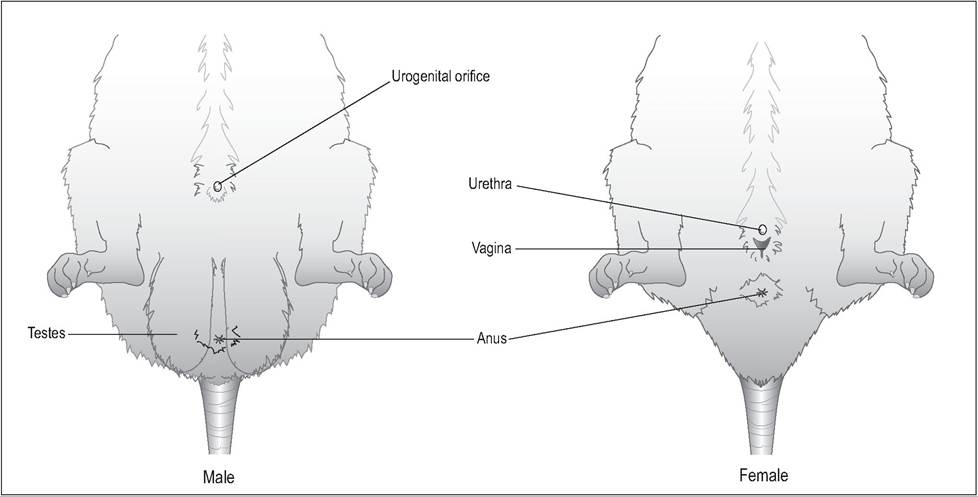
Figure 10.6 • External genitalia.
(a) Male - there is a common urogenital aperture and the anogenital distance is twice that of the female
(b) Female - the urethra and vulva have separate openings and there is a shorter anogenital distance than in the male
Appendicular skeleton
The rat has a well-developed clavicular brace with ligaments similar to the human shoulder joint (Fig.
10.15). A spoonshaped clavicle articulates with the sternum proximally, and distally with the scapula. The scapula is usually positioned horizontally and has a club-shaped hamate process extending laterally from the scapular spine (Bivin et al. 1979; Hebel & Stromberg 1986a).The forefeet are well developed and, unlike in the rabbit and guinea pig, have the ability to flex and grasp food in their palms. There are five metacarpal bones: the first digit has two phalanges while the other four all have three phalanges.
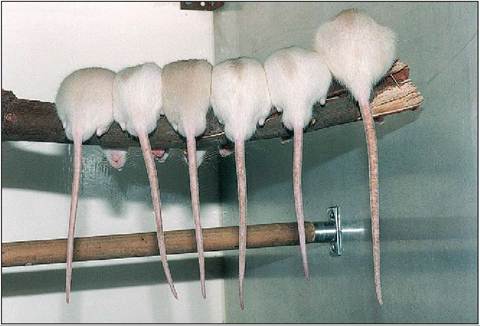
Figure 10.7 • Rats perched on branch showing rounded distal appearance of entire males and triangular appearance of female (right of picture). (Photo by Claire Nuttall)
In the young rat the os acetabulum fuses with the ischium and ilium to form the acetabulum. The tibia and fibula are fused distally and the tarsus has three rows of bones. The hind feet follow the same pattern as the forefeet but are much better developed (Hebel & Stromberg 1986a).