GLUTAMATE RECEPTORS
Glutamate receptors are a class of ionotropic and metabotropic receptors that bind the neurotransmitter glutamate. Glutamate is the primary excitatory neurotransmitter in the central nervous system and plays essential roles in synaptic transmission, neuronal development, and synaptic plasticity.
There are two main types of glutamate receptors (ionotropic and metabotropic) and their differences are given in Table 8.13.1. Ionotropic glutamate receptors: These receptors directly regulate flow of ions across the cell membrane when activated by glutamate. There are three subtypes of ionotropic glutamate receptors:
TABLE 8.13
Differences Between Ionotropic and Metabotropic Glutamate Receptors
| Feature | Ionotropic Glutamate Receptors Metabotropic Glutamate Receptors |
| Types/Subtypes Receptor Mechanism Primary Function | AMPA, NMDA, and Kainate receptors mGluR1 to mGluR8 Ligand-gated ion channels G-protein coupled receptors (GPCRs) Mediate fast synaptic transmission Modulate synaptic transmission and neuronal excitability |
| Ion Permeability | Permeable to Na+, K+, and Ca2+ (depending on Not directly ion-permeable subtype) |
| Activation Requirements Response Time Role in Synaptic Transmission | Activated by glutamate binding Activated by glutamate binding Fast (milliseconds) Slow (seconds to minutes) Directly mediate excitatory postsynaptic currents Modulate neurotransmitter release and synaptic (EPSCs) plasticity |
| Subunit Composition | AMPA: GluA1-4, NMDA: GluN1, GluN2 (A-D), Various subunits form different mGluR types GluN3, Kainate: GluK1-5 |
| Pharmacological Agents | AMPA agonists: AMPA, NMDA agonists: NMDA, Various agonists and antagonists specific to mGluR Kainate agonists: Kainate subtypes |
| Functional Importance | Rapid excitatory neurotransmission Modulation of synaptic plasticity, learning, memory, and neuroprotection |
• AMPA receptors (α-amino-3-hydroxy-5
-methyl-4-isoxazolepropionic acid receptors): AMPA receptors are tetrameric protein complexes composed of different combinations of four subunits: GluA1, GluA2, GluA3, and GluA4.
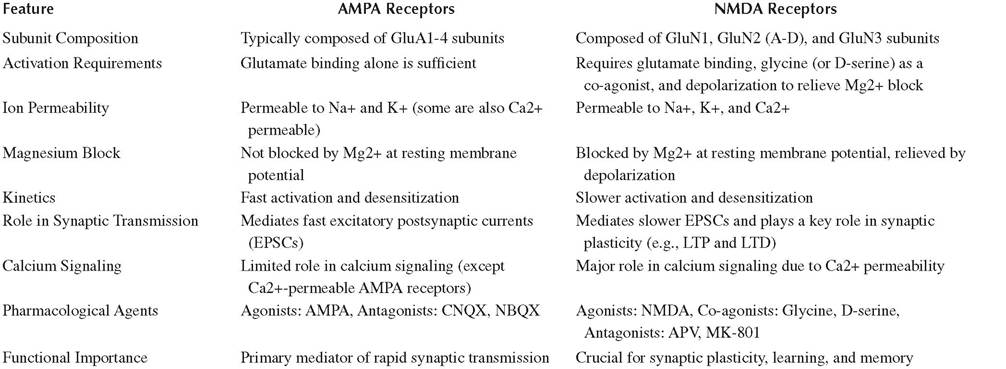
These subunits assemble to form functional receptor complexes, with the most common combination being heterotetramers containing GluA1 and GluA2 subunits. When glutamate binds to AMPA receptors located on the postsynaptic membrane, the receptors undergo a conformational change that leads to the opening of the ion channel pore, allowing the influx of Na+ and K+ ions into the postsyn- aptic neuron. This depolarization of the post- synaptic membrane results in the generation of EPSPs, which contribute to the integration of synaptic inputs and the generation of action potentials. AMPA receptors are responsible for the fast component of excitatory synaptic transmission and are critical for synaptic plasticity.• NMDA receptors (N-methyl-D-aspartate receptors): NMDA receptors are involved in mediating long-lasting synaptic plasticity. These receptors are composed of GluN1, GluN2, and GluN3 subunits, which assemble to form functional receptor complexes. The GluN1 subunit is essential for receptor function, while the GluN2 and GluN3 subunits determine the functional properties of the receptor like its pharmacology and conductance. Activation of NMDA receptors requires both binding of glutamate to the receptor, and simultaneous depolarization of the postsyn- aptic membrane to remove the magnesium (Mg2+) ion that blocks the ion channel pore. This unique property of NMDA receptors, known as the voltage-dependent magnesium blockade, allows them to act as coincidence detectors, integrating both synaptic activity and postsynaptic membrane depolarization. Once activated, NMDA receptors allow influx of Ca2+ ions into the postsynaptic neuron, which triggers various intracellular signaling cascades that are responsible for synaptic plasticity and the neuronal function (Table 8.14 for differences between AMPA and NMDA receptors).
• Kainate receptors: Less understood compared to AMPA and NMDA receptors, these receptors are involved in modulating synaptic transmission and are present in various regions of brain.
2. Metabotropic glutamate receptors (mGluRs): These receptors indirectly modulate cellular processes through intracellular signaling pathways when activated by glutamate. There are eight subtypes of metabotropic glutamate receptors, which are classified into three groups based on their sequence homology, signal transduction mechanisms, and pharmacological properties. Metabotropic glutamate receptors play roles in modulating synaptic transmission, neuronal excitability, and synaptic plasticity.
TABLE 8.14
Differences Between AMPA and NMDA Receptors
8.18