Important Transport Equations Summarize the Contributions of the Various Driving Forces
It is worthwhile developing some quantitative aspects of transport, beginning with simple examples and developing equations for the effect of more than one driving force. These equations can be seen as summaries of the physical laws.
In most cases the equations describe phenomena with which we have experience by living in a technological society. In these equations, c stands for concentration, V for volume, P for pressure, and so forth; these are common concepts. It is important, however, to think about these equations in real-life terms, not as abstract symbols.One of these equations relates a hydrostatic (pressure) driving force for water movement that just balances a driving force caused by a chemical potential difference. Osmosis is the movement of water across a Semipermeable membrane in response to the difference in the electrochemical potential of water on the two sides of the membrane (Figure I-7). The chemical potential of water is lower in I liter (L) of water (H2O) in which is dissolved 2 millimoles (mmol) of sodium chloride (NaCl) than in I L of H2O in which is dissolved 1 mmol of NaCL If these two solutions are separated by a pure lipid bilayer, Na+ and CΓ ions cannot move to equilibrate the concentration. Rather, the freely permeable water moves from the side with the higher waler potential (low concentration of solute) to the side with the lower water potential (higher concentration of solute). Thus, water follows solute (a good summary of osmosis), and this water movement dilutes the 2- mmol solution. However, water movement never produces equal concentrations of salt. Rather, another driving force appears as the water moves. The hydrostatic pressure of water increases on the side to which the water moves, increasing the electrochemical potential of the water on that side. Net water movement stops when the increase in water potential from hydrostatic pressure exactly balances the decrease in water potential from the dissolved salt, so that the electrochemical potential becomes equal on both sides of the membrane.
The initial potential difference of water in Figure 1-7 is caused by the difference in the concentration of material dissolved in the water. A proper explanation of why the water in a solution has a lower chemical potential than pure water (and why water in a concentrated solution has a lower potential than in a dilute solution) is beyond the scope of this chapter.
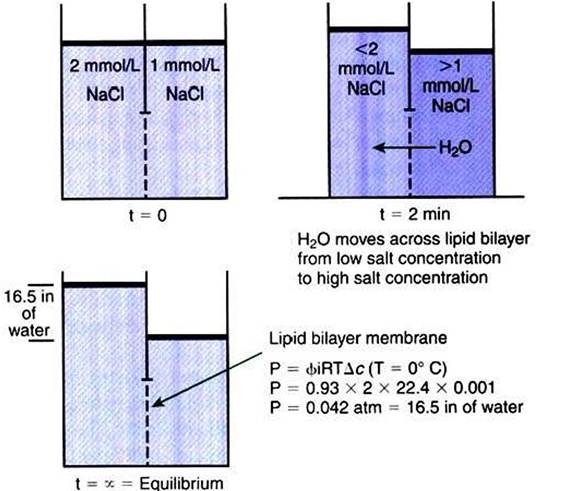
FIGURE 1-7 Osmosis. At time (t) = 0, two compartments are separated by a lipid bilayer membrane (no transport proteins) that contains salt solutions of differing concentrations. At t = 2 minutes, the salt ions cannot move across the membrane to equilibrate their concentration, but water can move. Water moves from the region of higher water potential (low salt) to the region of lower water potential (high salt). Water continues to pass the lipid bilayer until at t = equilibrium; the difference in the height of water between the two sides creates a difference in pressure that is equal but opposite to the difference in the water potential between the two sides. That is, the free energy difference resulting from differing salt concentrations is equilibrated by an equal but opposite free energy difference caused by pressure.
However, readers familiar with the concept of ent ropy will realize that the disorder of a system increases with the introduction of different particles into a pure substance and with the number of different particles introduced. An analogy would be that a canister with mixed sugar and salt is more disordered, and therefore at higher entropy, than a canister with only pure salt or pure sugar. Also, the disorder of the system increases as more sugar is added to salt (up to 50:50); a pinch of sugar in a canister of salt only increases the disorder slightly. Because an increase in entropy causes a decrease in free energy, the free energy of a solution is decreased as the mole fraction of solute increases.
Osmosis is important to cells and tissues because, generally, water can move freely across them, whereas much of the dissolved material cannot. Given a concentration difference of some nonpermeable substances, van’t Hoffs equation relates how much water pressure is required to bring the system to equilibrium, that is, the free energy contributed by a pressure difference across the membrane that exactly balances an opposing free energy contribution caused by a concentration difference.
∏ = iRT∆c
∏ = Osmotic pressure» the driving force for water movement expressed as an equivalent hydrostatic pressure in atmospheres (1 atm = 15.2 lb∕in2 = 760 mm Hg). Osmotic pressure is symbolized by ∏ to distinguish it from other types of pressure terms.
i = Number of ions formed by dissociating solutes (c.g., 2 for NaCl, 3 for CaCl2).
R = Gas constant = 0.082 1. alm/mol degree.
T = Temperature on the Kelvin scale; 0o C = 273o K.
(RT is a measure of the free energy of I mol of material because of its temperature, At 0o C, RT = 22.4 L atm/mol.) ∆c= Difference in the molar concentration of the impermeable substance across the membrane.
This equation summarizes a balance of driving forces; II amount of hydrostatic (osmotic) pressure is the same driving force as a particular concentration difference, ∆c. The osmotic pressure depends only on the concentration difference of the substance; no other property of the substance need be taken into account. Those phenomena that depend only on concentration, such as osmotic pressure, freezing-point depression, and boiling-point elevation, are called Colligative properties. VaiTt Hoff’s law is strictly true only for ideal solutions that are approximated in our less-than-ideal world only by very dilute solutions. Real solutions require a “fudge factor," called the osmotic coefficient. symbolized by φ. The osmotic coefficient can be looked up in a table, then plugged into the equation as follows:
Il = φiRT∆c
The term φ∕c tor a given substance represents the osmotically effective concentration of that substance and is often called the osmolar or osmotic concentration, measured in osmoles per liter (0sm∕l.).
In general, the osmolar concentration of a substance is approximated by the usual concentration times the number of ions formed by the substance; the osmotic coefficient provides a small correction. The osmolarity of a 100-mmol NaCl solution (0.1 mol) is then 0.93 (φ for NaCI) ? 2 (NaCl → Na+ + CΓ) ? 0.1 mol = 0.186 Osm = 186 mθsm.The previous equation summarizes a phenomenon crucial for physiological function. The greater the concentration difference of an impermeable substance across a membrane, the greater is the tendency for water to move to the side of high concentration. (Water follows solute.) Indeed, if you plug some numbers into this equation, you may be surprised at the large pressures required to balance modest concentration differences. For example, an NaCl concentration difference of 0.1 mol (5.8 g∕L) is equilibrated by a pressure (4.2 atm) equal to a column of water 141 ft high (divers must be wary of “the bends” when ascending from below 70 ft of water). The importance of this is that a small concentration difference can produce a strong force for moving water. The body makes effective use of this to transport water in many tissues: ions/ molecules are transported into or out of a compartment → and water follows by osmosis.