INTEGUMENT
The scales are formed by thickened parts of epidermis between which are foldings of thin skin, and this allows for great expansion when a snake consumes its prey (Fig. 5.29). The gastropeges are larger and thicker to provide support.
The subcaudal scales covering the ventral tail are usually paired. Snakes have few skin glands apart for the cloacal glands.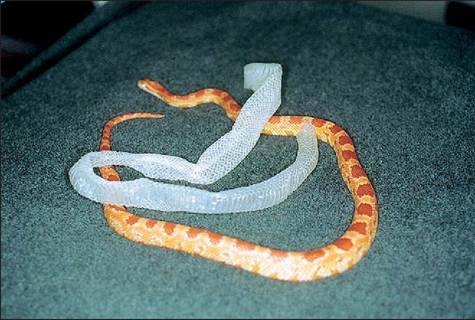
Figure 5.30 • Normal shedding.
CLINICAL NOTE
Reptile skin is very inelastic so incising between the scales will improve flexibility.
and sheen. After shedding the snake may defecate and be very thirsty. Failure to eat may occur if the spectacles fail to shed, thus inhibiting vision (Fig. 5.31).
Ecdysis
The snake grows by shedding their skin. Lymph fluid builds up between the old and new epidermal layers, causing the markings to become obscure and giving a blue appearance to the skin and spectacle. Snakes cannot see clearly around this time so may become more irritable than usual. Just before the shed takes place the spectacle clears and the skin circulation then becomes engorged, stretching the old skin and causing it to split. The snakes become more restless and start to crawl about and rub against rough surfaces. In healthy snakes the skin is shed in one piece from snout to tail and is generally 20% longer than the original (Fig. 5.30). It is colorless because the pigment cells are in the dermal layer.
Once ecdysis is completed the old inner layer becomes the new outer layer and gives the snake a wonderful luster
CLINICAL NOTE
Failure to shed can be caused by lack of humidity in the vivarium. Increasing the humidity and providing rocks or logs for the snake to rub against will prevent dysecdysis. Warm water soaks and artificial tears can also literally help the “scales fall from the eyes” so that the snake can then see to eat.
GENERAL INTEREST
The Rattlesnake’s rattle is made from previous skin sheds left behind on the tail. Each time it sheds it leaves behind a horny segment on the tail. The sound is produced when the rattlesnake vibrates its tail, causing the segments to bang together (Bellairs I969e; Evans 1986).
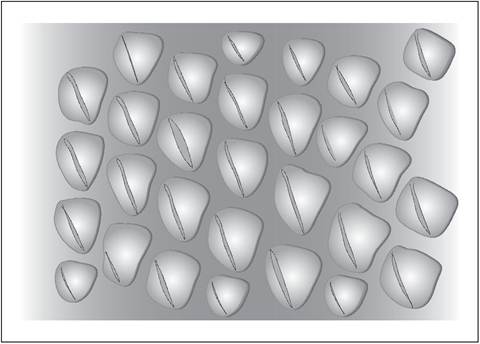
Figure 5.29 • Stretched snake skin showing the thin skin (alpha keratin) hinged in between the thick scales (beta keratin).
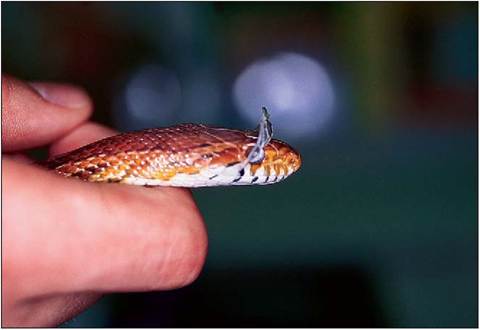
Figure 5.3I • Poor shedding or dysecdysis in a corn snake.
Frequency of shedding
The shedding frequency is affected by many factors, such as growth, season (e.g., post hibernation in spring), oviposition or parturition (8-10 days before these). Most snakes shed about 2 to 4 times a year.