SENSES
Sight
Sight is quite poor in snakes as they may have evolved from burrowing snakes. The snake eye is very different to that in lizards and chelonians as it is small with a relatively large cornea and has no scleral ossicles.
The eyeball is spherical and lined by a fibrous sclera. The eyes have no eyelids but have fused to form a protective spectacle or brille over the cornea (Fig. 5.28). The Harderian and lacrimal glands secrete into the subspectacular space, which is then drained by the nasolacrimal duct. Infections here can lead to bullous spec- taculopathy and subspectacular abscesses where the fluid cannot drain away. There is no nictitating membrane. Unlike lizards, eye mobility beneath the spectacle is very limited (Underwood 1970).Most reptiles focus the eye by using muscles in the ciliary body to change the lens curvature. However, snakes have a reduced ciliary body, relying on movement of the iris muscles instead, and as a consequence the lens is spherical in shape and accommodation is poor. The pupil shape varies with the mode of life and the habitat in which the snake lives and may be round, elliptical, or even horizontal in some arboreal species (Bellairs 1969f; Pough 1998a; Underwood 1970).
Unlike lizards, snakes have both cones and rods in their retina, although many diurnal forms have lost their rods. Only a few snakes have a conus papillaris (similar to the avian pecten) arising from the optic nerve papilla.
Hearing
Snakes have no external aural structures, no tympanic membrane, and only a narrow tympanic cavity (Murray 1996). The columella (stapes) is directly attached to the quadrate bone and the inner ear appears to be well developed and sensitive to ground vibrations. Contrary to popular belief, snakes are not deaf but hearing sensitivity is only over a limited low frequency in the range of 150-600 Hz.
Snakes hear by literally having “an ear to the ground”. They pick up sensitive vibrations via the quadrate bone (which acts like an eardrum) and direct them to the inner ear and brain. Snakes do not vocalize between themselves but hiss or rattle as warning signals (Baird 1970; Bellairs 1969f).Olfaction
This is the most developed of senses in snakes. Apart from the usual olfactory epithelium in the nostrils, snakes possess a highly developed Jacobson’s organ (Fig. 2.14). This is a pair of domed cavities or vomeronasal pits lined with sensitive epithelium. The forked tongue is flicked out through a groove in the mouth called the lingual notch or fossa where it picks up scent particles from its surroundings. It then inserts the fork in the vomeronasal pits and sends information via the olfactory nerves to the brain (Bellairs 1969f; Parsons 1970).
Touch and taste
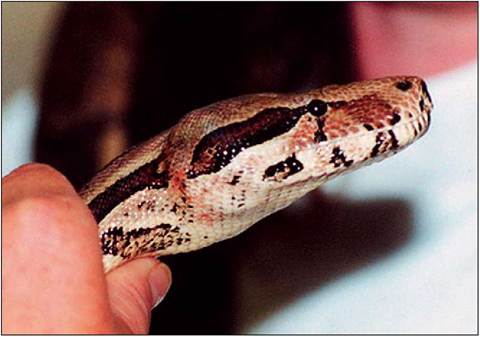
Figure 5.28 • The snake has no eyelids. Instead they are fused to form the transparent spectacle or brille which is shed with the other scales during ecdysis. (Photo by Janet Saad)
The tongue is an organ of taste, touch and smell. It lies in a sheath beneath the glottis and is protruded through the lingual notch or fossa, enabling the snake to protrude its tongue without opening its mouth. It is primarily a sensory organ that brings odor from the environment to the vomeronasal organ. Snakes in unfamiliar surroundings will flick their tongue in and out as they explore.
Heat sensing: the sixth sense
Some snakes possess specialized infrared receptors, or pits, which enable them to sense warm-blooded prey and strike to catch them, even in total darkness. They are located between the nostril and eye on the side of the head in pit vipers. Boas and pythons have a series of smaller, less sensitive slit-like openings on the upper and lower labial scales but the pattern and number varies between species. The pits are richly innervated via the ophthalmic, mandibular, and maxillary branches of the trigeminal nerve. They are so sen-
sitive they can detect a temperature variation of as little as 0.003° C (Barrett 1970). These thermal cues combine with visual cues to give the snake a general image of its surroundings (Bellairs 1969f; Bennett 1996).