INTEGUMENT
The integument of the ferret contains numerous sebaceous glands, which give the animal its musky smell. This is different from musk (anal) gland odor. There are no skin sweat glands and this makes ferrets vulnerable to heat stress in hot climates.
The blackish-brown coloring of the thick outer coat guard hairs varies in the fitch or sable ferret, and ferrets living outside tend to be darker; the undercoat is white to yellow. Albino ferrets, with unpigmented (pink) eyes, and black-
eyed whites (white-coated ferrets with dark pigmented eyes) are two other common colors. The silver mitt ferret has white paws. Sable, silver mitt, black-eyed white (BEW) and albino are basic ferret colors (Figs. 12.31-12.34), while the American Ferret Association recognizes a range of 30 coat color variations, derived from breeding programmes in the USA.
The AFA-approved color variations include:
Silver - dark gray guard hair and a cream-colored undercoat but little or no mask.
■ Black-eyed white - pigmented eyes and white coat. Chocolate - dark brown guard hairs rather than the characteristic black of sable ferrets.
Siamese - guard hairs lighter than the chocolate type and with a light-colored mask.
Panda - white hair on the head and shoulders but a body of various colors.
Shetland sable - sable body color but with a white stripe placed vertically on the face from the nose to the top of the head (Brown 1997).
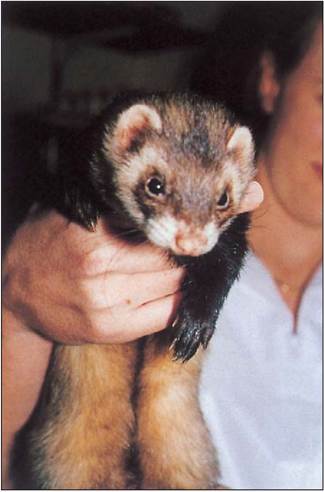
Figure 12.31 • Sable ferret.
Molting
The ferret coat is subject to seasonal molts. With a summer molt sables lighten somewhat; they then darken with the autumn (fall) molt and thicken in coat. This is especially prevalent in ferrets living outdoors, as is usual in Australia, New Zealand, and the UK, compared to indoor-kept American ferrets.
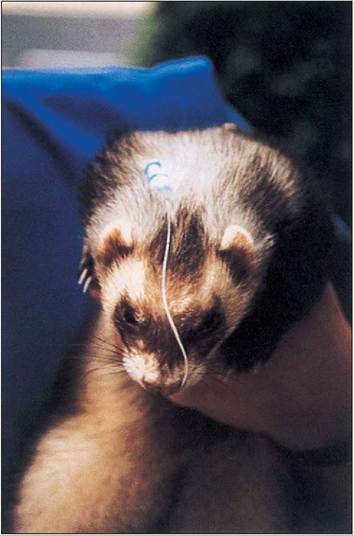
Figure 12.30 • A correctly secured nasogastric catheter. Slide courtesy of Dr. Anthony Lucas.
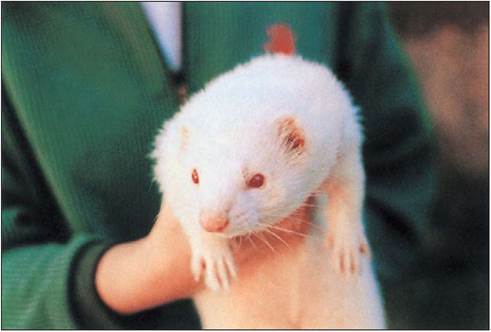
Figure 12.32 • Albino ferret.
KEY POINTS
• The ferret has acute hearing and smell.
• Being nocturnal, rods predominate to the cones in the ratio 50-60:1 (Jackson & Hickley 1995).
• The ferret sees and responds to moving objects better than to stationary objects.
• The visual nervous system and pineal gland are intimately involved with reproduction and subsequent endocrine problems.
• The very narrow ventral space in the nasal conchae makes passing a nasogastric tube difficult.
• Numerous sebaceous skin glands convey the musky ferret smell.
• The lack of sweat glands makes ferrets vulnerable to heat stress.
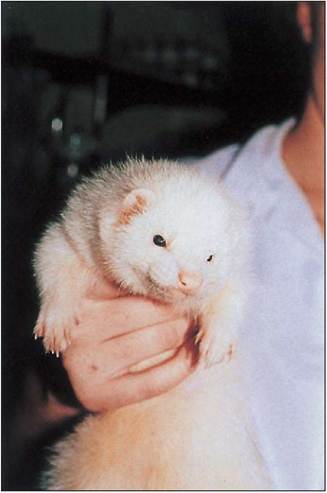
Figure 12.33 • Black-eyed white ferret.
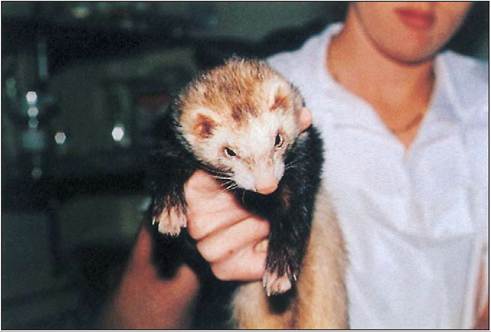
Figure 12.34 • Silver mitt ferret.