LACTOGENESIS AND LACTATION
1. What is meant by lactogenesis?
2. Why is progesterone withdrawal a prerequisite for lactogenesis?
3. How is the increase in estrogen concentration before parturition associated with lactogenesis?
4.
What is the role of prolactin in lactogenesis?5. What is accomplished by a growth hormone surge just before parturition?
6. What is the role of growth hormone in the maintenance of lactation in cattle?
Lactogenesis is the process by which mammary alveolar cells acquire the ability to secrete milk. The first stage includes increases in mammary enzymatic activity and differentiation of cellular organelles that coincide with limited secretion of milk before parturition. The second stage is associated with copious secretion of all milk components shortly before parturition in most species, continuing for several days after parturition.
Hormones and Their Interactions
The hormones involved in the second stage of lactogenesis (onset of copious milk secretion at parturition) include increased secretion of prolactin, adrenocorticotropic hormone (ACTH), and estrogen, and.a decrease or virtual absence of progesterone. ACTH stimulates the secretion of, glucocorticoids.
Prolactin concentration in cattle does not change appreciably during gestation, but a major increase occurs within 48 to,24 hours before parturition. Other hormones, glucocorticoids, growth hormone, prostaglandins, and estradiol also increase concurrently, and the progesterone level declines (Figure 16-8).
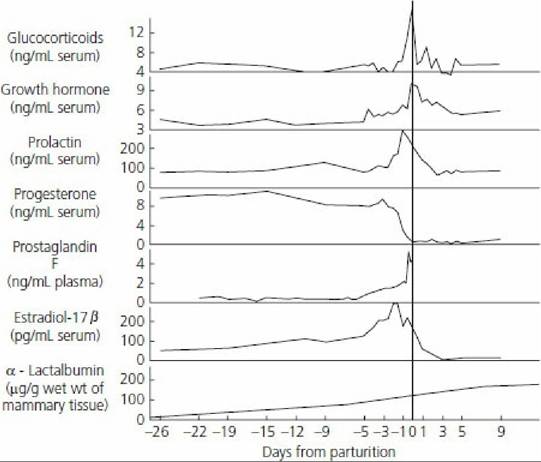
■ FIGURE 16-8 Changes in plasma concentration of several hormones found in cows near parturition. (From Tucker HA. Endocrine and neural control of the mammary gland. In: Larson BL, ed. Lactation. Ames, IA: Iowa State University Press, 1985.)
These hormones interact in various ways:
1.
Prolactin induces gene expression in mammary tissue for casein synthesis, and glucocorticoids are required for this process.2. The presence of progesterone prevents the formation of prolactin binding sites in mammary tissue and also saturates the sites where glucocorticoids would bind. The withdrawal of progesterone is thus a prerequisite for lactogenesis.
3. Prostaglandin increase just before parturition causes lysis of the corpus luteum and a consequent decline in the progesterone level.
4. In cattle, the concentration of estrogens begins to increase about 1 month before parturition and reaches a maximum about 2 days before parturition. Lactogenesis is thus enhanced because estrogens stimulate the secretion of prolactin and possibly other hormones from the anterior pituitary.
5. A surge in growth hormone (from the anterior pituitary) occurs just before parturition, perhaps assuming its role of directing nutrients to the mammary gland for milk synthesis.
Hormonal Maintenance of Lactation
The increase in milk yield in cattle after parturition peaks in 2 to 8 weeks and gradually decreases thereafter. To continue with lactation, mammary alveolar cell numbers and alveolar cell activity must be maintained and the milk produced must be removed regularly. Hormones required for milk synthesis include prolactin, growth hormone, insulin, parathyroid hormone, ACTH, and thyroidstimulating hormone. The latter two hormones are required for their subsequent stimulation of glucocorticoid and thyroid hormone production, respectively.
Prolactin
In cows and goats, once lactation has been established, the concentration of basal circulating prolactin (see Chapter 6) and the release of prolactin at milking can be reduced to low levels without affecting milk yield. This situation contrasts markedly with nonruminants and even in other ruminants, particularly sheep, where milk yield is affected. The increase in prolactin secretion during milking is brought about by stimulation of the udder and teats.
No prolactin is released when the udder is denervated.Growth Hormone
Whereas prolactin is important for milk secretion in nonruminants, growth hormone is more important in the maintenance of ruminant lactation. Growth hormone (see Chapter 6) is galactopoietic (increases milk yield) in cattle and is essential for the maintenance of lactation in the goat. Growth hormone does not directly stimulate the mammary gland but instead seems to direct nutrients from body tissues toward milk synthesis. It has been shown that plasma growth hormone concentration is significantly higher in high-yielding than in low-yielding cows and that a significant reduction occurs when high-yielding cows cease lactating.
Thyroid Hormone
Thyroid hormone is essential for the maintenance of lactation in cattle. Partial removal of the thyroid gland causes a decrease in milk production that can be restored by treatment with thyroactive compounds. Treatment of thyroid-intact cattle with thyroactive compounds can increase milk yields that are associated with increases in metabolism at the expense of body fat and protein.
Insulin
Glucose is required for lactose synthesis. Various adaptations favor mammary gland priority in glucose metabolism. In goats and cattle, insulin is not required for glucose transport into the mammary gland alveolar cells or for milk synthesis. Therefore, other tissues do not compete for the available glucose. Also, insulin concentrations are low during early lactation (when milk production is high) and increase as milk production declines. Low insulin concentrations reduce glucose uptake by those tissues that require its presence for cellular transport and permit greater use by those cells that do not (e.g., alveolar epithelium). In cattle and goats, the pancreas releases less insulin in response to a glucose load. In animals other than cattle and goats, mammary uptake of insulin (associated with the uptake of glucose) is maintained throughout lactation and is essential for maintenance of lactation.
Corticosteroids
Intact adrenal glands are essential for the maintenance of lactation in both ruminants and nonruminants. Mineralocorticoid and glucocorticoid components are needed. Plasma corticosteroid concentrations are higher in lactating than in nonlactating animals and are higher in high-yielding than in low-yielding cows. The exact.role of the corticosteroids has not been established but might be correlated with metabolic rate.
Parathyroid Hormone
In view of the relatively high calcium content of milk, it is not surprising that parathyroid hormone is related to the maintenance of lactation. Parathyroid hormone stimulates bone resorption of calcium and the conversion of vitamin D to its active form, 1,25-dihydroxycholecalciferol [1,25 (OH)2D3], which is necessary for the absorption of calcium from the intestine. The concentration of. 1,25 (OH)2D3 in plasma is markedly,elevated during lactation.
■