Mammogenesis
1. What is the state of mammary gland development in the female at birth?
2. How is mammogenesis affected with successive estrous cycles after puberty?
3. What are the mammary gland changes that occur during pregnancy?
Mammogenesis refers to the growth and development of the mammary gland.
During embryologic development, a milk (or mammary) line appears on each side of the abdominal wall parallel to the midline (Figure 16-7). In most animals, mammary glands develop only in the inguinal area of the milk line.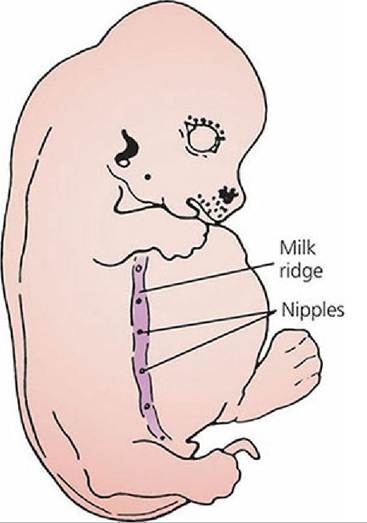
■ FIGURE 16-7 A 20-mm pig embryo, showing the milk ridge (milk line) (original magnification, ?515). (From Frandson RD, Spurgeon TL. Anatomy and Physiology of Farm Animals. 5th edn. Philadelphia, PA: Lea & Febiger, 1992.)
Development in Cattle
At birth, the female calf has teat and gland cisterns that are already somewhat mature in form. The mammary ducts are short and are confined to the region of the gland cistern. The stroma is well organized and is interspersed with fat.
The rate of growth of the mammary gland from birth to puberty is the same as for the rest of the body. The mammary gland is a skin gland that responds to female sex hormones. These are present in low concentrations until puberty. At the beginning of puberty, follicle-stimulating hormone (FSH) and luteinizing hormone (LH) are released from the anterior pituitary at cyclic intervals that characterize the estrous cycles. FSH and LH activity cause the ovary to secrete the female sex steroid hormones, estrogens (primarily estradiol) and progesterone. Estradiol is secreted mostly during the follicular phase of the estrous cycle and progesterone is secreted mostly during the luteal phase. An effective response of the mammary gland to estradiol and progesterone depends on the synergism (working with) provided by the two anterior pituitary hormones, prolactin and somatotropin (STH; growth hormone).
During the first several cycles, the growth affected by the synergism of estradiol, progesterone, STH, and prolactin consists of duct lengthening, thickening, and branching. By the age of 18 months, heifers have a system of ducts in the mammary glands. Differentiation of the ducts into alveoli continues with each recurring estrous cycle. The maximum amount of lobule and alveolar growth produced by estrous cycles alone is thought to occur at about 30 to 36 months of age.When pregnancy begins, the concentrations of estrogen, progesterone, STH, and prolactin increase to cause changes in the uterus that are essential for the survival of the fertilized oocyte. Most mammary gland growth occurs during pregnancy in response to the greater hormone concentrations. The adipose is slowly eroded and replaced by ducts, lobule alveoli, blood vessels, lymph vessels, and the connective tissue structures of the suspensory apparatus. Duct and alveolar growth continues throughout gestation.
The source of hormones varies with species. In cattle the placenta is a source of estrogen only. The corpus luteum continues as the major source of progesterone. A placental lactogen (hormone) that contributes to mammogenesis and is similar to STH and prolactin is secreted in several species and is directed from the fetal placenta to maternal blood. Placental lactogen secretion occurs at midpregnancy and continues until parturition. However, in contrast to other species, secretion of placental lactogen in cattle is directed to the fetal circulation, and its role in mammary gland development is unknown.
In addition to the pituitary, ovarian, and placental hormones already mentioned as contributors to mammogenesis, other hormones can have a peripheral role, such as adrenal steroids, thyroid hormone, insulin, and relaxin.
Development in Other Animals
In the dog, cat, and sow, mammary glands develop along the entire length of the milk line. In the elephant and primates, mammary glands develop only in the pectoral region.
The placenta becomes a source of both estrogens and progesterone in many species (but not in cattle; see previous text). In sheep and goats, the greatest secretion of placental lactogen coincides with the greatest lobule and alveolar growth of the mammary gland.
■