MECHANISM OF HEARING
The pinna, the visible part of the outer ear, helps collect and direct sound waves into the external auditory meatus (ear canal).
10.5.1 Eardrum Activation
The incoming sound waves strike the tympanic membrane or eardrum, causing it to vibrate in response to the changing air pressure.
10.5.2 Ossicle Transmission
The vibration of the eardrum is transmitted through the middle ear by three small bones known as the auditory ossicles (malleus, incus, and stapes).
The malleus (hammer) is connected to the eardrum and transfers vibrations to the incus (anvil), which, in turn, transmits them to the stapes (stirrup).
The stapes then pushes against the oval window, a membrane-covered opening that leads to the inner ear.
10.5.3 Inner Ear Activation
The movement of the stapes against the oval window sets the fluids inside the inner ear in motion, particularly the perilymph in the vestibule.
10.5.4 Perilymph Transmission
Perilymph, a fluid in the inner ear, is incompressible and thus efficiently transmits the sound wave through the scala vestibuli, a spiral-shaped chamber within the cochlea.
10.5.5 Organ of Corti Stimulation
As the sound wave travels through the cochlea, it reaches the scala media and scala tympani, stimulating the organ of Corti, a structure located along the basilar membrane in the cochlea.
The specific hair cells in the organ of Corti are activated based on the frequency and intensity of the sound wave, initiating a response.
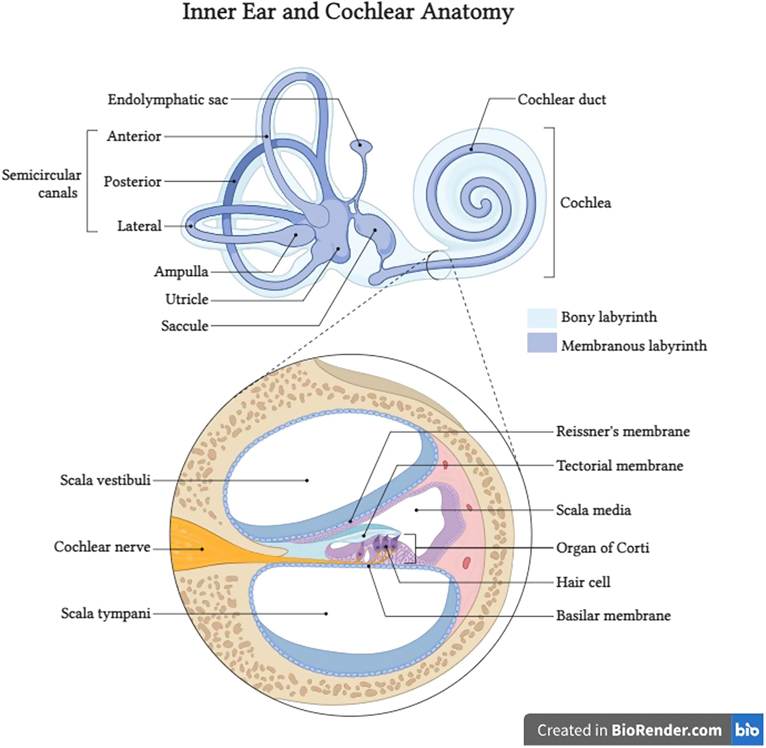
FIGURE 10.4 Structural component of the cochlear portion of the inner ear.
10.5.6 Liquid Movement Compensation
The movement of perilymph in the scala tympani is compensated by an outward movement of the cochlear (round) window, preventing excessive pressure build-up in the inner ear.
10.5.7 Hair Cell Stimulation
The stimulation of hair cells in the organ of Corti occurs as the basilar membrane vibrates in response to the fluid movement. Hair cells convert mechanical vibrations into electrical signals.
10.5.8 Nerve Transmission
Nerve impulses generated by the stimulated hair cells are transmitted via the cochlear branch of the vestibulocochlear nerve (auditory nerve) to the brain.
These electrical signals travel to the auditory cortex, where they are interpreted as sound, allowing us to perceive and understand the auditory stimulus.