METABOLISM
Birds are endothermic, meaning they have the ability to maintain a relatively stable body temperature, irrespective of the ambient temperature. At around 40° C (±1.5° C) birds' body temperature is about three degrees higher than mammals, so high metabolic rates are needed to maintain this and enable them to fly.
Birds expend 20 to 30 times more energy than reptiles of similar body size so their circulatory and respiratory systems have evolved to rapidly provide energy and oxygen to cells (Dorrestein 1997a).Passerine birds have the highest basal metabolic rate of all vertebrates, which is 50 to 60% higher than other birds of the same body size (Dorrestein 1997a; Maina 1996). During the day birds expend a lot of energy as they are constantly active with feeding, digestion, and flying. Many small birds can also store up fat reserves for energy overnight. Other small birds, like hummingbirds and swifts, can reduce metabolic rate to save energy and become torpid when the temperature
GENERAL INTEREST
Archaeopteryx - ancestor of all birds
Five remains of this earliest known bird have been found in late Jurassic limestone in Germany. The bird was bipedal, about the size of a magpie and still retained reptilian features like teeth, a long tail, claws on the wings, and simple ribs without uncinate processes. Distinctive avian features were the presence of feathers, paired clavicles, and a foot with opposing digits like present day passerines (Figs. 6.1 and 6.2). However Archaeopteryx must have been a poor flier as it had no carina or triosseal canal. This meant it had poorly developed pectoral muscles and must have relied on the deltoid muscle to lift the wing (King & King 1979; Maina 1996).
Birds
98
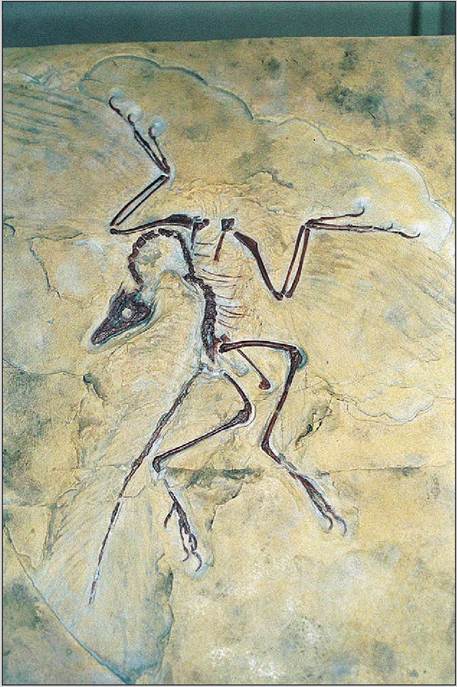
Figure 6.1 • Archaeopteryx lithograph.
These fossils were found in late Jurassic marine deposits in southern Germany in the 1860s. They were so well preserved in the limestone that details of feathers (including the asymmetrical vane) could be identified, indicating their avian lineage.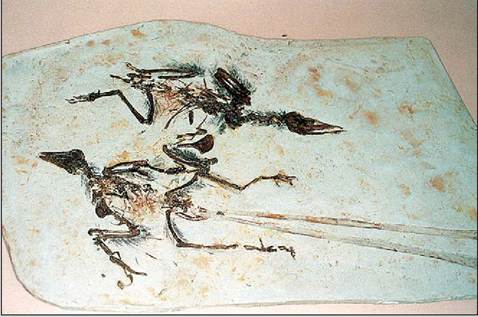
Figure 6.2 • Archaeopteryx.
drops. They warm out of this torpid state by shivering but this method is limited to small birds because the rate of rewarming is inversely related to the size of the bird and would just take too long in larger species (Blem 2000; Dawson & Whittow 2000; Dorrestein 1997a; Welty 1982b).
Birds have a rapid growth rate and reach full adult weight and size much faster than mammals of equal weight (Kirkwood 1999). Altricial birds growth faster than precocial ones. These rapid growth rates mean that there can be a three- or fourfold increase in energy requirements during growth (Blem 2000; Kirkwood 1999).
CLINICAL NOTE
Birds carry little excess fat so when cachexic their high metabolic rate means they will rapidly catabolize muscle. A small bird of prey can lose pectoral mass within just 2-3 days. Signs of emaciation are a prominent keel bone and translucent skin.
The breeding season is a very energy-expensive time for birds so species build up fat deposits beforehand. Courtship, territorial aggression, mating, nest building, egg formation, and egg laying all draw vast reserves of energy. In addition, incubation and feeding hungry chicks leaves little time for the parent to forage so it can suffer from a shortage of energy. Molting also increases the metabolic rate because birds need to draw on protein and energy for feather regrowth (Blem 2000).
Thermoregulation
Birds regulate their body temperature between 39-42° C, with smaller birds like the passerines having higher body temperatures and large flightless birds like the ostrich falling within the mammalian range (Dawson & Whittow 2000).
They have very poor tolerance for high temperatures and 46° C is fatal. Unlike mammals, they have no brown fat but regulate their body temperature by a variety of behavioral and physiological means.Plumage
Birds use their plumage for both heat loss and heat conservation. The contour feathers provide some insulation but it is the fluffy down feathers underneath that provide most thermal insulation. When cold, birds fluff these feathers to trap air pockets between the feathers and will shiver the pectoral muscles to produce heat. They can also reduce heat loss by 12% by tucking their head under their wing and by 40-50% by sitting down (Dawson & Whittow 2000; Maina 1996; Welty 1982b).
To dissipate heat birds can extend their wings from their body and elevate the scapula feathers to expose the bare skin (apteria) of the back of the neck.
Body mass
Birds are extremely sensitive to draughts or poor ventilation as heat loss due to convection means they must increase their metabolic rate. This is particularly severe in small birds as the high ratio of surface area to body mass means body cooling is more rapid. Likewise feather-plucking birds or young chicks are also very vulnerable and need extra nutritional support to avoid negative energy balance.
Fat is a very poor thermal conductor so aquatic birds like penguins which inhabit cold climates have a large subcutaneous layer of fat to insulate against the cold.
CLINICAL NOTE
It is important to avoid too much feather plucking in the surgical patient to prevent heat loss. Use warmed prepping solutions only and avoid surgical spirit as this will also increase evaporative heat loss.
Evaporation
Birds which are overheated can use thermal panting or gular fluttering. Thermal panting increases evaporative loss from the upper respiratory tract and is a highly effective means of heat loss. In fact, the ostrich can maintain a body temperature of 39.3° C by thermal panting, even when the ambient temperature is 51° C (Welty 1982b).
Gular fluttering is when the bird vibrates the hyoid muscle and bones in the throat causing evaporation from the lining of the mouth and throat (Dawson & Whittow 2000).When the bird is expending high energy, that is, when it is flying or running, heat can also be dissipated through the large surface area of the airsacs (Jukes 1971). Flying also exposes the thinly feathered ventral wing and dissipates heat by convection.
Blood shunting
Birds do not have sweat glands but lose heat through their skin or via blood shunts. Some birds, like pigeons and doves, dilate a large vascular plexus on the back of their neck called the plexus venosus intracutaneous collaris (Harlin 1994; Hooimeijer & Dorrestein 1997).
A large proportion of the blood from the left ventricle flows to the legs during stress to increase heat loss. In some long-legged species the legs get three times as much blood per heartbeat as the pectoral muscles and twice as much as the brain. Some aquatic and wading birds have countercurrent arteriovenous retes in the proximal feathered part of the leg. These tibiotarsal retes transfer heat from body core arteries to the colder venous vessels bringing blood from the extremities. This enables blood to flow to the legs without detrimental heat loss (West et al. 1981).
Behavior
When they are cold some birds select microclimates to reduce heat loss, like roosting in holes or sheltering in trees. Small birds often huddle together to keep warm. They also adapt their behavior in the heat of the day by seeking shade, bathing or soaring on thermals for cooler air (Dawson & Whittow 2000).
KEY POINTS
• The constraints of flight means there is more morphological uniformity among birds than in reptiles or mammals.
• Fast metabolism, especially in passerines, means birds must eat frequently to maintain energy levels.
• Birds are endothermic, with a body temperature range of 40-42°C.
• Birds conserve heat via insulating plumage and tibiotarsal retes.
• Birds lose heat by exposing bare areas of skin, through the airsacs, panting and gular fluttering, and dilation
of superficial blood vessels.