Most of the Milk ThatAccumuIates Before Suckling or Milking Is Stored in the Alveoli, Even ThoughAnimaIs Have Enlarged Milk-Storage Areas Called Cisterns
Duct systems connect alveoli with the nipple, or teat, enabling milk to pass from the area of formation to the area of delivery (nipple). The ducts may come together so that there is only one final duct per gland, which has one opening through the nipple, or teat, such as occurs in cattle, goats, and sheep.
Two main ducts and associated openings occur in the mare and sow, whereas the cat and dog can have 10 or more openings in the nipple, with each opening representing separate glands (Figure 39-2). Both the cow and the doe (goat) have specialized areas for holding milk, called cisterns, which are located in the ventral part of the gland and into which all main ducts empty (Figure 39-3). This has enabled the cow, for example, to synthesize and store larger amounts of milk than would otherwise be possible. Despite this adaptation, it is important to realize that a majority of the milk present at the time of milking is stored in the duct system of the mammary glands.Mammary glands develop typically as paired structures. The number of pairs in domestic animals vary from one in goats, horses, and sheep; two in cattle; to seven to nine in the
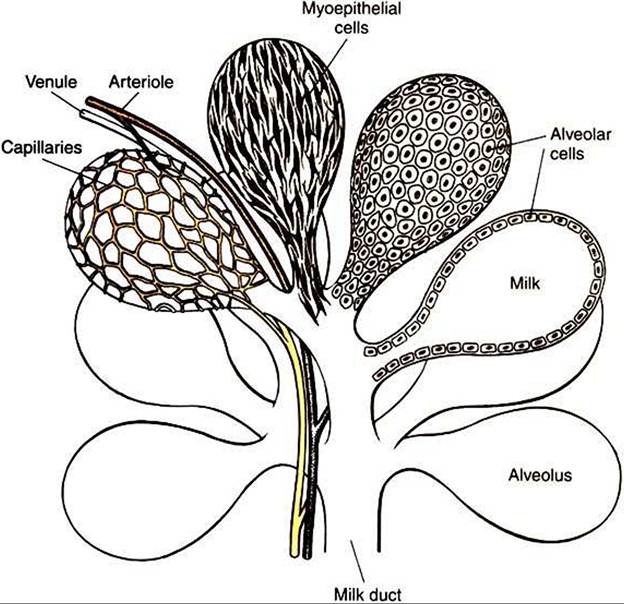
FIGURE 39-1 Diagram of a cluster of alveoli in the mammary gland of a goat. (From Cowie AT: Lactation. In Austin CR, Short RV, editors: Reproduction in mammals, ed 2, vol 3, Hormonal control of reproduction, Cambridge, UK, 1984, Cambridge University Press,.)
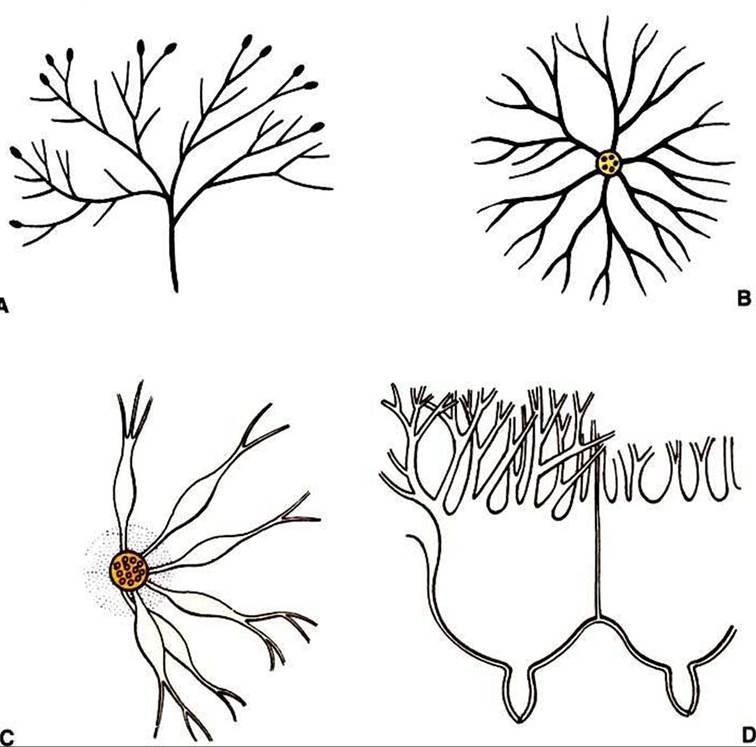
FIGURE 39-2 Diagram showing different arrangements of the mammary duct system. A, Cow, goat, sheep. B, Horse, pig. C, Cat, dog. D, Cow, goat cistern. (From Cowie AT: Lactation. In Austin CR, Short RV, editors: Reproduction in mammals, ed 2, vol 3, Hormonal control of reproduction, Cambridge, UK, 1984, Cambridge University Press.)
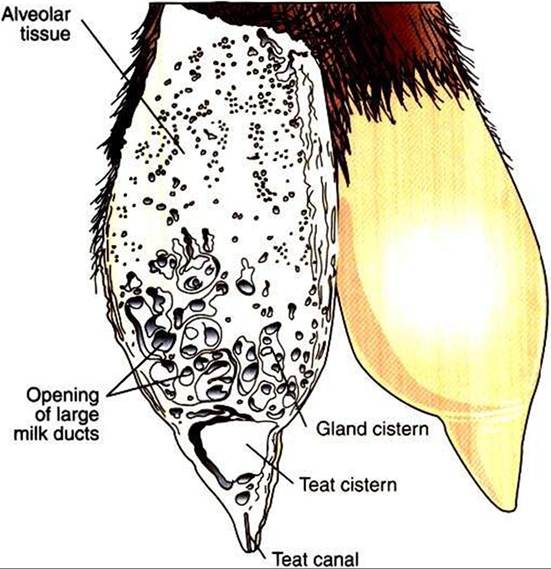
FIGURE 39-3 Depiction of the udder of a goat in which a section of the left mammary gland shows the dense alveolar tissues, the gland cistern with the large ducts opening into it, the teat cistern, and the teat canal. (From Cowie AT: Lactation. In Austin CR, Short RV, editors: Reproduction in mammals, ed 2, vol 3, Hormonal control of reproduction, Cambridge, UK, 1984, Cambridge University Press.)
sow and seven to ten in the bitch and queen. The position of mammary glands varies in animals, being thoracic in primates; extending the length of the thorax and abdomen in cats, dogs, and pigs; and being inguinal in cattle, goats, and horses. In domestic species, such as cattle, goats, horses, and sheep, pairs of mammary glands are closely apposed to each other; the resulting structure is called an udder. In the cow, for example, two pairs of glands (four quarters) compose the udder.