Movements of Joints
synovial joints may exhibit one or more of the following movements: gliding or sliding, flexion, extension, hyperextension, rotation, adduction, abduction, and circumduction (Fig.
6-3).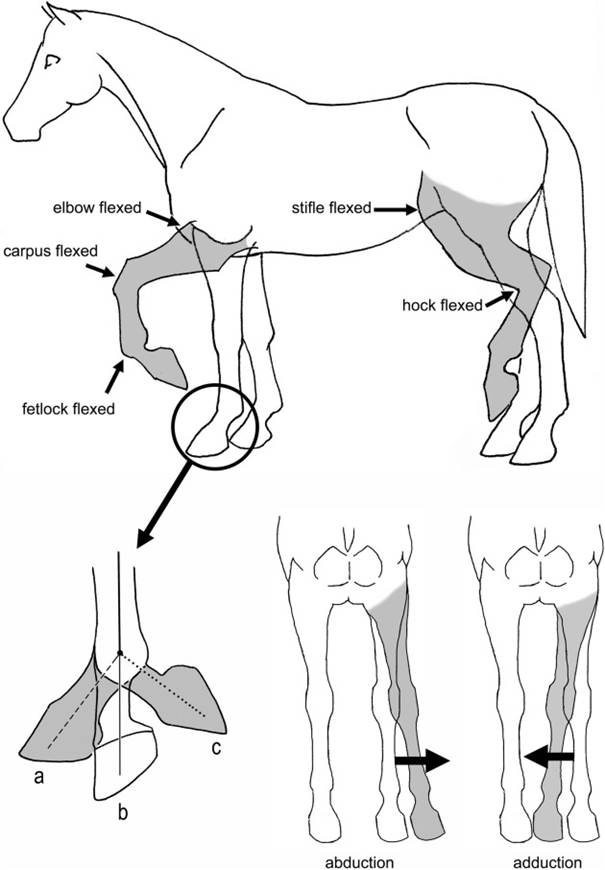
Figure 6-3. Joint movements. In the top figure, the shaded limbs are shown flexed as during the swing phase of gait. In the lower left figure, the wide range of movement in the fetlock joint is illustrated. a, the normal physiological hyperextension of the fetlock during standing; b, the straight-line extended position; c, shows the flexed position of the joint.
Gliding or sliding movement occurs between two more or less flat surfaces in plane joints.
Flexion is movement in the sagittal plane that tends to decrease the angle between segments making up a joint. The carpus must be flexed when a horse’s front foot is picked up for trimming.
Extension is the reverse of flexion and is movement in the sagittal plane that tends to increase the angle between segments forming the joint.
Hyperextension is movement in which the angle between segments is increased beyond 180° (a straight line). The fetlock of the horse is hyperextended while in the normal standing position (often called physiologic hyperextension). Other joints do not normally hyperextend unless fatigued or stressed or when poor conformation provides inadequate support to the joint. Hyperextension of the equine carpus, for example, may occur late in a race, when the galloping horse is fatigued, and can result in injury to the joint. A horse whose carpi are hyperextended because of poor conformation is said to be calf-kneed, and it is prone to go lame with hard work.
Rotation consists of a twisting movement of a segment around its own axis. shaking the head “no” is a good example of rotation, in this case between the atlas and axis of the vertebral column.
Adduction is movement toward the median plane. Abduction is movement away from the median plane.
Circumduction combines the other types of movement with the exception of rotation; it may be defined as a movement in which an extremity describes a cone, with the distal end of the extremity describing a circle. A horse that paddles (an undesirable outward swinging of the feet while in motion) is exhibiting circumduction.
Pronation rotates an extremity so that the dorsum is up. Supination is a movement that rotates an extremity so that the palmar or plantar aspect of the limb is up. Pronation and supination are rarely seen to any extent in domestic animals.