NERVOUS SYSTEM
The reptile is the first group of vertebrates to have 12 cranial nerves (Barten 1996; Bennett, RA 1996). The brain comprises 1% of body mass and is larger than amphibians and fishes, with more developed optic lobes reflecting their well-developed vision.
Unlike mammals the spinal cord extends to the tail tip and there is no cauda equina (Bennett, RA 1996). Reptiles do not have a true subarachnoid space; the space between the leptomeninges (pia-arachnoid) and the dura mater is called the subdural space.CLINICAL NOTE
The spinal cord possesses some localized autonomy so spinal cord injuries could have a better clinical prognosis than in mammals (Bennett, RA 1996).
Senses
Hearing
Crocodiles are the only reptiles with an external ear. In the other species the tympanic membrane is the outer boundary of the middle ear and often lies level with and covered by modified skin. Some species, such as snakes, tuatara, and chameleon, lack a tympanic membrane. Crocodiles, geckos, and turtles have the best hearing of all reptiles (Young 1997).
There is only one single middle ear bone, the columella, which is the forerunner of the mammalian stapes and so named because it is column or rod shaped. (In mammals the quadrate and articular bones have become the incus and malleus and this sound conduction system gives mammals better hearing.) The columella is attached to the tympanic membrane and also to the quadrate bone of the lower jaw. Vibrations pass from the air or ground to the tympanic membrane and then to the columella, which then moves the perilymphatic fluid to give rise to nerve impulses (Murray 1996b; Young 1997).
A short, broad auditory (eustachian) tube leads from the middle ear to the pharynx and, as in birds, is not closed. The middle ear is lined by mucous membrane which is continuous with this tube and pharynx. The inner ear consists of the organs of balance: the three semicircular canals, the utricle and saccule, and the organ of hearing, the cochlea.
The cochlear duct is not coiled as it is in mammals (Baird 1970; Bellairs 1969e).Taste and touch
Reptiles have taste buds on their tongue and oral epithelium. Tactile papillae are found along the head and oral cavity in some species. Tactile stimuli play a major role in courtship in snakes and lizards (Young 1997).
Olfaction
Olfaction plays an important role in courtship and mating. All reptiles have an accessory olfactory organ called Jacobson's organ. These organs are paired and lie on the rostral roof of the oral cavity over the vomer bones. They are lined by thick sensory epithelium and innervated by the vomeronasal nerve, a branch of the olfactory nerve.
Jacobson's organ is most highly developed in snakes (Fig. 2.14) where they receive data from the tip of the tongue as it flickers in and out. Chelonians only have a modified Jacobson's organ while in adult crocodiles it only exists in the early embryonic stage (Bellairs 1969e; Parsons 1970; Young 1997).
Sight
The principal receptors in reptiles are eyes and the secondary receptors are the pineal gland and, possibly, the skin. Lizards and chelonians have scleral ossicles and all eyes have lenses. Aquatic species have poor accommo-
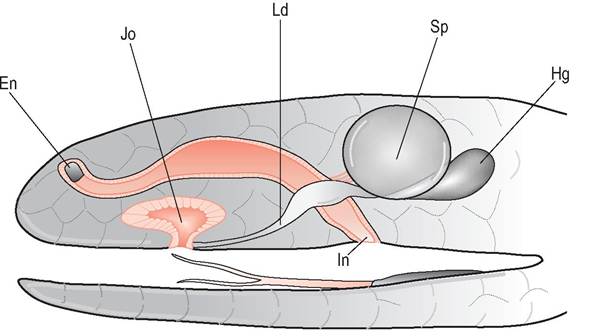
Figure 2.14 • Section of snake head showing the fused eyelids or spectacle, Jacobson’s organ and tongue.
En = External nostril Hg = Harderian gland In = Internal nostril
Jo = Jacobson's organ Ld = Lacrimal duct
Sp = Spectacle
dation because the refractive index of water is almost the same as that of the cornea; marine turtles have a very flattened cornea. As in birds, the iris is controlled by skeletal muscle so is non-responsive to mydriatics like atropine. Mydriatics such as d-tubocurare can be used instead of general anesthesia (Barten 1996; Bennett, RA 1996; Williams 1996). Miosis is quite sluggish in reptiles and there is no consensual pupillary light reflex. Two large glands are associated with the orbit and these are the Harderian and lacrimal glands.