Nervoustissue
Nervous tissue is a vital part of the nervous system, consisting of a highly intricate network of neurons and glial cells. Neurons transmit signals, while glial cells support and protect them.
It's essential for sensation, movement, cognition, and communication within the body. The nervous system is not just a mere reflex response; it dynamically processes sensory information to generate adaptive behaviour and form lasting memories. This remarkably sophisticated information processing allows organisms to react to their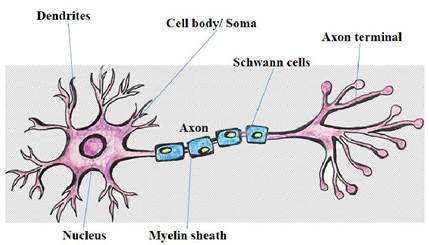
FIGURE 8.2 Structure of Neuron
Neurons can be classified based on various criteria, including their structure, function, and neurotransmitter characteristics.
Based on functionality the neurons are classified into Sensory (Afferent) neurons that transmit information from sensory receptors (such as those for touch, temperature, and pain) to the central nervous system, allowing for the perception of the external environment and internal bodily conditions, Motor (Efferent) neurons that convey signals from the central nervous system to muscles and glands, controlling voluntary and involuntary movements as well as glandular secretion, and Interneurons (Association neurons) that form connections between other neurons within the central nervous system, facilitating communication and integration of
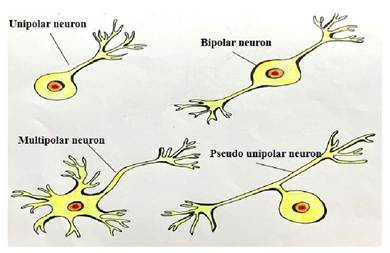
FIGURE 8.3 Different types of Neuron
sensory, motor, and cognitive signals. They play a crucial role in information processing and neural circuitry.
Based on the neurotransmitter released by them, neurons are classified into Glutamatergic neurons (glutamate; excitatory), GABAergic neurons (GABA; inhibitory), Dopaminergic neurons (dopamine), Serotonergic neurons (serotonin), Noradrenergic neurons (norepinephrine), etc.
Structurally the neurons are classified into Multipolar, Bipolar, and Unipolar (Pseudounipolar) neurons (Figure 8.3).
8.5.1 Unipolar Neurons
Unipolar neurons, also known as pseudounipolar neurons, have a single process that extends from the cell body. This single process functions as both an axon that transmits signals to the central nervous system and a dendrite that receives sensory input. The single, elongated process of unipolar neurons allows for rapid conduction of sensory signals over long distances. This is facilitated by the myelin sheath, which insulates the axonal segment of the process and increases the speed of signal transmission. Their cell bodies are commonly found in the peripheral nervous system, particularly in sensory ganglia such as the dorsal root ganglia. They are primarily involved in sensory transmission, conveying sensory information from peripheral receptors (touch, temperature, and pain) to the central nervous system.
8.5.2 Bipolar Neurons
Unlike unipolar neurons, bipolar neurons have a distinct dendrite extending from one end of the cell body and also a single axon extending from the other end. This structural arrangement allows for separate reception of sensory input via the dendrite and transmission of signals to other neurons or sensory organs via the axon. Being relatively rare, located in sensory ganglia, these are primarily found in specialized sensory organs, such as the retina of the eye, the olfactory epithelium (nasal cavity), and the vestibular and cochlear apparatus of the inner ear. This proximity allows for efficient transmission of sensory information from the periphery to the central nervous system. Their specialized structure and function make them well-suited for relaying specific types of sensory information to higher brain centres for further processing and interpretation. In the retina, for example, bipolar neurons relay visual information from photoreceptor cells (rods and cones) to ganglion cells, which then transmit signals to the brain via the optic nerve.
Similarly, in the olfactory epithelium, bipolar neurons detect odorants and transmit olfactory signals to the olfactory bulb in the brain.8.5.3 Multipolar Neurons
These are the most common type of neuron in the central nervous system, characterized by having multiple dendrites and a single axon. The numerous dendrites increase the surface area available for synaptic connections, allowing the neuron to receive input from multiple sources. The single axon that carries electrical signals away from the cell body to other neurons, muscles, or glands may branch extensively as it extends from the cell body, allowing for communication with multiple target cells. These neurons integrate excitatory and inhibitory inputs from dendrites to determine whether to generate an action potential. They can be found in various regions of the brain and spinal cord, where they participate in sensory processing, motor control, cognitive functions, and other complex neural processes. essential roles in both normal brain function and various neurological disorders.
8.6