Nonruminant Stomach
in nonruminants (horse and pig), the stomach is just caudal to the left side of the diaphragm. it is sometimes described in these species as a simple stomach. The old term monogastric is discouraged because it perpetuates the misconception that ruminants possess more than one stomach, although the ruminant actually has a single stomach with multiple compartments.
The simple stomach is grossly subdivided into the cardia (entrance), fundus, body, and pyloric region (outflow); the pyloric region features a dense, palpable sphincter muscle called the pylorus that controls gastric emptying into more distal parts of the digestive tract (Fig. 20-8).
The esophagus joins the stomach at the cardia, a part of the stomach so named because of its proximity to the heart. The walls surrounding the cardia (where the lumen of the esophagus becomes continuous with that of the stomach) feature a thickening of the muscle that constitutes a functional sphincter, the cardiac sphincter. This muscle is especially well developed in the horse, where its strength and configuration make it difficult or impossible for the horse to vomit.
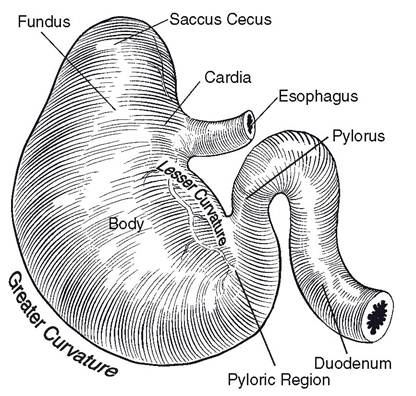
Figure 20-8. External anatomy of the equine simple stomach. Dorsal view.
The cardia and pylorus are quite close together, giving the stomach a J shape. This arrangement results in a very short concave side between the cardia and pylorus, known as the lesser curvature, and a much longer convex side, the greater curvature. The large bulge near the cardia is the fundus. In the horse, the fundus is enlarged to create a blind sac, the saccus cecus, the mucosa of which is stratified squamous and nonglandular. The porcine stomach features a similar albeit smaller out- pocketing called the gastric diverticulum; the mucosa of this feature of the pig stomach is of the typical glandular, columnar type.
The body of the stomach is the expansile part that is defined externally by the greater curvature. The size of the gastric body is determined largely by the degree of filling. it narrows as the stomach arcs ventrad and to the right, becoming the pyloric region. A very strong sphincter, the pylorus, regulates the outflow of the stomach in this region. in the pig (and in the equivalent region of the ruminant stomach), the pylorus features a muscular and fatty enlargement, the torus pyloricus. its function is unknown.
The tunica muscularis of the stomach features three discontinuous layers of smooth muscle: an outer longitudinal, a middle circular, and an inner oblique layer.
The lumen of the simple stomach features several histologically distinct regions whose names are similar to the gross parts of the stomach but that unfortunately do not directly correspond to these (Fig. 20-9). Immediately surrounding the cardia is an area of stratified squamous epithelium called the esophageal region. This nonglandular region is limited in swine but is expanded in the horse, in which it lines the saccus cecus. it is the esophageal region of the stomach that is so markedly expanded in ruminants, where it lines the forestomach.
Exclusive of the esophageal region, the mucosa of the simple stomach is glandular. Grossly, the mucosa here is thrown into prominent gastricfolds that allow the stomach volume to expand to accommodate meals. On the microscopic level, the columnar epithelium of the tunica mucosa undulates in deep infoldings that create depressions called gastric pits.
A transition from the stratified squamous epithelium of the esophageal region to columnar epithelium in the glandular part of the stomach demarcates the beginning of the cardiac gland region. This transition is grossly obvious in the horse, where it is called the margo plicatus.
The cardiac glands that give this region its name are short, branched tubular glands whose major secretory product is mucus. The equine cardiac gland region is small, but it covers nearly half of the interior of the porcine stomach.
The fundic gland region lines much of the interior of the stomach (and certainly more than just the fundus). The typical gland is the fundic gland (also called the gastric gland proper). Fundic glands are simple tubular glands that open into the gastric pits, where they discharge their secretions.
The pyloric gland region corresponds more or less to the pyloric region of the simple stomach. The pyloric glands are histologically similar to the cardiac glands, and like them, they secrete mucus.
Enteroendocrine cells are scattered throughout the mucosa of the glandular stomach. These secrete hormones that affect the secretory and muscular activity of the gut and its accessory organs (e.g., liver and pancreas).