NUCLEUS
Robert Brown discovered the cell nucleus in 1831. The nucleus is the most noticeable and the largest cellular organelle of the cell. The diameter of the nucleus is about 10 μ to 22 μ and occupies approximately 10% of the total volume of the cell.
Nucleus is present in all the cells of the body except the red blood cells. The nucleus is required for cell division. Most of the cells are uninucleated (one nucleus) cells but some types of cells like skeletal muscle are multinucleated (more than one nucleus). Generally, the nucleus is spherical in shape and located in the center of the cell (Figure 2.3).The nucleus is a double membrane-bound dense protoplasmic body that contains many components (Major components of the nucleus are nucleoplasm, chromatin, and nucleolus) and controls all cellular metabolism and encloses the genetic information of the cell. Electron microscopy has
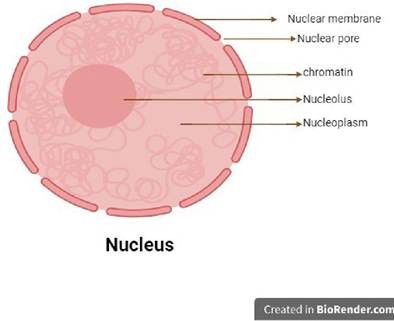
FIGURE 2.3 Nucleus
revealed that the nuclear envelope or nuclear membrane is double-layered and porous in nature. The nuclear membrane acts as a barrier between the materials present inside (nucleoplasm) and outside (cytoplasm) of the nucleus. The nuclear membrane’s outer layer remains connected to the endoplasmic reticulum, which also carries ribosomes on its surface. The nuclear membrane is perforated by minute nuclear pores, which are guarded by protein molecules. The nuclear pore plays an important role in exchanging materials between the nucleoplasm and cytoplasm. The inner nuclear membrane is lined by the nuclear lamina, which is formed by filaments of lamin protein.
Nucleoplasm is a very viscous fluid that makes up the ground substance of the nucleus. Chromatin and nucleolus are embedded in the nucleoplasm. It also contains a dense fibrillar network of proteins known as the nuclear matrix and many substances such as nucleotides, ATPs, proteins and enzymes of RNA and DNA polymerases, endonucleases, minerals, cations (Ca++, Mg++) etc..
The nuclear matrix creates the structural framework for organizing chromatin. The soluble liquid part of the nucleoplasm is called nuclear hyaloplasm.Chromatin is the intranuclear thread-like fine material that is mostly made up of DNA molecules. Histone is a specialized basic protein that helps pack the DNA molecules tightly.
DNA is a double helix that encircles the central core of eight histone molecules and forms the fundamental packing unit of chromatin called a nucleosome. A chromatin fiber is created when nucleosomes are firmly packed together with the aid of a histone molecule. The chromatin condenses to form the chromosome just prior to cell division.
Nucleolus is a naked or membrane-less small, round granular structure of the nucleus, which is generally associated with chromatin (chromosome) at a specific area called NOR (Nucleolar Organizer Region). The nucleolus is made up of RNA and some proteins that are similar to ribosomes. The RNA is made up of five different pairs of chromosomes and stored in the nucleolus. Subsequently, it condenses to create the ribosome subunits. Ribosome synthesis is the primary activity of the nucleolus, which is why it is called the ribosome factory of the cell. All the ribosomal subunits formed in the nucleolus are transported to the cytoplasm through the nuclear pores. These subunits unite in the cytoplasm to become ribosomes, which play an important role in the synthesis of proteins.
2.13.1 Chromosomes
The term “chromosome” was first proposed in 1889 by Waldeyer. The chromosome is the rod-shaped nuclear structure that contains a full blueprint of all the inherited characteristics of the species. Chromosomes are best studied at the metaphase stage. This is because the size of the chromosome is reduced during the metaphase because the chromatin threads are very thin. Each chromosome is made up of a single DNA molecule arranged around histone molecules, each of which contains many genes. Generally, chromosomes are not visible under the microscope. All the dividing cells in the body, except reproductive cells, contain 23 pairs of chromosomes (humans). Each pair is made up of one inherited chromosome from the mother and one inherited from the father. The cells with 23 pairs of chromosomes are known as diploid cells, and the cells with 23 single chromosomes are known as haploid cells. The reproductive cells, called gametes or sex cells (haploid), contain only 23 single chromosomes.
2.13.2 Functions
Control of all cellular functions such as metabolism, synthesis of proteins, growth, reproduction (cell division), RNA synthesis, ribosome formation, genetic instruction to the cytoplasm for protein synthesis (mRNA), control of cell division by genes, storage of hereditary information (genetic information), and transformation of that information from one generation to next.
2.14