Ovulation Is Caused by an Estrogen- Induced Preovulatory Surge of Gonadotropins
The preovulatory surge of luteinizing hormone (LH), which begins about 24 hours before ovulation in most domestic species, including the cow, dog, goat, pig, and sheep, initiates
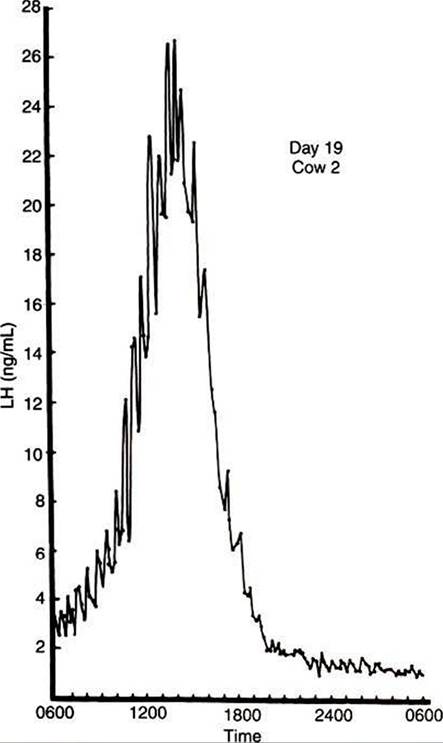
FIGURE 36-3 Preovulatory surge of luteinizing hormone (LH) on day 19 of the estrous cycle in a cow.
(From Rahe CH, Owens RE, Fleeger JL, et al: Pattern of plasma luteinizing hormone in the cyclic cow: dependence upon the period of the cycle. Endocrinology 107:498, 1980.)the critical changes in the follicle that affect its endocrine organ status and result in release of the oocyte (Figure 36-3). Two important tissues, the oocyte and the granulosa, have been kept under control by the production of inhibitory substances that are probably of granulosa origin. An Oocyte-Inliibitingfactor prevents the oocyte from resuming meiosis, and a Iuteinizing- inhibitingfaetor prevents the granulosa from prematurely being changed into Iuteal tissue. The impact of the LH surge blocks the production of both these factors. In most animals the resumption of meiosis results in the first division of meiosis (meiosis I), or formation of the first polar body, which is complete before ovulation. In animals with the potential for reasonably long reproductive longevity (e.g., cattle) the initiation of the meiotic process could have begun as long as 10 years or more before its completion.
The effect of the LH surge on the granulosa is to allow initiation of the process Ofluteinization, which transforms the cells from estrogen to progesterone secretion. This process is underway before ovulation occurs. With the advent of the LH surge, estrogen secretion declines concomitantly with the onset of progesterone secretion.
Another function of the preovulatory surge release of LH is to cause the granulosa to produce substances, such as relaxin and prostaglandin F2a (PGF∖α), that affect the continuity of the connective tissue of the thecal layers of the follicle. These and other unknown substances disrupt the theca through the development of vesicles (within Iibrocytes) that contain hydrolytic enzymes capable of breaking down the collagen matrix of connective tissue. The rupture of the follicle is caused by the disintegration of the connective tissue.
In summary, estrogen is used by the follicle(s) (1) to stimulate the growth and development of the granulosa and (2) to signal the hypothalamus and anterior pituitary as to the readiness of the follicle(s) for ovulation.