PARTURITION
1. What are some signs of approaching parturition?
2. How is respiratory rate in the sow associated with closeness of farrowing? What happens to body temperature in the bitch just before parturition?
3.
What functions are served by estrogen increase just before parturition?4. What functions are served by PGF2α at the time of parturition?
5. How do oxytocin and the presence of feet in the pelvic canal assist parturition?
6. What are the stages of labor?
7. What is meant by presentation of the fetus? How is it initiated?
8. What is the difference between an anterior and a posterior presentation? What is an example of an abnormal presentation?
9. What term is applied to difficulty encountered in expulsion of.the fetus?
Parturition, sometimes called labor, is the physiologic process by which the pregnant uterus delivers the fetus and fetal membranes from the mother.
Signs of Approaching Parturition
Throughout pregnancy the abdomen continues to enlarge and its maximum size is reached just before parturition. The mammary glands also continue to enlarge and, within a few days of parturition, begin to secrete a milky material. Other signs include swelling of the vulva and a discharge of mucus from the vulva. The abdominal muscles relax, which causes the belly to drop and the rump to sink on both sides of the tail head. It is believed that the hormone relaxin, in association with the increasing level of estrogen of late pregnancy, causes the relaxation of ligaments to enable the birth canal to enlarge. Also, it is thought that PGF2α helps to relax the cervix. In addition to these physical signs, certain behavioral signs are characteristic, such as restlessness, frequent lying down and getting up, and frequent urination. The bitch and sow often attempt to build elaborate nests.
Respiratory rates are better indicators than milk letdown that sows are close to farrowing.
Respiratory rates increase steadily and peak 6 hours before farrowing in almost all sows. In contrast, some sows produce colostrum as long as 3 to 4 days before farrowing. An example of the respiratory rate index can be obtained from the following data:1. Respiratory rates average 54 breaths/min during the 24- to 12-hour period before farrowing.
2. From 12 to 4 hours before farrowing, respiratory rates are the highest, averaging 91 breaths/min.
3. The lowest respiratory rates are recorded between 6 and 18 hours after birth of the last piglet, averaging 25 breaths/min.
Rectal temperature changes have also been studied as indicators of impending parturition under the assumption that certain hormones influence body temperature. For example, progesterone increases the basal body temperature because it causes an increase in the basal metabolic rate. However, with regression of the corpus luteum immediately preceding parturition (see further on), there is cessation of progesterone production, which is followed by a decrease in body temperature. Body temperature decrease is most dramatic and reliable in the bitch, in which normal body temperature decreases of 2 to 3 °C (4 to.5 °F) might be observed within 24 hours before parturition. Body temperature has not been found to be a reliable indicator in other species.
Hormone Changes
An important hormone change that occurs just before parturition is an increase in the production of estrogen. Estrone is produced by the fetoplacental unit as maturity of the fetus increases (approximately 3 to 4 weeks prepartum in the cow). The increase in production of cortisol by fetal adrenal cortices, concurrent with maturity of the fetus, initiates the prepartum increase in estrogen production. The secretion of estrogen assists in the production of uterine muscle contractile proteins before parturition. Estrogen might also be the signal for the secretion of PGF2α that occurs in the immediate prepartum period (24 to 36 hours prepartum in the cow).
PGF2α initiates regression of the corpus luteum (if present) and subsequent lowering of progesterone levels. The increase in estrogen and decrease in progesterone levels convert the uterus from a state of quiescence to a state of potential contractility. The increase in estrogen level varies among domestic animals regarding time of occurrence before parturition (Figure 15-24). The length of increase is longest for the cow and shortest for the ewe.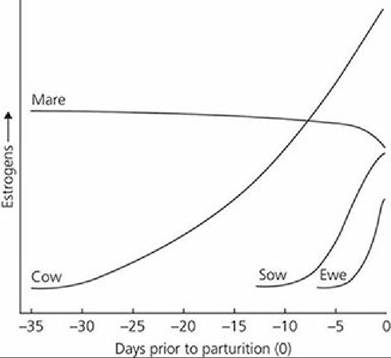
■ FIGURE 15-24 Estrogen patterns in the mare, cow, sow, and ewe before parturition. Negative numbers refer to days before parturition (0). (From Edqvist LE, Stabenfeldt GA. Reproductive hormones. In: Kaneko JJ, ed. Clinical Biochemistry of Domestic Animals. 3rd edn. New York: Academic Press, 1980.)
Changes in maternal hormonal levels do not seem to play a major role in parturition in the mare. At parturition the mare has relatively high levels of the progestin DHP and low levels of estrogens. The PGF2α level increases, however, during foaling.
PGF2α is also believed to increase the contractility of the uterus by permitting greater mobility of sarcoplasmic calcium. These early contraction increases might be important in positioning the fetus for delivery (presentation) through the pelvic canal. The presence of the fetus in the pelvic canal causes oxytocin to be released from the posterior pituitary. In the presence of an estrogen-primed uterus, the muscle contractions increase in intensity to assist in expelling the fetus. PGF2α also increases the sensitivity of the uterus to oxytocin, which enhances the rhythmic contractions of the uterine musculature during delivery. The uterus can only assist in the expulsion of the fetus and must have the coordinated contraction of the abdominal muscles. The presence of the feet in the pelvic canal and the consequent stimulation of the vagina provides for reflex contraction of the abdominal muscles, similar to the straining that occurs when one attempts to replace a prolapsed uterus.
The abdominal and uterine muscle contraction, coupled with relaxed pelvic ligaments, separation of the pelvic symphysis, and dilatation of the cervix, provide for expulsion of the fetus. A summary of the events associated with parturition, beginning with the prepartum secretion of fetal cortisol and ending with expulsion of the fetus, is shown in Figure 15-25.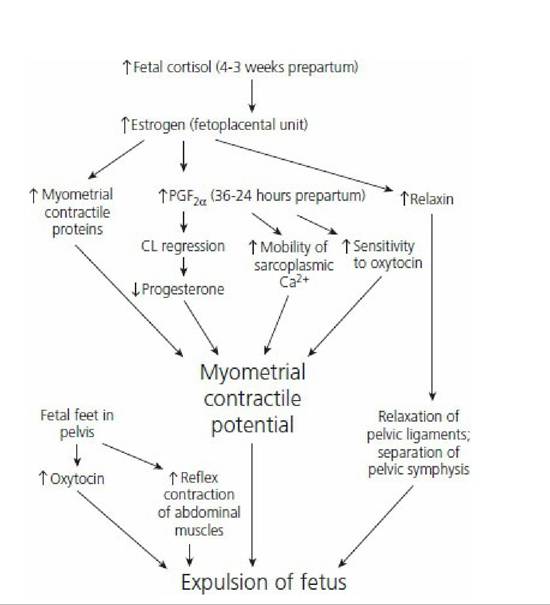
■ FIGURE 15-25 Events of parturition beginning with the prepartum secretion of fetal cortisol and ending with expulsion of the fetus. PGF2α (prostaglandin F2α); CL, corpus luteum.
Stages
The three stages of parturition are as follows:
1. Uterine contractions (contribute to.dilatation of cervix and presentation of fetus)
2. Contractions associated with expulsion of fetus (involve abdominal muscle.contraction)
3. Expulsion of fetal membrane
The stages of labor and related events are summarized in Table 15-2.
| TABLE 15-2 STAGES OF LABOR AND RELATED EVENTS IN FARM ANIMALS | ||||
| STAGE OF LABOR | MECHANICAL FORCES | PERIOD | RELATED EVENTS | |
| I | Dilation of cervix | Regular uterine contractions | Beginning of uterine contractions until cervix is fully dilated and continuous with vagina | Maternal restlessness, elevated pulse, and respiratory ratesChanges in fetal position and posture |
| II | Expulsion of fetusa | Strong uterine and abdominal contractions | From complete cervical dilation to end of delivery of fetus | Maternal recumbency and strainingRupture of allantochorion and escape of fluid from vulvaAppearance of amnion (water bag) at vulvaRupture of amnion and delivery of fetus |
| III | Expulsion of fetal membranes | Uterine contractions decrease in amplitude | After delivery of fetus to expulsion of fetal membranes | Maternal straining ceasesLoosening of chorionic villi from maternal cryptsInversion of chorioallantoisStraining and expulsion of fetal membranes |
| aIn polytocous species (sow) and twin-bearing species (sheep and goat), this stage cannot be separated from the next stage (III). From Hafez ESE, Hafez B. Reproduction in Farm Animals. 7th edn. Baltimore, MD: Lippincott Williams & Wilkins, 2000. | ||||
In monotocous (single birth) species, the fetus lies on its back during gestation. Just before birth, a position is assumed in the uterus that is characteristic for the species (presentation). Presentation can be initiated by early contractions of the uterus. A proper presentation for the bovine fetus is shown in Figure 15-26. The front feet are pointed toward the cervix, the head is extended and tucked between the feet, and the back of the calf is directed toward the sacral vertebrae. This is known as an anterior or cranial presentation. A posterior or caudal presentation with the hind feet extended into the pelvic canal is considered normal, but is less common. An example of an abnormal presentation is one in which there might be an anterior presentation, but with a deviation of the head and neck. Abnormal presentations usually require correction before the fetus can be expelled successfully.
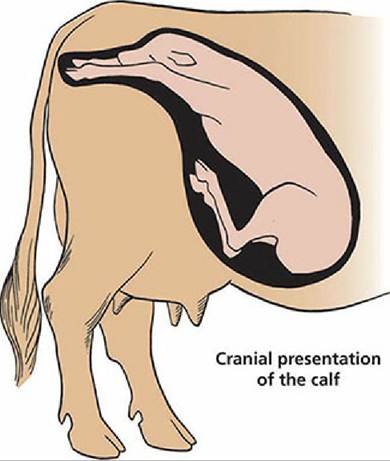
■ FIGURE 15-26 Normal presentation for the bovine fetus, known as a cranial or anterior presentation. (From Frandson RD, Wilke WL, Fails AD. Anatomy and Physiology of Farm Animals. 7th edn. Ames, IA: Wiley-Blackwell, 2009.)
Difficulties are often encountered during parturition and delays are observed in what are considered normal durations of each stage. Undue delay in providing assistance often aggravates the condition and can injure the mother and cause death to the fetus. Rules of thumb for the average duration of the three stages of labor in the mare, cow, buffalo, ewe, and sow are given in Table 15-3. A difficulty encountered in expulsion of the fetus is referred to as a dystocia.
| TABLE 15-3 AVERAGE DURATION OF THE THREE STAGES OF LABOR IN FARM ANIMALS (HOURS) | |||
| STAGE OF LABOR | |||
| ANIMAL | I. DILATION OF CERVIX | II. EXPULSION OF FETUS(ES) | III. EXPULSION OF FETAL MEMBRANES |
| Mare | 1-4 | 0.2-0.5 | 1. |
| Cow, buffalo | 2-6 | 0.5-1.0 | 6-12, |
| Ewe | 2-6 | 0.5-2.0 | 0.5-8 |
| Sow | 2-12 | 2.5-3.0 | 1-4. |
| From Hafez ESE, Hafez B. Reproc Williams & Wilkins, 2000. | uction in Farm Animals. 7t | h edn. Baltimore, MD: Lippincott | |
648
■