PENIS AND PREPUCE
1. Why is greater enlargement of the penis possible in the stallion than in the bull?
2. What is the urethral process of the ram and buck penis?
3. How does the bulbus glandis of the dog penis participate in the “tie” associated with canine coitus?
4.
Which domestic species have a sigmoid flexure of their penis?5. Note the preputial diverticulum (pouch) in the boar and the double-folded prepuce in the stallion shown in Figure 14-9.
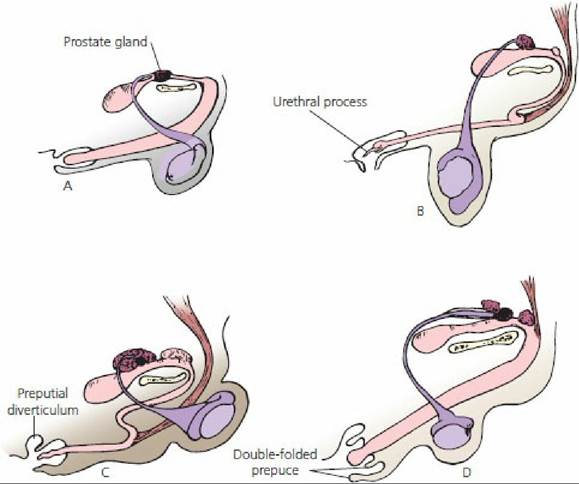
■ FIGURE 14-9 Comparative anatomy of the male reproductive organs of various domestic animals. A. Dog. B. Ram. C. Boar. D. Stallion. Note the encirclement of the pelvic urethra by the prostate in the dog, urethral process in the ram, preputial diverticulum in the boar, and doublefolded prepuce in the stallion.
The penis is the male organ of copulation through which urine and semen pass by way of the penile urethra. The appearance of the penis of several farm animals and its association with other structures is shown in Figure 14-9. The roots (crura) of the penis begin at the caudal border of the pelvic ischial arch. The forward extension from the roots is known as the body and the free extremity is known as the glans. The internal structure (Figure 14-10) is occupied mostly by cavernous tissue that fills with blood during erection and is referred to as the corpus cavernosum (commonly known as erectile tissue). A dense fibroelastic covering, the tunica albuginea, surrounds the corpus cavernosum and also contributes to the connective tissue sheets found within it. Depending on the amount of connective tissue found within the corpus cavernosum, domestic mammals are described as having either a musculocavernous (more cavernous space and less connective tissue, Figure 1410B) or a fibroelastic (less cavernous space and more connective tissue, Figure 14-10A) type of penis.
The musculocavernous penis is a characteristic of the horse and dog and the fibroelastic penis is found in the ruminant (cattle, sheep, goat) and pig. During erection the musculocavernous penis greatly increases in both length and girth as the cavernous spaces fill with blood, while in the fibroelastic penis the increase in length is largely brought about by a straightening of the sigmoid flexure. The urethra is on the ventral aspect of the body of the penis (Figure 14-10) and is surrounded by the corpus spongiosum.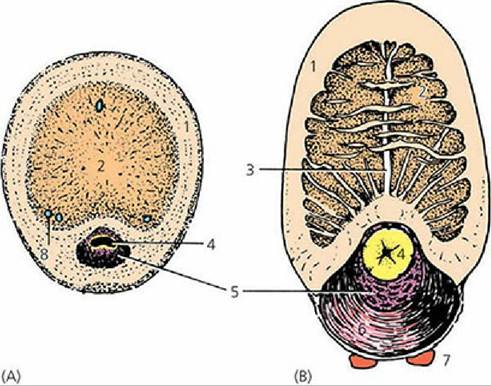
■ FIGURE 14-10 A. Transverse sections of the fibroelastic penis of a bull. B. the musculocavernous penis of a stallion. 1,. Tunica albuginea; 2, corpus cavernosum; 3, septum; 4, urethra; 5, corpus spongiosum; 6, bulbospongiosus; 7, retractor penis; 8, large, thick-walled veins. (From Dyce KM, Sack WO, Wensing CJG. Textbook of Veterinary Anatomy. 3rd edn. Philadelphia, PA: WB Saunders, 2002.)
The ram and buck have a highly visible urethral process (see Figure 14-QB), and sometimes urethral calculi become lodged in its narrowed extremity. This can be corrected by amputation of the process. It is speculated that the function of the urethral process in the ram and buck is to spray the cervical area with semen during ejaculation. The free end of such an extension would move in a circular pattern with the emission of fluid under pressure.
The dog has a bulbus glandis at the caudal part of the glans. The enlargement of the bulbus glandis is responsible for prolonged retention of the penis during coitus. Contraction of muscles in the vestibule of the female caudal to the bulbus glandis assists this retention, commonly known as the tie (Figure 14-11).
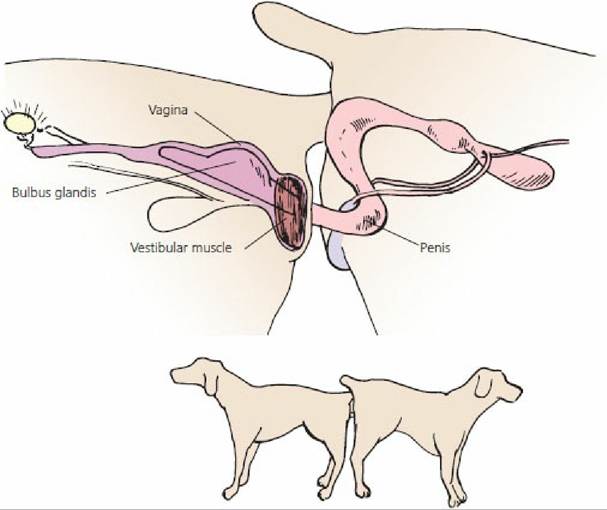
■ FIGURE 14-11 “Locking” phase, or “tie”, of canine coitus (lateral view). In the dog, erection involves primarily the glans penis.
Enlargement of the bulbus glandis and contraction of vestibular muscles during intromission “lock” the dog’s penis in the bitch’s vagina.The bull, ram, and boar have a sigmoid flexure of their penis, resulting in an S shape when not erect (see Figures 14-8 and 14-Q∖ Erection causes extension of the flexure as shown for the bull in Figure 14-12.
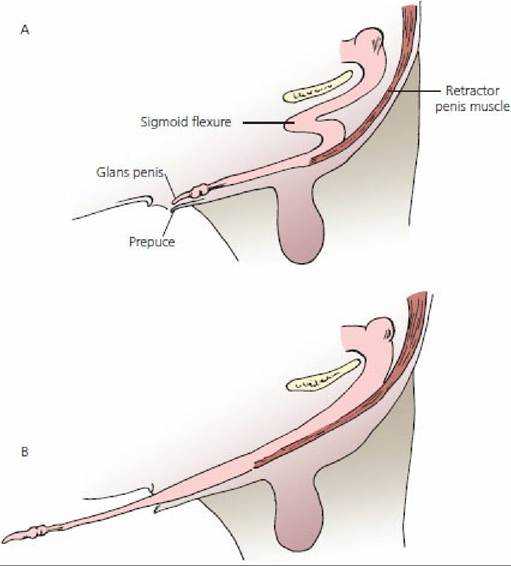
■ FIGURE 14-12 Penis of the bull. A. Nonerect position with its characteristic sigmoid flexure. B. Erect position with elimination of the sigmoid flexure and extension beyond the prepuce. The retractor penis muscle assists return of the penis to its nonerect position.
The prepuce is an invaginated fold of skin that surrounds the free extremity of the penis (see Figure 14-9). The stallion has a double-folded prepuce. Waxy accumulations known as beans sometimes form in the outer fold and must be removed manually. The boar has a preputial diverticulum (pouch) on the dorsal wall, which often contains decomposing urine and macerated epithelium. The fluid in the diverticulum also contains a pheromone (see Chapter 5) that causes sows to assume the immobile mating stance.
■