ACCESSORY SEX GLANDS AND SEMEN
1. What composes the accessory sex glands? Which one is present in all of the domestic animals? What is the relationship of the accessory sex glands to the pelvic urethra?
2. What is the collective name of the accessory gland secretions? What is the difference between seminal plasma and semen?
3.
What function is served by seminal plasma?4. What function may be served by the prostaglandins present in seminal plasma?
5. How large a number of sperm are present for each artificial insemination? Give an example.
The accessory sex glands provide secretions that empty into the pelvic urethra near their origin (Figure 14-8). They vary in size and shape among species and can be absent in some. The accessory sex glands are composed of the ampulla of the ductus deferentes, the vesicular glands (sometimes called the seminal vesicles), the prostate gland, and the bulbourethral glands (sometimes called the Cowper glands). The ampullae (absent in the boar and dog) are enlargements of the terminal part of,the ductus deferentes, and their secretion empties into the lumens of the ductus deferentes. The vesicular glands (absent in the dog) are paired glands that empty into the pelvic urethra along with the ductus deferentes. The prostate gland is present in all domestic animals. It is prominent in the dog, encircling the urethra. Enlargement can be a cause for obstruction of urine flow through the urethra; this condition is more common in older dogs. Multiple ducts from this gland empty directly into the urethra. The paired bulbourethral glands (absent in the dog) are the most caudal of the accessory glands. At the time of ejaculation, the accessory sex gland secretions (collectively known as seminal plasma) are mixed with sperm and fluid from the epididymides to form semen.
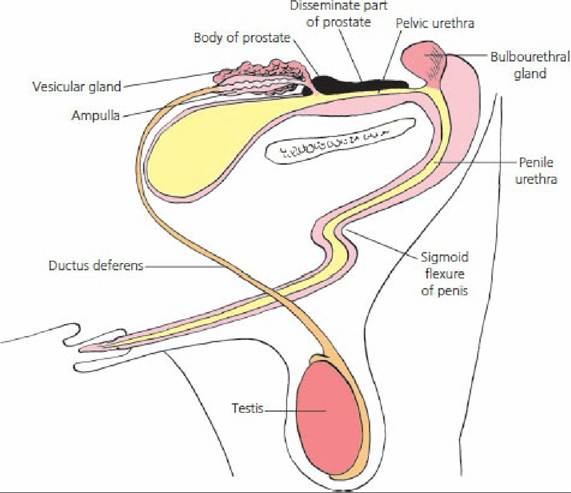
■ FIGURE 14-8 Disposition of the accessory glands that discharge into the pelvic urethra of the bull.
The seminal plasma provides an environment conducive to the survival of sperm within the female reproductive tract. It is rich in electrolytes, fructose, ascorbic acid, and other vitamins. Whereas fertilization can occur with sperm unaided by seminal plasma, the greatest fertilization potential is achieved with it. Species differ in the composition of seminal plasma, but it seems that each species has solved the same fundamental problems in a different way. However, one unvarying component among all species is fructose. The advantage of fructose as an energy source might be that it does not require metabolic energy for entrance into the spermatozoa.
Several prostaglandins (see Chapter 6) are present in seminal plasma. It is thought that they aid in fertilization in two ways: (1) prostaglandins react with cervical mucus and make it more receptive to sperm and (2) some of the prostaglandins cause smooth muscle contraction, so it is believed that reverse peristalsis is initiated in the uterus and oviducts to facilitate transport of sperm toward the ovaries.
Most of the sperm in an ejaculate never reach the oviduct. In fact, only a few dozen might reach the vicinity of the oocyte, where only one is required for fertilization. Semen collected for artificial insemination is often diluted and mixed with extenders to obtain the greatest number of insemination units. The number of sperm intended for each artificial insemination varies among species, but approximates 10 and 125 million, respectively, for cattle and sheep, and 2 billion each for pigs and horses.