Postnatal Development
At birth the ruminant stomach is prepared for the digestion of milk. The abomasum of the neonate is structurally mature and has more capacity than the combined capacity of the other chambers.
Its full extent is apparent directly after the consumption of a generous feed, when it extends from the liver and diaphragm to the pelvic entrance, from one flank to the other, and from the floor well into the upper half of the abdomen (Figs. 28.20A and 28.25/4). Its capacity may already exceed 60% of the adult measure. The abomasum impinges on nearly all other abdominal organs but makes extensive contact only with the liver, which in the neonate reaches far across the median plane. The abomasal mucosa is at first not quite mature, and a few days elapse before the fundic glands become fully active, which actually benefits the host in protecting the colostral antibodies and keeping them in their native state for absorption in the intestine.In contrast to the abomasum, the rumen and reticulum of the newborn calf are very small. They are confined to the left dorsal and cranial corner of the abdomen and are generally found crumpled and collapsed (Fig. 28.25/2 and 3). They are bypassed by milk feeds and normally contain only a small amount of fluid from secretions of the respiratory tract (swallowed in utero) in the youngest animals and saliva in those a little older. The omasum is also retarded in development and forms a relatively inconspicuous bridge between the reticulum and the abomasal fundus. The walls of the forechambers are thin and deficient in muscle, and while their mucosae possess the characteristic adult features, these are present in subdued form.
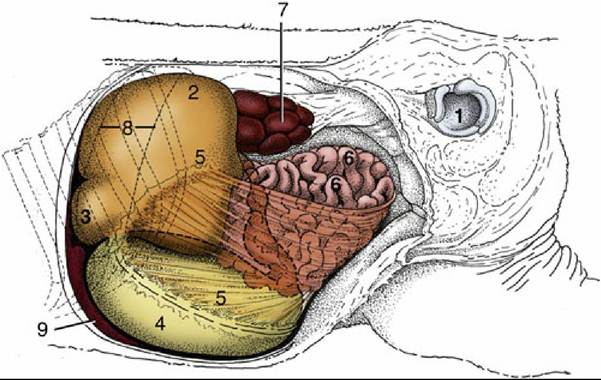
FIG. 28.25 Topography of the abdominal organs in a newborn calf, left lateral view. The left abdominal wall and the left hindlimb have been removed.
1, Left acetabulum; 2, rumen; 3, reticulum; 4, abomasum;5, greater omentum; 6, small intestine; 7, left kidney; 8, position of spleen; 9, liver.
No striking changes in proportions and structure of the chambers take place until the young calf is 2 to 3 weeks old and starts on solid food. Thereafter, the abomasum continues to increase at a slow but steady rate while the rumen and reticulum enter a period of spectacular growth. They have generally overtaken the abomasum by 8 weeks, and at 12 weeks they are more than twice as large. This unequal growth continues—but more slowly—till the definitive topography and proportions are established, which many contend occurs by 3 months but others think is not complete until 12 months.
Normal development depends on the availability of a normal diet of solid forage and other factors. Earlier it was thought that roughage stretched and stimulated the muscle of the stomach wall and also promoted the differentiation of the mucosa. Later it was shown that many gross and microscopic features of the mucosa develop only with exposure to certain end products of microbial fermentation, notably butyric acid. The full development requires exposure to these stimuli for some time because the return of a young, partly weaned calf to a wholly milk diet may result in the arrest and sometimes even reversal of the maturation processes.
The abomasum is initially the most vigorous chamber, but its activity diminishes as the ruminoreticulum, first inert and then only spasmodically active, establishes a regular cycle of contraction by the second month. The feeding habits, the structural changes, and the motor and chemical activities of the stomach, when taken in conjunction, define three phases of development. A neonatal period, in which milk forms the sole diet, may last for 2 or at most 3 weeks and may be followed by a transitional period when the stomach is adapting to solid food. From the eighth week onward the anatomy and the processes of digestion may be essentially those of the adult. The chronology will clearly be different in dairy and suckler calves.
In the newborn the liver is relatively large and lies across the midline, extensively related to the abomasum. The growing rumen and reticulum press the liver to the right and dorsally, and it rotates such that its left lobe comes to lie cranioventral to the right one and out of the reach of the abomasum. The intestines are simultaneously pushed away from the left flank and become confined to the right side. The expansion of the dorsal ruminal sac also displaces the left kidney, thrusting it across the midline until it comes to rest below and caudal to its fellow (Fig. 28.11/9 and see Fig. 29.9/10).