Potassium Is Absorbed Primarily by Passive Diffusion Through the Paracellular Route
Potassium (K4), although a highly important ion in the body, is present in abundance in most animal diets. This is in contrast to sodium (Na,), which is present in nutritionally inadequate amounts in most natural animal feeds.
Therefore, frequently the K+ concentration in the material entering the intestinal lumen is relatively high compared with Na' concentration. In addition, dietary potassium is concentrated in the gut lumen because of the absorption of other nutrients, electrolytes, and water, unaccompanied by active potassium absorption. Thus, K+ concentration within the gut lumen increases as digestion and absorption of other osmotically active molecules proceeds.As K+ reaches relatively high concentrations in the intestinal lumen, a concentration gradient favorable for the diffusion of potassium across the intestinal epithelium is created. Furthermore, the concentration gradient is enhanced by the normally low K4 concentration in the lateral spaces. The primary mechanism of potassium absorption is paracellular passive diffusion, which occurs in response to this concentration gradient (Figure 30-20). A clinical ramification of this absorptive mechanism is that potassium absorption is directly coupled to water absorption. That is, the movement of water out of the intestinal lumen results in an increase in the luminal K+ concentration, which in turn drives K1 absorption. In diarrhea conditions, in which net absorption of water is impaired, K+ absorption is impaired as well, because potassium in the gut lumen is diluted so that a concentration gradient favorable for passive diffusion of K+ never develops. In addition to passive diffusion, it appears that an H',ICAT Pase pump exists in the distal colon. This transport
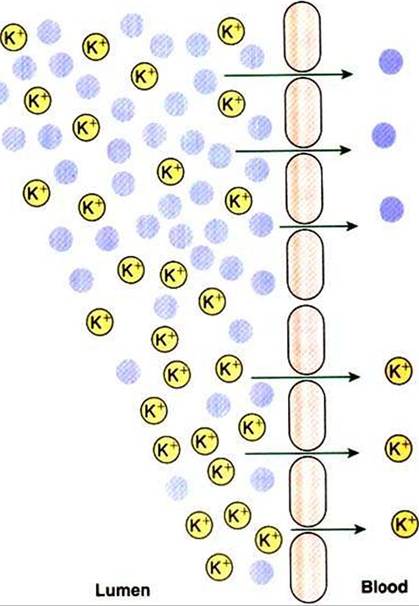
FIGURE 30-20 Potassium (K') is absorbed by simple diffusion through the paracellular route. Water absorption in the upper intestine increases K* concentration in the lower intestine, creating a favorable diffusion gradient for potassium. Note that the removal of water (solid blue circles) in the upper part results in a relative increase in the number of K* ions in the lower part.
pathway may he important for recovering the last remaining potassium from the colonic ingesta of animals with diets low in potassium.