PRACTICE QUESTIONS
1. Troponin and tropomyosin are components of which one of the following structures?
a. Myosin thick filament
b. Sarcolemma
c. T tubule
d. Actin thin filament
e. Sarcoplasmic reticulum
2.
Action potentials in skeletal muscle cells trigger the release from the sarcoplasmic reticulum of what ion critical to the muscle’s contractile process?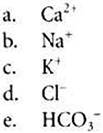
3. A gross skeletal muscle belly can be instructed (by the central nervous system) to contract more forcefully by:
a. Causing more of its motor units to contract simultaneously.
b. Increasing the amount of acetylcholine released during each neuromuscular synaptic transmission.
c. Increasing the frequency of action potentials in the α motor neuron’s axon.
d. Both a and c.
e. Both b and c.
4. Which one of the following is not found in smooth muscle?
a. Actin filaments
b. Myosin filaments
c. T tubules
d. Voltage-gated calcium channels
e. Sarcoplasmic reticulum
5. Choose the incorrect statement below:
a. The muscle fiber and neuronal cell membranes are similar because they both have a resting membrane potential.
b. A whole muscle, such as the gastrocnemius muscle, can be made to contract more forcefully by increasing the number of motor units contracting.
c. The muscle membrane’s transverse tubular system transmits the action potential to the interior of the muscle cell.
d. The muscle cell membrane transmits action potentials by saltatory conduction.
e. The shortening of a skeletal muscle during contraction is caused by the sliding together of actin and mvosin filaments.
6. Which one of the following is least likely to be significantly associated with a muscle that is primarily involved in brief, powerful movements?
a. Large α motor neuron cell body
b. Small motor unit
c. Fast-twitch fibers
d. White muscle
e. Large motor unit