Pregastric Physiology
Prehension and Chewing
The act of bringing food into the mouth is prehension. The teeth, lips, and tongue are used as prehensile organs by domestic animals. The lips of the horse, the tongue of the cow and sheep, and the snout of the pig are used extensively in obtaining food.
The type of teeth, arrangement of jaws, and chewing (mastication) habits vary with the species and the food. Carnivorous animals have simple teeth and tear their food but do little grinding. Herbivorous animals have at least some hypsodont teeth; the upper jaw is wider than the lower jaw; and chewing of the food is thorough. Mastication can be controlled voluntarily, but the presence of food in the mouth will stimulate reflex chewing.
Saliva and Salivary Glands
saliva consists of water, electrolytes, mucus, and enzymes. The water and mucus soften and lubricate the ingesta to facilitate mastication and swallowing. Lysozyme is a salivary enzyme with antibacterial actions. The starch-digesting enzyme amylase is present in the saliva of omnivores (pig) and to a limited degree in horses but absent in ruminants and carnivores (dog).
Adult cattle may secrete up to 200 L of saliva per day as compared to 1-2 L per day for humans. This large volume maintains the fluid consistency of the rumen contents, and components of the saliva may also prevent frothing of the rumen fluid. Ruminant saliva has a relatively high pH and contains high concentrations of bases (bicarbonate and phosphate). These bases neutralize acids produced by fermentation in the rumen so that the pH in the rumen does not become too acidic.
Parasympathetic nerves are the efferent limbs of neural reflexes that regulate salivary secretion. Afferent inputs that stimulate salivary secretion include sight and smell of food, presence of food in the oral cavity, and conditioned reflexes, where some event is associated with food and feeding.
Conditioned reflex control of salivation was the subject of the classic studies by Pavlov, who conditioned dogs to salivate at the sound of a bell.Swallowing
Deglutition, the act of swallowing, is arbitrarily divided into three stages. The first stage is passage of food or water through the mouth; the second is passage through the pharynx; and the third consists of passage through the esophagus into the stomach.
The first stage of swallowing is under voluntary control. After the food is chewed and mixed with saliva, a bolus (rounded mass of
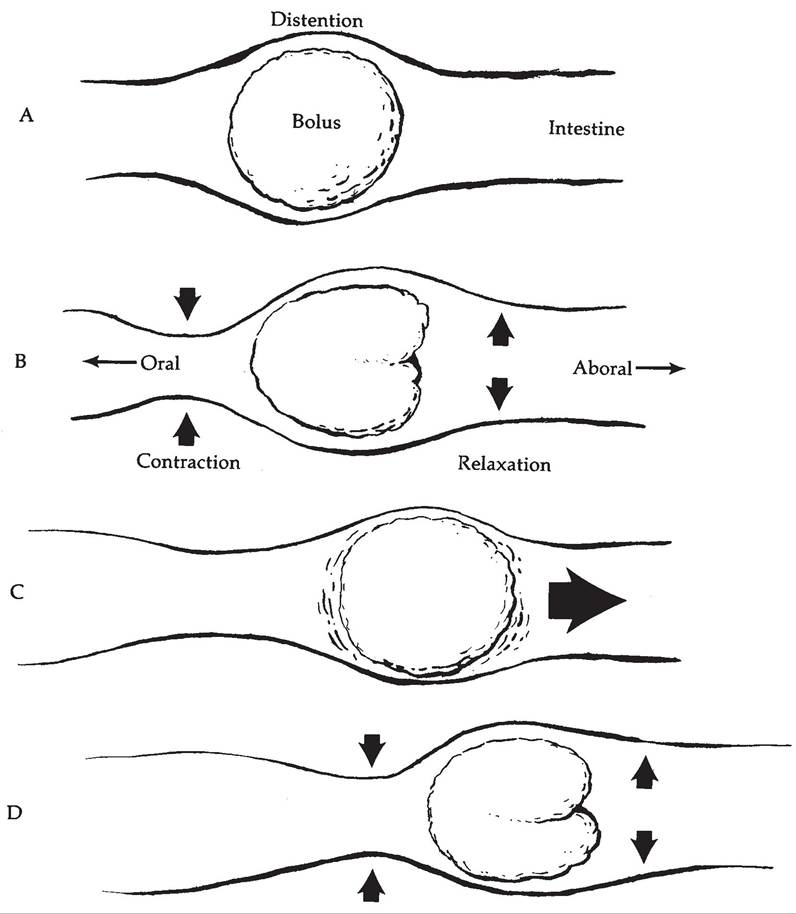
Figure 21-2. Intestinal peristalsis and movement of contents. A) Original distension. B) Contraction cranial to distension and relaxation caudal. C) Movement of contents. D) New distension point and new points of contraction and relaxation. (Reprinted with permission of Wiley-Blackwell from Reece W.O. Physiology of Domestic Animals. 2nd ed. Baltimore: Williams & Wilkins, 1997.)
food) forms and is moved to the upper surface of the tongue. The tongue is raised against the hard palate (tip first) to push the bolus toward the pharynx. At the same time the soft palate is raised, closing the caudal nares. The base of the tongue then acts as a plunger, forcing the bolus into the pharynx.
As the bolus enters the pharynx, it stimulates pressure receptors in the walls, which reflexively initiates the second stage, passage of the bolus through the pharynx. Respiration is reflexively inhibited, and the larynx reflexively closes and pulls up and forward. The base of the tongue folds the epiglottis over the laryngeal opening as it moves back. The pharynx shortens, and a peristaltic (milking) action of the pharyngeal muscles forces the bolus into the esophagus.
The third stage of deglutition consists of reflex peristalsis of the esophagus initiated by the presence of food in the esophagus. Peristalsis consists of alternate relaxation and contraction of rings of muscle in the wall coupled with regional contraction of longitudinal muscles in the area of the bolus (Fig.
21-2).Peristalsis carries solid and semisolid food through the esophagus of the horse at 35 to 40 cm/second. Liquids travel about five times as fast by a squirting action of the mouth and the pharynx.
Vomiting (emesis) is a protective response to remove potentially harmful ingesta from the stomach and upper small intestine. Vomiting is a highly coordinated reflex that is controlled by a reflex center in the brainstem. Drugs that stimulate this center to produce vomiting are termed emetics. The process begins with relaxation of the sphincter between the stomach and upper small intestine and reverse peristalsis to move intestinal contents to the stomach. The movement of stomach contents into the esophagus and out of the mouth requires relaxation of the upper and lower esophageal sphincters together with an inspiratory movement against a closed glottis and forceful contraction of abdominal muscles. Closure of the glottis and movement of the soft palate prevent regurgitated food from entering the trachea and nasal cavity, respectively.