Properties of Life
It is difficult to give a satisfactory definition of life. However, the cell is the functional unit of all animal life. It is the unit that makes up all tissues, organs, and systems, which in turn make up the total animal.
Therefore, the properties of the cell are equated with those of life. These properties include homeostasis, growth, reproduction, absorption, metabolism, secretion, irritability, conductivity, and contractility. The last two characteristics, however, are not properties of all cells. Conductivity is an important functional characteristic of both nerve and muscle cells, whereas contractility is a property of muscle cells.Homeostasis is the tendency for living things to attempt to maintain a state of relative stability. At the whole-animal level or at the cellular level, all living things respond to stresses placed upon them by changes in their environment. Their responses are attempts to maintain a state of homeostasis.
Growth is increase in size. Increase in size of a cell or organ beyond normal is called hypertrophy. An increase in the size of a structure due to an increase in the number of cells is called hyperplasia. A decrease in size from normal is called atrophy. Failure of a tissue or organ to develop is called aplasia, while incomplete development or defective development of a tissue or organ is called hypoplasia.
Reproduction of a cell or of an organism implies the ability to produce more cells or more organisms that are essentially the same as the original. some fully differentiated cells, for instance nerve cells, do not normally retain the ability to reproduce in the adult.
Cells may be found in solutions whose composition is quite different from that of the fluid within the cells. To maintain intracellular homeostasis in these conditions, the passage of particles and water in and out of the cell must be regulated.
Absorption is the process of taking dissolved materials or water through the cell membrane into the substance of the cell. This can be a passive process dependent on the forces of diffusion and osmosis, an active process requiring the expenditure of energy from adenosine triphosphate, or the result of electrochemical ionic forces and affinities that require no direct expenditure of energy. All three can occur at the same time across the same cell membrane.Endocytosis is another means by which extracellular materials may enter a cell. In endocytosis the exterior cell membrane moves to surround extracellular materials in a membrane pocket (Fig. 2-1). This membrane vesicle detaches from the inner surface of the cell membrane and moves into the interior of the cell.
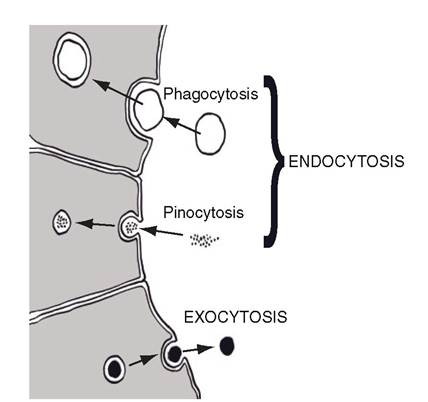
Figure 2-1. Endocytosis (phagocytosis and pinocyto- sis) and exocytosis.
If a large amount of particulate material is endocytosed by ameboid movements of a cell, the process is more specifically termed phagocytosis (Fig. 2-1), and cells capable of taking in large amounts of material are called phagocytes. This ability is characteristic of some white blood cells, which engulf large particulate matter, tissue debris, or bacteria. After a phagocytic vesicle enters the substance of a cell, it may fuse with a different type of membrane vesicle, a lysosome that was produced within the cell. Lysosomes are specialized membrane vesicles that contain enzymes, also produced within the cell. This fusion permits the lysosomal enzymes to act upon the contents of the phagocytic vesicle in a small, local area that is isolated from the cytosol. Most types of cells are capable of endocytosing small amounts of fluid containing dissolved particles. This type of endocytosis is termed pinocytosis (Fig. 2-1).
Metabolism refers to the sum total of the physical and biochemical reactions occurring in each cell and therefore in the entire animal.
Reactions that build and maintain cellular components are called anabolic, and those that break down cellular components or constituents are called catabolic. The oxidation of carbon compounds to carbon dioxide and water, with the release of energy, is a catabolic reaction.The secretion of products synthesized by the cell into the extracellular fluid (ECF) that surrounds the cells occurs by exocytosis (Fig. 21), which is essentially the opposite of endocytosis. Membrane-bound secretory vesicles containing substances synthesized within the cell and packaged by the Golgi apparatus migrate in the cytoplasm to the plasma membrane.
Here the membrane of a secretory vesicle fuses to the exterior cell membrane, an opening appears at the point of fusion, and the contents of the vesicle are released into the ECF.
Irritability (also called excitability) is the property of being able to react to a stimulus. The reaction must necessarily consist of one of the other properties of protoplasm, such as conduction, contraction, or secretion.
Conductivity is the property of transmitting an electrical impulse from one point in the cell to another. This property is discussed in more detail later in this chapter. Nerve cells and muscle cells are specialized for conductivity and irritability.
Contractility is the ability to shorten in one direction. Muscle cells are specialized for contractions, although many other cells and cell organelles also contain contractile proteins and exhibit limited movement (e.g., cilia).