Chemical Composition of the Cell
Chemical composition of various parts of the cell plays an important role in cellular function. The approximate composition of protoplasm by constituent is water, 85%; protein, 10%; lipid, 2%; inorganic matter, 1.5%; and other substances, including carbohydrates, 1.5%.
Water
Each cell is about 60-65% water. Water is by far the largest constituent of protoplasm, which is largely a colloidal suspension in water. Water acts as a solvent for inorganic substances and enters into many biochemical reactions.
Most body water is within cells, and this fluid volume is called intracellular fluid. This fluid volume is about 40% of body weight. The remaining fluid (about 20% of body weight), found outside of cells, is termed extracellular fluid (ECF). Most ECF (about 15% of body weight) surrounds cells throughout the body and is termed interstitial fluid. Unique interstitial fluids include the cerebrospinal fluid, the fluid in the joints, the fluid in the eyes (aqueous and vitreous humors), and the serous fluid in the visceral spaces (i.e., pericardial, pleural, and peritoneal spaces). Blood plasma, a specific type of ECF, is about 5% of total body weight. The percentages for the different types of body fluids vary from one animal to another. Factors affecting these percentages include condition (amount of fat), age, state of hydration, and species.
Water is constantly lost from the body, and it must be replenished if the animal is to remain in water balance and not become dehydrated. Most is lost via the urine, but it is also lost in the feces and by evaporation from body surfaces, such as the skin and respiratory passages. Water replacement is almost entirely by drinking, because minimal amounts of water are produced in the bodies of domestic animals as a result of cellular metabolism (metabolic water).
Proteins
After water, proteins are the next largest constituent of protoplasm.
Proteins are complex high-molecular-weight colloidal molecules consisting primarily of amino acids that are polymerized (joined) into polypeptide chains (Fig. 2-2A). The union of amino acids within a protein molecule is by way of a peptide linkage, a bond between the amino (NH2) group of one amino acid and the carboxyl (CooH) group of another amino acid, with the elimination of water. A small chain of amino acids is called a peptide. A polypeptide is a chain of more than 50 amino acids connected by peptide linkages,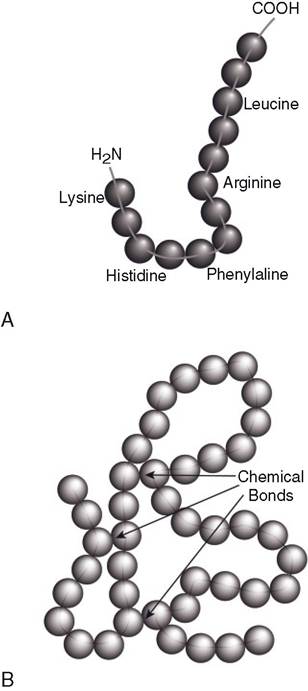
Figure 2-2. A) A chain of amino acids joined by peptide bonds to form a protein. B) A large protein. Each filled circle represents a single amino acid. Chemical bonds between amino acids at distant points in the chain produce the three-dimensional shape of the protein molecule.
and a chain that contains more than 100 amino acids is called a protein.
The peptide linkages between amino acids in a protein are somewhat flexible, and this permits the chain to bend into various threedimensional shapes (Fig. 2-2B). These configurations may become relatively stable, because chemical attractions, or bonds, form between amino acids at various points in the chain. The three-dimensional shape of a protein is an important determinant of its biologic function, because the shape can determine what segments of the protein chain are exposed and available to interact with other molecules.
Amino acids, and thus proteins, contain carbon, hydrogen, oxygen, and nitrogen. Proteins may also contain other elements such as sulfur, phosphorus, or iron. simple proteins yield only amino acids or their derivatives upon hydrolysis. The simple proteins, and examples of each, are as follows:
1. Albumins (plasma albumin, milk lactalbumin)
2. Globulins (plasma globulins, globulins in plant seeds)
3. Protamines (in sperm cells)
4. Histones (with nucleoproteins in cell nuclei)
5.
Albuminoids (collagen and elastin of connective tissue)Conjugated proteins consist of simple proteins combined with a component that is not a protein or amino acid. Rather, it is called a prosthetic group. The conjugated proteins and examples of each are as follows:
1. Glycoproteins: includes mucopolysaccharides and oligosaccharides as the carbohydrate prosthetic group (in connective tissue and salivary mucus)
2. Lipoproteins: Prosthetic group is lipid (in blood plasma and egg yolk)
3. Nucleoproteins: Nucleic acid prosthetic group (in cell nuclei, chromosomes, and viruses)
4. Chromoproteins: Fe-porphyrin prosthetic group (hemoglobin, cytochromes)
5. Metalloproteins: Contain iron, zinc, or copper (blood transferrin, ferritin, carbonic anhydrase)
6. Phosphoproteins: Phosphate prosthetic group (casein in milk, vitellin in eggs)
Most proteins can be classified as structural proteins or as reactive proteins. Structural proteins include these fibrous proteins: collagens, which are the major proteins of connective tissue and which represent about 30% of the total protein content of the animal body; elastins, which are present in elastic tissues such as the ligamentum nuchae, the abdominal tunic, and some arteries; and keratins, which are the proteins of wool, hair, horns, and hoofs. Reactive proteins include enzymes, protein hormones, histones associated with nucleic acids in the nucleus of cells, and contractile proteins in muscle (actin and myosin). Many varieties of proteins are found in blood plasma. Functions of plasma proteins include the transport of substances such as hormones and lipids in the blood, contributing to the process of blood coagulation, and creating an effective osmotic pressure difference between the plasma and interstitial fluid. Plasma proteins also include antibodies, which are produced by certain blood cells and are part of an overall immune response.
All cell membranes contain proteins, and like plasma proteins, the proteins in cell membranes have a variety of functions.
These include serving as membrane receptors for hormones and drugs, contributing to the transport of water and particles into and out of cells, acting as membrane-bound enzymes, and serving as markers to permit the immune system to recognize cells as normal or abnormal body components.Differences in the sequence of the amino acids of the polypeptide chains of proteins often occur between species. For example, the serum albumin in the blood plasma of horses is different from that in the plasma of cattle and sheep. In cattle, the protein hormone insulin is slightly different from that in swine. Such variable proteins may still function in a different species, though usually at levels below that of the naturally occurring form of the molecule. Note: Throughout the text, clinical extracts are set in blue type. These are examples of the application of basic anatomy and/or physiology in clinical settings.
Lipids
Lipids (fatty substances) consist primarily of carbon, hydrogen and oxygen, but some also contain minor amounts of phosphorus, nitrogen, and sulfur. Most lipids are nonpolar molecules and thus are insoluble in water. The four primary chemical types of lipids in animals are fatty acids, triglycerides or triacylglycerols, phospholipids, and steroids.
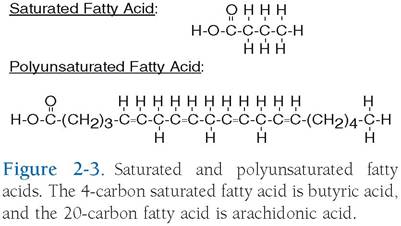
Fatty acids are chains of covalently bound carbon atoms with hydrogens attached (Fig. 23). If each carbon atom has four single covalent bonds, the fatty acid is saturated. If any carbon atom has fewer than four single bonds, the fatty acid is unsaturated. A polyunsaturated fatty acid has multiple carbon atoms with fewer than four single bonds. Animal tissues tend to have higher amounts of saturated fatty acids than do vegetable oils.
Prostaglandins and leukotrienes, derived from fatty acids, are produced by a variety of cells throughout the body. In many cases, these serve as local messengers that permit one cell to affect the function of another nearby. Both prostaglandins and leukotrienes are local messengers in the process of inflammation, and prostaglandins regulate ovarian function in some species.
Triglycerides consist of a glycerol molecule with three fatty acids attached (Fig. 2-4). Also known as neutral fats, triglycerides are the primary form of lipid storage in adipose tissue in animals. Fatty acids must be detached from glycerol before they can undergo further metabolism. This detachment is the function of enzymes known as lipases. Because triglycerides are not soluble in water, most are not transported as individual molecules in blood plasma. For transport, they are combined with other lipids and proteins into relatively large particles known as lipoproteins. In this form they can be transported from site to site within the body.
The glycerol and fatty acids derived from the breakdown of triglycerides are all sources of energy. Glycerol can serve as a substrate for the glycolytic pathway in the cytosol. Fatty acids enter the mitochondria, where they are broken down into two carbon units, which become acetyl coenzyme A (acetyl CoA). The metabolism of acetyl CoA within the mitochondria ultimately results in the production of the high-energy compound adenosine triphosphate (ATP). Details about the role of the mitochondria in the production of ATP are described in the section on organelles later in this chapter.
Phospholipids are similar to triglycerides except that a molecule containing a phosphate group has replaced one of the three fatty acids. The replacement of the nonpolar (hydrophobic) fatty acid with a nonlipid polar (hydrophilic) molecule creates a unique compound
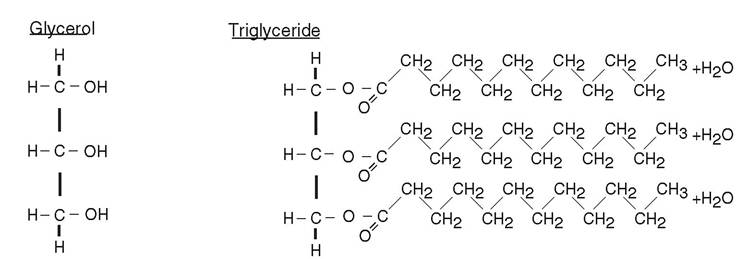
Figure 2-4. Three fatty acids combined with glycerol to form a triglyceride.
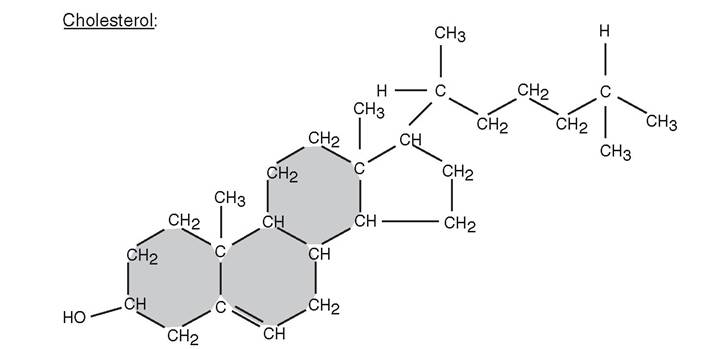
Figure 2-5. Cholesterol. Different biologic steroids are formed by modifying the cholesterol molecule, but the four carbon rings remain intact.
with two regions that vary in water solubility. The phosphate-containing region becomes water soluble and the remainder of the phospholipid molecule is water insoluble. This unique characteristic is important in the role of phospholipids in the structure of cell membranes. Cell membranes throughout the body primarily consist of phospholipids.
Steroids are lipids in which the carbon atoms are connected in ring structures. Cholesterol is a steroid (Fig. 2-5), and most of the steroids found in animals are derived from cholesterol (e.g., bile salts and various hormones, including several reproductive hormones). Cholesterol itself is an essential constituent of the cell membrane of all animal cells. Cholesterol can be obtained from dietary sources, but it is also synthesized in the liver of animals, including humans. Inappropriate rates of cholesterol synthesis by the liver are responsible for elevation in serum cholesterol in humans in spite of reductions in dietary intake of cholesterol.
Waxes are a class of lipids. The waxes synthesized in the animal occur mostly in the epithelial cells of the skin. Here the waxes form a protective coating on the skin or hair as a water repellent and as a barrier against bacteria. Lanolin is wool fat, and cerumen is earwax.
Carbohydrates
Like lipids, carbohydrates are composed of carbon, oxygen, and hydrogen. simple sugars, or monosaccharides, are carbohydrates containing three to seven carbon atoms. Glucose, with six carbon atoms, is the most prevalent simple sugar in the body. Two simple sugar molecules may be combined to form a disaccharide. some common and important disaccharides are sucrose, or table sugar (glucose + fructose); lactose, or milk sugar (glucose + galactose); and maltose (glucose + glucose).
Multiple molecules of glucose can be linked (polymerized) to form a polysaccharide, glycogen. Two major sites of glycogen synthesis are the liver and skeletal muscle. in the liver, the stored glycogen can be broken down to glucose and metabolized by liver cells or secreted as glucose into the blood. in skeletal muscle, glycogen stores are an immediate source of energy, but this glycogen cannot be a source of glucose for release into the blood.
Glucose is a source of cell energy, and the enzymatic pathway that metabolizes glucose to produce energy is glycolysis. This pathway can be completed within the cytosol, resulting in the production of ATP and pyruvate. if oxygen is readily available, the pyruvate can enter the mitochondria to be metabolized.
The sugar deoxyribose is found in combination with a base (purine or pyrimidine) and a phosphate, forming DNA (deoxyribonucleic acid). DNA is the carrier of all genetic information from generation to generation and from cell to cell and ultimately controls all functions of the cell. DNA is found almost exclusively in the nucleus of the cell. A related substance, RNA (ribonucleic acid), includes the sugar ribose combined with a base and a phosphate. RNA is intimately associated with synthesis of all cell proteins.
Even though carbohydrates are a major part of the diet of most animals, the amount of carbohydrates in animal’s bodies is relatively small. Carbohydrates make up less than 1% of most cells.
Inorganic Substances
of the atoms or elements found in protoplasm, more than 99% are hydrogen, carbon, oxygen, and nitrogen contained in the organic compounds described earlier. Protoplasm also has inorganic compounds containing iodine, iron, phosphorus, calcium, chlorine, potassium, sulfur, sodium, magnesium, copper, manganese, zinc, cobalt, chromium, selenium, molybdenum, fluorine, silicon, tin, and vanadium. Of the 24 elements found in the body cells, 20 represent less than 1% of the total amount of elements in living tissue.
An electrolyte is any molecular substance that in solution dissociates into its electrically charged components, called ions. For example, this occurs when sodium chloride in solution dissociates into Na+ and Cl-. The solution can then carry an electrical charge and current.
The major ions found within cells in order of abundance, expressed in milliequivalents per liter of fluid, are potassium (K+) 140 mEq/L; phosphate (HPO42-), 75 mEq/L; magnesium (Mg2+), 60 mEq/L; sodium (Na+) 10 mEq/L; bicarbonate (HCO3-) 10 mEq/L; and chloride (Cl-) 4 mEq/L.
A milliequivalent is one-thousandth of an equivalent. An equivalent weight is the weight in grams that will displace or react with 1 gram atomic weight of hydrogen ion (H+ = 1.008 g).
The practical importance of this concept is that laboratory reports and records of measurements of body fluid electrolyte and ion concentrations are often expressed as milliequivalents per liter (mEq/L). Another way of expressing measurements is in mg%, or milligrams per 100 milliliters (mg/100 mL). Measurements may also be expressed as milligrams per deciliter (mg/dL); a deciliter is 100 mL, or a tenth of a liter. A liter is 1000 mL, or 1.06 quarts.
Bone contains about 65% inorganic material by volume. Most of this mineral material is in the form of hydroxyapatite crystals with a molecular formula Ca10(PO4)6(OH)2. In addition, sodium, magnesium, and iron may be incorporated in the mineral structure.
Acids, Bases, and pH
An acid is a compound that is capable of ionizing and releasing a hydrogen ion. The pH of a solution is a measure of the concentration of H+. However, pH is reported as the negative of the logarithm to the base 10 of the H+ concentration in moles, so the greater the H+ concentration, the more negative, or lower, the pH. Concentrations of H+ in normal body fluids are much lower than other electrolytes. A typical H+ concentration in plasma is 4 ? 10-9 moles per liter, or 4 nanomoles per liter, equivalent to a pH of 7.45. A nanomole is one-millionth of a millimole.
A base is a compound that is capable of reducing the concentration of hydrogen ions in a solution by combining with them. When bases are added to solutions, the H+ concentration is reduced, so the pH rises. Chemical buffer solutions contain both acids and bases and therefore are capable of either releasing or combining with H+. This dual ability tends to provide a relatively stable pH.
All body fluids, intracellular and extracellular, contain mixtures of several chemical
buffers. These buffers act simultaneously to maintain a relatively stable pH within their respective fluids. This stability is critical for normal metabolic processes and enzymatic reactions.