Proteins Are Digested by a Variety of Luminal-Phase Enzymes
Proteins are a source of amino acids, which are essential components of all animal diets. Dietary proteins come from both plant and animal sources. The general pattern of protein digestion is similar to that of carbohydrate digestion, in that large molecular proteins are broken down into small peptide chains by luminal digestion.
Subsequent digestion of the peptide chains to individual amino acids occurs to a large extent by membranous-phase digestion, although unlike in carbohydrate digestion, a portion of free monomers, that is, amino acids, is released in the luminal phase.A major difference between protein digestion and carbohydrate digestion is in the number of different enzyme types involved. The relatively larger number of enzymes involved in protein digestion is expected, considering that starch molecules are made up of only one type of monomer, glucose. Therefore, only bonds between glucose molecules need to be broken. On the other hand, proteins are made up of infinite combinations of up to 20 individual types of amino acids; the various proteolytic enzymes are necessary for digestion because they differ in their efficiency in cleaving peptide bonds between specific types of amino acids.
The major luminal-phase proteolytic enzymes are listed in Table 30-1. Most proteolytic enzymes are endopeptidases, meaning that they break proteins at internal points along the amino acid chains, resulting in the production of short-chain peptides from complex proteins. Endopeptidases produce essentially no free amino acids. Two exopeptidases, which release individual amino acids from ends of peptide chains, are secreted also from the pancreas and are active in luminalphase digestion.
The proteolytic enzymes are secreted from the stomach glands or pancreas in the form of inactive zymogens (see Chapter 29), which are activated in the stomach or intestinal lumen, respectively.
These enzymes must be secreted in an inactive form; otherwise, the active enzymes would digest the cells in which they are synthesized. Activation of the zymogens occurs in the gut lumen. The stomach enzymes pepsinogen and Chymosinogen arc activated by hydrochloric acid (HCl) in the stomach. Pepsinogen is also activated by pepsin in an autocatalytic feedback loop. Trypsinogen from the pancreas is activated by enterokinase, an enzyme elaborated by duodenal mucosal cells. The active enzyme, trypsin, then serves as an autocatalytic agent to activate additional trypsinogen as well as the other pancreatic protein-digesting enzymes. Figure 30-8 illustrates the cascade of intraluminal zymogen activation.Luminal-phase protein digestion begins in the stomach. Gastric digestion of protein is facilitated not only by the stomach enzymes but also by HCl, which has hydrolytic properties of its own. The acid environment of the stomach is suited to the action of pepsin, which has its optimal activity at pH I to 3. Gastric hydrolysis of protein is probably important to the physical as well as the chemical digestion of protein, because most connective tissue of animal origin is protein; digestion of connective tissue aids in breaking food down into particles small enough to pass the pylorus. Although stomach action is important in initiating protein digestion, it is not
Table 30-1
Luminal-Phase Enzymes of Protein Digestion
| Enzyme | Action | Source | Precursor | Activator |
| Pepsin Chymosin (rennin) Trypsin Chymotrypsin Elastase Carboxypeptidase A Carboxypeptidase B | Endopeptidase Endopeptidase Endopeptidase Endopeptidase Endopeptidase Exopeptidase Exopeptidase | Gastric glands Gastric glands Pancreas Pancreas Pancreas Pancreas Pancreas | Pepsinogen Chymosinogen Trypsinogen Chymotrypsinogen Proelastase Procarboxypeptidase A Procarboxypeptidase B | Hydrochloric acid, pepsin 7 Enterokinase, trypsin Trypsin Trypsin Trypsin Trypsin |
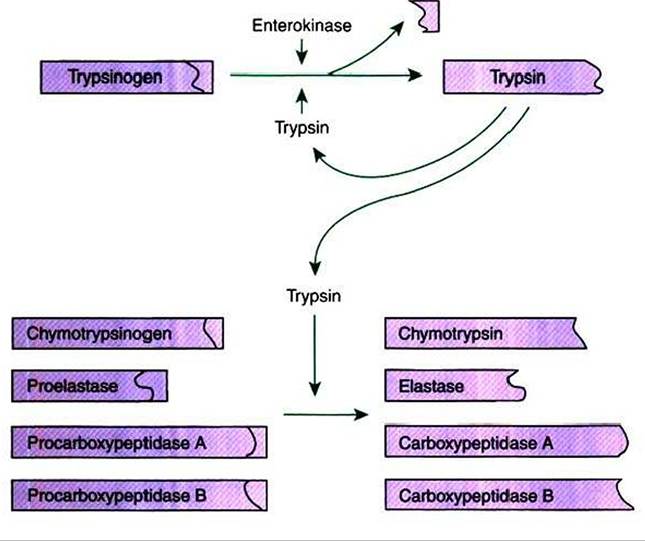
FIGURE 30-8 Activation of pancreatic zymogens. Note that trypsinogen is activated by trypsin as well as by the duodenal enzyme enterokinase.The autocatalytic action of trypsin on trypsinogen forms a positive feedback loop that ensures the rapid and complete activation of trypsinogen in the gut.Trypsin then activates the other zymogens.
essential; animals without stomachs can digest proteins, provided they have a functional pancreas and are fed small, frequent meals of soft, moist food. Luminal-phase digestion of proteins is completed in the small intestine by the action of pancreatic enzymes.