Receptors
Animals have a variety of receptor types that detect different stimuli (thermal, mechanical, chemical and photo stimuli); receptors detect changes in both the animal’s external and internal environments.
Receptors may be encapsulated in connective tissue or non-encapsulated and have bare dendrites. They are designed to respond preferentially to a certain type of stimulus, but will usually respond to several different forms of energy. Regardless of stimulus type, it is transduced as an electrical impulse.
Exteroceptors are activated by stimuli in the immediate external environment such as temperature and touch. They include both encapsulated (Pacinian corpuscles and Ruffini endings) and free nerve endings that respond to pressure, vibration and distortion of the tissue. They may adapt to a constant stimulus either rapidly or slowly. Exteroceptors also include those receptors concerned with special sensations, such as audition, vision and gustation (taste) (see Chapter 10).
Interoceptors detect the internal, visceral environment of the body. Conscious perception of the viscera is mainly via nociceptors, which are stimulated by distension of visceral walls or ischaemia.
Proprioceptors include receptors such as the muscle spindle fibres and Golgi tendon organs located in muscles, tendons or joints and also tactile/pressure receptors. They detect muscle stretch, tension, position and movement of body parts.
Nocioceptors respond to many types of stimuli but have a high threshold; that is the stimulus must be of sufficient intensity to cause tissue destruction.
Pathway: Most conscious sensory systems share a common format that comprises a three-stage system:
1. A receptor and an axon with a cell body in the ganglion in the PNS;
2. A relay section in the CNS comprising a central pathway that has one, or more, synapses in specific nuclei. It eventually joins, or runs adjacent to, a pathway called the medial lemniscus through the brainstem to the thalamus;
3. Thalamocortical projection to the somatosensory cortex of the cerebrum.
Sensory modalities that do not fit this three-stage structure include olfaction, vision and some nociceptive pathways (Table 6.1).
Table 6.1 Ascending tracts, their functions and locations in the spinal cord
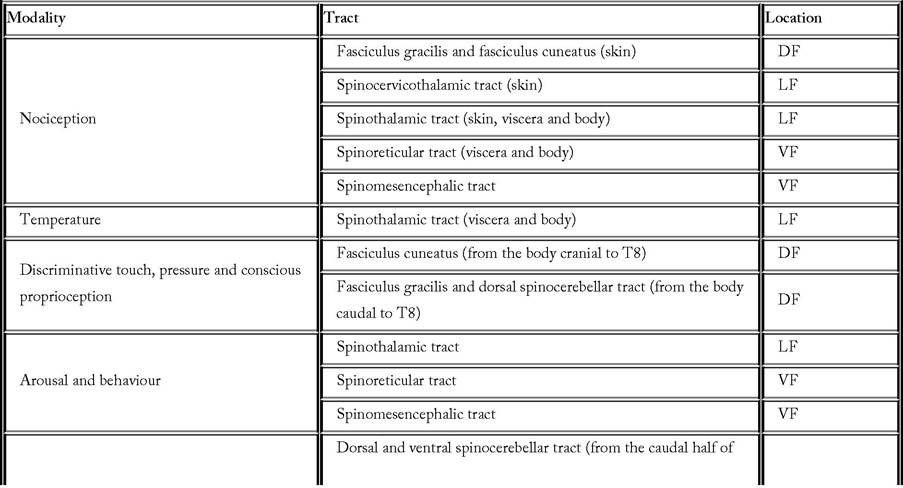
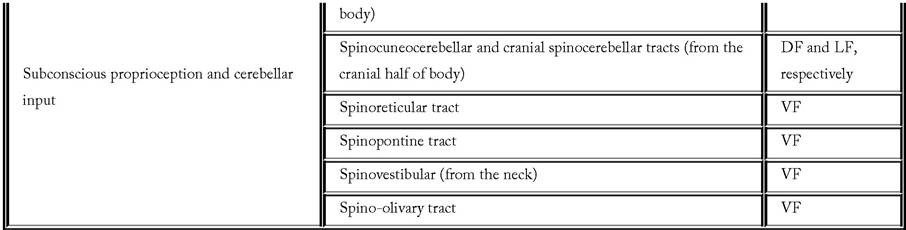
DF = dorsal funiculus, LF = lateral funiculus, VF = ventral funiculus.
See also Fig. 2.5.