Reflex Arcs Can Be Segmental or Intersegmental
A segmental reflex is a reflex in which the reflex arc passes through only a small rostrocaudal portion of the CNS (Figure 7-2, A). In such cases the sensory neuron entrance to the CNS, the CNS circuitry, and the motor neuron exit all have a similar rostrocaudal location.
The quadriceps stretch reflex (knee jerk reflex) and the pupillary light reflex are examples ofsegmental reflexes because they use only, respectively, a small number of spinal cord segments (e.g., L4-L6) or a small rostrocaudal region of the brainstem.In an intersegmental reflex the reflex arc traverses many segments of the spinal cord or several major brain divisions (e.g., medulla to midbrain). In one class of intersegmental reflex, the motor neuron exit is located, or extends, a considerable rostral or caudal distance from the location of the sensory neuron entrance to the CNS (Figure 7-2, B). Examples include the vestibulospinal reflexes that produce postural adjustments in response to acceleration or tilt of the head. The sensory input, originating in the vestibular apparatus of the inner ear, enters the CNS near the pontomedullary border of
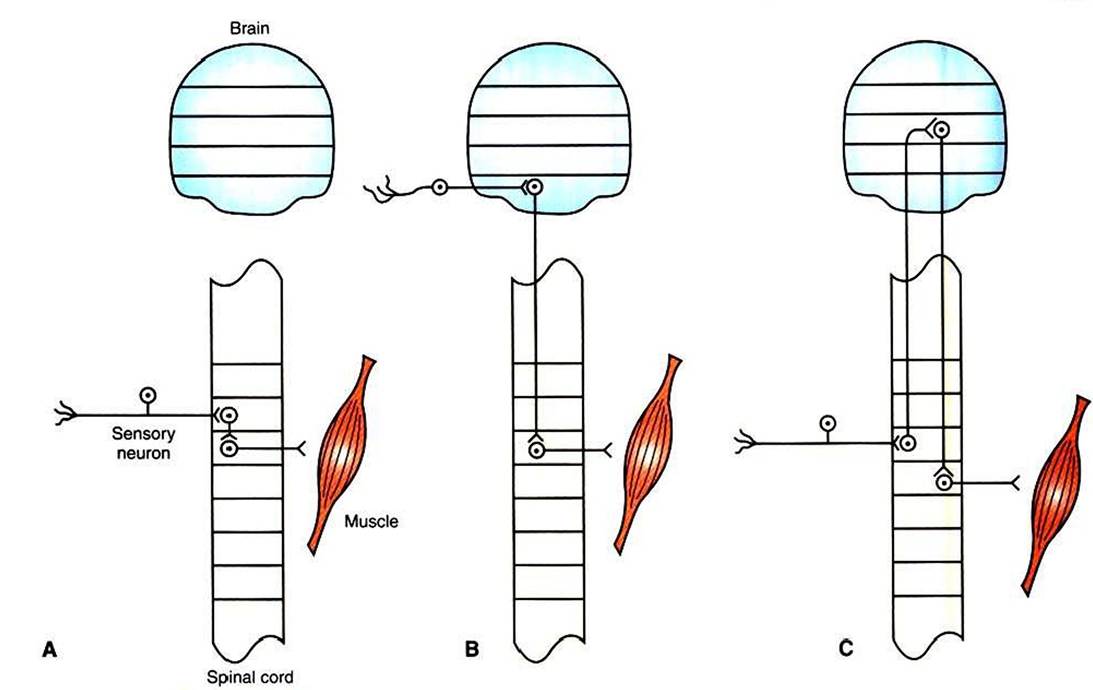
FIGURE 7-2 Segmental and intersegmental reflexes. A, In the segmental reflex the sensory neuron input, central nervous system (CNS) circuitry, and motor neuron output traverse only a small number of rostrocaudal segments of the CNS. B, Intersegmental reflex arcs traverse several CNS segments. In some intersegmental reflexes the sensory neuron input and motor neuron output are separated by several segments. C,The Iong-Ioop intersegmental reflex arc traverses several CNS segments, even though the sensory input and motor output are located in close rostrocaudal proximity. Horizontal lines delimit either spinal cord segments (e.g., L1, 12) or major brain divisions (e.g., medulla, pons).
the brainstem, and the motor neurons exit from the spinal cord, over a large number of spinal cord segments.
For some intersegmental reflexes, the sensory neuron entrance and motor neuron exit are at a similar rostrocaudal location, but the CNS circuitry lying in between travels to and returns from a distant region of the CNS (Figure 7-2, C). These are sometimes referred to as long-loop intersegmental reflexes. The proprioceptive positioning reaction is often associated with this category. This reaction involves the animal promptly returning its paw to the normal pad-down position after the clinician flexes it to make the dorsal surface touch the floor or tabletop. The sensorimotor circuitry of this reaction courses from the limbs peripheral nerves and associated spinal cord segments all the way through the cerebral cortex and back to the limbs spinal cord segments and peripheral nerves.