Regression of the Corpus Luteum in Nonpregnant Large Domestic Animals Is Controlled by Uterine Secretion of Prostaglandin F2α
Regression of the CL is important in large domestic non- pregnant animals so that animals reenter a potentially fertile state as soon as possible. The CLs life span after ovulation must be of sufficient duration to allow a newly developing conceptus to synthesize and release factors that allow the CL to be maintained, but it must be relatively short so that a nonpregnant animal can return to a potentially fertile state.
In large domestic animals the duration of the luteal phase is about 14 days in the absence of pregnancy. This allows large domestic animals to recycle at relatively frequent intervals, approximately every 3 weeks.Leo Loeb first showed (in 1923) the importance of the uterus for the regression of the CL through hysterectomy studies that extended the luteal phase in guinea pigs. He concluded that the uterus must produce a substance that terminated luteal activity. This information lay dormant for many years, until hysterectomy studies in cattle, pigs, and sheep in the 1950s produced similar results, that is, a prolongation of the luteal phase of the estrous cycle. Through these studies the concept developed that the uterus is responsible for control of the duration of the life span of the CL, at least in large domestic species (and guinea pigs).
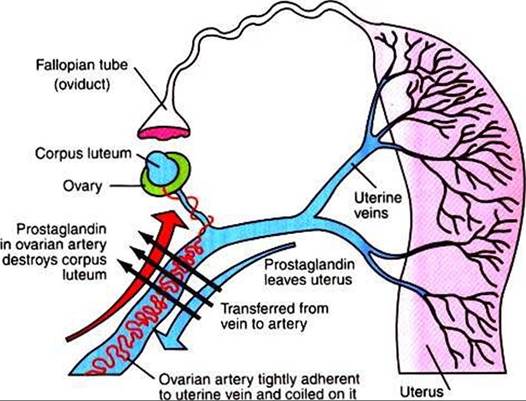
FIGURE 36-4 Postulated route by which prostaglandin secreted by the progesterone-primed uterus is able to enter the ovarian artery and destroy the corpus Iuteum in sheep. (From Baird DTThe ovary. In Austin CR, Short RV, editors: Reproduction in mammals, vol 3, Hormonal control of reproduction, Cambridge, UK, 1984, Cambridge University Press.)
It is now accepted that PGF20, a 20-carbon unsaturated fatty acid, is the uterine substance that causes regression of the CL in large domestic animals, including cattle, goats, horses, pigs, and sheep; PGF2o has no known natural role in CL regression in cats and dogs or in primates.
Prostaglandin (PGF2α and PGE) therapy has been used clinically to cause Iuteolysis in the bitch and queen, for the treatment of pyo- metra, or to induce abortion. In large domestic species, regression of the CL is initiated by uterine synthesis and release of PGF2o (likely of endometrial origin) at about 14 days postovulation. The mode of transfer of PGF2o from the uterus to the ovary is thought to occur either by local countercurrent transfer or general systemic transfer. Countercurrent transfer involves the movement of molecules across the blood vascular system from higher concentrations in the venous effluent (utero-ovarian vein) to an area of lower concentration (ovarian artery) (Figure 36-4). Systemic transfer involves passage of the molecules through the general circulatory system. In some species (cow and ewe), PGF2o synthesis from a uterine horn only influences the life span of the CL in the ipsilateral ovary. In other species (sow and perhaps mare), PGF2o synthesis from one horn is sufficient to cause regression of CL in both ovaries. This effect likely occurs because of greater production of PGF2o by uterine tissue, as well as a difference in the rate of metabolism of PGF2o. PGF2o is rapidly metabolized systemically, with more than 90% changed by one passage through the lungs. Thus the system involving the use of PGF2o as the Iuteolytic agent in large domestic species requires that PGF2o be conserved through a special transfer system, or that it be produced in relatively large amounts.The pattern of synthesis and release of PGF2o is essential to its Iuteolytic effect. For example, PGF2o synthesis and release
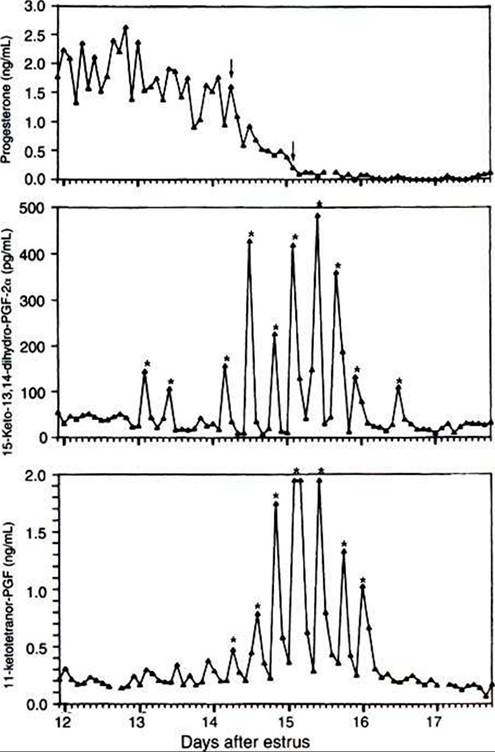
FIGURE 36-5 Concentrations of progesterone, 15-keto- 13,14-dihydro-PGF2α, and 11-ketotetranor-PGF metabolites in a nonpregnant ewe. Values identified as significant pulses of either PGF2α metabolite are indicated by asterisks.The times of initiation and completion of functional Iuteolysis are indicated by arrows. PGF, Prostaglandin F. (From Zarco L, Stabenfeldt GH, Basu S, et al: Modification of prostaglandin PGF2α synthesis and release in the ewe during the initial establishment of pregnancy, J Reprod Fertil 83:527, 1988.)
the uterus to initiate another round of PGF2rt synthesis. PGF2ot synthesis ceases 6 to 12 hours after progesterone concentrations have become basal, that is, with the completion of Iuteolysis. A system for early recycling is not present in nonpregnant dogs and cats as far as regression of CL; the luteal phase is about 70 and 35 days, respectively. Bitches experiencing infertility as a result of frequent estrous cycles may have pathologically shortened diestrus or anestrus.