REPRODUCTIVE SYSTEM
Reptiles with nasal salt glands sneeze excess salts when the plasma osmotic concentration is high. A clear fluid is produced that dries to form a fine white powder at the nostrils.
This method of water conservation should not be confused with respiratory infection (Dunson 1976).Renal portal system
The reptilian kidney has a dual afferent blood supply consisting of the renal arteries and the renal portal vein, which arises near the confluence of the epigastric and external iliac veins. This vein bypasses the renal glomerulus and enters the kidneys at the level of the kidney tubule where it plays a role in the secretion of urates. The renal portal system may play a role too in water conservation because, when the glomerular filtration rate slows down during dehydration, the renal portal system will keep perfusing the tubules to prevent necrosis (Holz 1999).
It is thought that, similarly to birds, reptiles have a valve system in place such that when the valve is closed blood flows through the kidney to the heart. However, under stress the valves open to bypass the kidney. The control of the valve is unknown but it may be opened by adrenaline and closed by acetylcholine, as in birds.
CLINICAL NOTE
As venous return from the hindlimb goes straight to the kidney tubules via the renal portal system, injecting drugs in the caudal half of the body could theoretically result in lower serum concentrations (Holz 1999). This could lead to underdosing and also renal toxicity from nephrotoxic drugs.
Nevertheless, this is unlikely to have much effect on therapeutics as it would only affect drugs excreted by tubular secretion; aminoglycosides like gentamycin and amikacin, which are excreted solely by glomerular filtration, would not be affected (Holz 1999). Although renal portal flow to the kidney increases when the animal is dehydrated, when the glomerulus is closed epithelial transport ceases.
This means that although more drug may enter the kidney it will not necessarily be excreted (Holz 1999).KEY POINTS
• Reptiles feed less frequently than mammals and birds.
• Herbivorous reptiles have longer gut transit times than carnivores.
• Digestion will not take place if the reptile is kept at suboptimal temperatures.
• Only Chelonia and some lizards have a urinary bladder.
• Dehydrated reptiles run the risk of developing gout.
• Reptile urine is not well concentrated and as it passes through the cloaca is not sterile.
The pineal gland and the hypothalamus/pituitary gland interpret environmental stimuli into hormonal change to regulate reproduction. In temperate species, rising temperatures and increasing daylight stimulates the gonads wheras in tropical species food availability and rainfall are more important. If food is scarce the fat bodies will be used for nutrition rather than vitellogenesis and reproduction.
Hormones of reproduction
The main trigger of hormones involved in reproduction is increasing light. Melatonin, which is produced by the pineal gland, is only secreted at night so production declines when the days are longer, controlling the circadian rhythm. This stimulates the hypothalamus to produce gonadotropin releasing hormone (GnRH), which stimulates the anterior pituitary to produce luteinizing hormone (LH), and folliclestimulating hormone (FSH).
In the female, FSH stimulates follicle growth while LH stimulates the production of sex steroid hormones, ovulation, and formation of the corpus luteum. Estrogen stimulates vitellogenesis of the follicles and LH surge, triggering ovulation. Post ovulation the regressing follicle becomes a corpus luteum and produces progesterone, which maintains the gravidity/pregnancy by inhibiting arginine vasotocin and prostaglandin in the uterine smooth muscle. When the corpus luteum regresses arginine vasotocin induces uterine smooth muscle contraction, which is then regulated by prostaglandins (Palmer et al.
1997).Sexual maturity
This is related more to size than age and will vary with species. Small lizards reach maturity at 1-2 years but snakes can take 2-3 years. Chelonia can vary from 3 years in Redeared sliders to 8 years in Box turtles (DeNardo 1996).
Sex determination
Two types of sexual determination can occur in reptiles:
1. Genotypic
2. Temperature-dependent sexual determination (TSD)
Genotype
Reptiles differ from mammals in that the female is heteroga- metic, being ZW, and the male is homogametic, being ZZ.
Temperature-dependent sex determination
TSD can occur in over 70 species of reptiles, including some lizards, the tuatara, turtles, and all crocodilians. So far research has found no evidence of TSD in snakes (Palmer et al. 1997).
In TSD, the sex of the embryo is not determined by sex chromosomes but by the incubation temperature during the early and middle incubation period. This is the period when the embryonic gonad develops into either testis or
ovary. Although the full mechanism is still unknown it acts through the sex steroid hormones. It is thought that the different temperatures act on the aromatase enzyme complex that converts testosterone to estradiol. This then binds to estrogen receptors on the gonads to create females. To create males, enzymes convert testosterone to dihydrotestosterone, which binds to androgen receptors on the gonads and triggers males (Pough et al. 1998e). Although the range of temperature can be small the incidence of intersexes is in fact rare.
The advantage of this process is still uncertain but it may be a more primitive reptilian feature as it is found in the more ancient reptiles like tuatara, chelonia and crocodiles but appears not to occur in the more recently evolved snakes.
TEMPERATURE SEX DETERMINATION
Although the process is not clearcut, three patterns of temperature-dependent sex determination (TSD) appears to occur (Espinoza & Tracy 1997; Pough et al. 1998e; Thompson 1997).
• Crocodiles, some turtles and lizards (e.g., the Leopard gecko, Eublepharis macularius) produce females at both low and high temperatures but males at intermediate ones.
• Many chelonia produce females at high temperatures and males at low temperatures.
• Some lizards, such as the Rainbow lizard (Agama agama) produce the opposite: males at high temperatures and females at low temperatures.
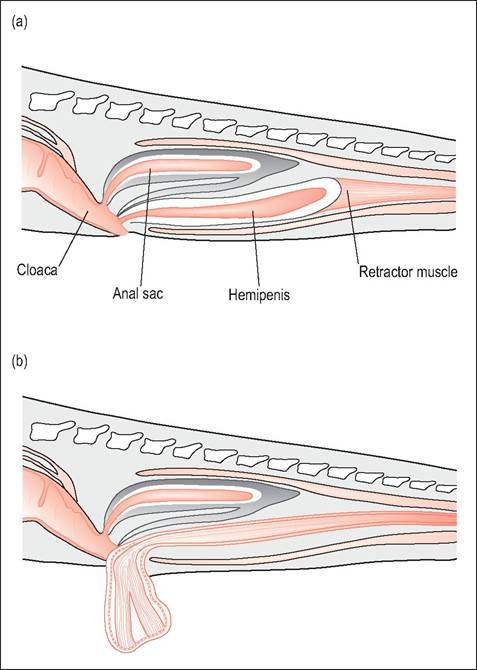
Figure 2.11 •
(a) Snake tail showing normal inverted hemipenis lying caudal to cloaca.
(b) Hemipenis everted out through cloaca.
The male
The testes produce the sperm and also secrete the hormones responsible for mating behavior and secondary sexual characteristics. Testicular size varies with season and therefore with light, temperature, and food supply. Male snakes and lizards have a renal sexual segment in the caudal half of the kidney. Secretions from this segment are transported to the cloaca where they are mixed with sperm (Bellairs 1969f; Palmer et al. 1997).
In both male and females the right gonad lies adjacent to the vena cava and is connected to it by very tiny vessels. The left gonad has it's own blood supply but lies intimately associated with the left adrenal gland.
Lizards and snakes have two extracloacal hemipenes. These lie side by side, just caudal to the cloaca, and are blind-ended organs containing walls of blood and lymph and a seminal groove. These become engorged and evert from their cavity for mating (Fig. 2.11).
Chelonia and crocodiles have developed the ventral proctodeum into a single unpaired intracloacal phallus. While this is protruded during copulation it is not turned inside out (Pough 1998b).
As can be seen in Figures 2.12 and 2.13, prolapse of the hemipenes or intracloacal phallus can be problems requiring surgery.
The female
The ovaries function in the production of estrogens and gametogenesis.
They are saccular in shape and covered with a variety of follicles. There are two oviducts, which not only provide egg transport but also secrete albumin, protein, and calcium for eggshell formation. They can be divided into infundibulum, uterine tube, isthmus, uterus, and vagina that opens directly into the urodeum of the cloaca. In viviparous reptiles (see Viviparity) a large part of the uterus is thickened and muscular to hold the developing embryo (Palmer et al. 1997).The ovarian cycle of mature reptiles is divided into three phases (Palmer et al. 1997).
1. Quiescent - This is where there is no development of the ovary or oviduct.
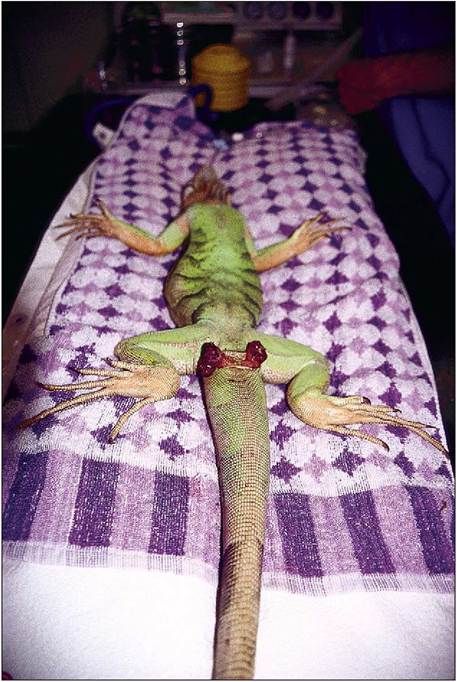
Figure 2.12 • This Green iguana (Iguana iguana) had a prolapse of both hemipenes of 3 days duration. They were necrotic so it was too late to replace them and they were surgically amputated.
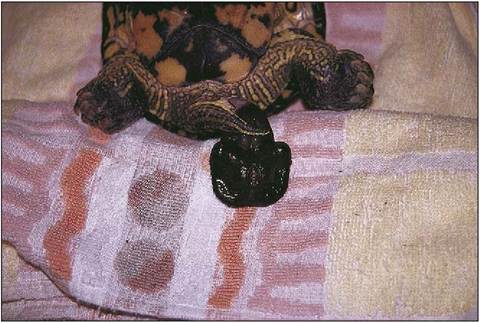
Figure 2.13 • Prolapsed phallus in a Red-eared slider (Trachemys scripta) secondary to debilitation.
2. Vitelligenic - This is the phase of rapid hypertrophy of the ovaries and oviduct. Under the influence of estrogen, yolk is produced by the liver and transported via the blood to the maturing ovary. The largest
follicles mature first and become heavily filled with yolk. Increased estrogen activity mobilizes calcium from the bone into the bloodstream and can cause serum levels to rise two- to four-fold (Campbell 1996). The increase in serum calcium is concomitant with serum lipid being drawn from the fat bodies.
3. Gravidity/pregnancy - The gestation period is from the time of fertilization to oviposition, not from the time of mating. The terms gravidity and pregnancy refer to the presence of either eggs or embryos within oviduct following ovulation. The follicle then becomes the corpus luteum, which secretes progesterone to maintain the gravid or pregnant state and inhibit oviposition or parturition.
Most species have a pre-lay shed (ecdysis) before oviposition and this is usually the signal to provide the reptile with a nest (DeNardo 1996).Sperm storage
Fertilization is always internal in reptiles. Many species of snake and turtle can store sperm so that mating can occur in one season and reproduction in the next. In these species, sperm is stored in the oviduct and fertilization is triggered when the ova enter the oviduct months later. Sperm storage can range from several months to 6 years (Bellairs 1969f; Fox 1977; Seymour 1982).
Reptiles can be oviparous or viviparous (Palmer et al. 1997). The term ovoviviparous used to be used for an intermediate stage where the embryo was ready to hatch, just as the egg was laid. It was previously thought that there was no placental transfer of nutrients in these cases but when ovoviviparous species were studied in more detail it was found that some form of exchange usually exists, render-ing the term redundant. For example, the garter snake (Thamnophis sirtalis) has placental exchange yet lays an soft membrane egg.
Chelonia and crocodiles always lay eggs, so it is only lizards and snakes that have evolved viviparity. The eggs of crocodiles, some turtles, and geckos are hard shelled while most snakes and lizards have softer more parchment-like shells (Palmer et al. 1997; Pough et al. 1998b; Thompson 1997).
Oviparity
In oviparous reptiles eggs are laid quite early and the embryos are relatively undeveloped. The eggs are white with soft, but tough, leathery shells and contain a large amount of yolk. This yolk is the only source of nutrients to the developing embryos and is rich in fat, protein, and calcium. Oviparous species can produce 2-3 clutches during the breeding season but are unable to reproduce in cold climates because low temperatures would prevent the eggs developing. Examples include most colubrids, iguanas, monitors, geckos, and all chelonia and pythons (Bellairs 1969f; DeNardo 1996; Palmer et al. 1997).
Viviparity
Viviparity involves some form of placental exchange between mother and fetus and may have evolved to help offspring survive in cooler climates (Bellairs 1969f; Palmer et al. 1997; Pough et al. 1998e). The corpus luteum is maintained and secretes progesterone, which inhibits oviduct contraction. The main disadvantage of viviparity is that the female is more vulnerable to predation during gestation and can only have one clutch a year as gestation can last from 1.5 to 6 months. The added space of the fetuses also puts pressure on the gastrointestinal tract so pregnant females dramatically lose condition (DeNardo 1996). All boas, vipers, and some skinks and chameleons are viviparous, as are temperate climate species such as the European lizard (Lacerta vivipara), garter snakes (Thamnophis spp.), and the slow worm (Anguis fragilis).
Structure of the egg
In contrast to amphibians, which have only the yolk sac, reptile eggs have three membranes and a leathery shell, which though water resistant allows gas exchange. The egg has the amniotic membrane surrounding the embryo, and the chorionic membrane, which covers the inside of the egg. The allantois membrane lies between the two and is attached to the chorion and stores the urea and/or uric acid waste products.
The eggshell is not just a protective layer but also a rich source of calcium to the developing embryo. This is particularly important for turtles, which use 80% of the eggshell to form their shell. All lizards and snakes use their modified tooth (egg tooth) to break their way out of the shell. Chelonians and crocodiles have a horny thickening of the epidermis instead, called the egg caruncle, which performs the same function.
Fat bodies
Fat bodies lie adjacent to the kidney and gonads in the caudal celomic cavity. Some reptiles from temperate climates use these to provide yolk for the first clutch of eggs after the winter. Males show similar cycles but have smaller fat bodies than females.
Maternal care
Some female Indian pythons (e.g., Python molorus) show parental care. The female coils around her clutch and generates heat by muscle shivering. This muscle twitching keeps her body temperature 7° C above ambient temperature and may last for up to 2 months. Crocodiles often guard their nest and young for up to a year. However, most reptiles do not exhibit parental care as it poses too much risk to adult survival.
KEY POINTS
• Many chelonia and lizards have temperature dependent sexual determination (TSD).
• Male lizards and snakes have two hemipenes; crocodiles and chelonia have a single phallus.
• Ovarian follicles become heavily filled with yolk from the liver.
• Sperm can be stored for years in the oviduct.