REPRODUCTIVE SYSTEM
Sexual maturity
Smaller species can reach sexual maturity in one year but larger, more long-lived species, may not be sexually mature until 5 years of age.
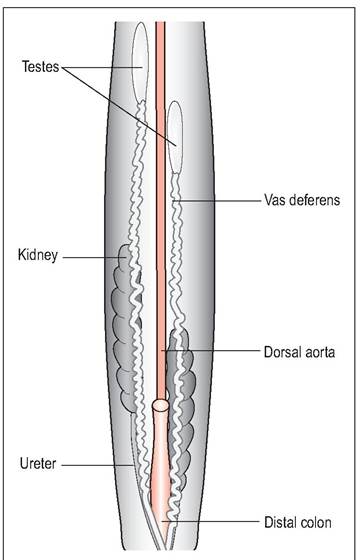
Figure 5.26 • Urogenital system of male snake (celomic fat bodies have been removed).
SEXUAL DETERMINATION
Snakes can show some sexual dimorphism, such as difference in size, but in general the signs are subtle. A number of methods are therefore used to sex snakes:
• Counting the number of subcaudal scales - The males have longer tails than females (Boidae).
• Measuring the tail base - The male tends to be broader due to the presence of hemipenes.
• Measuring the spurs - Vestigial spurs are bigger in the male (Boidae).
• Probing - In the male a probe can be inserted for about 6-10 subcaudal scales while in the female it is only 2-3 scales (Fig. 5.27).
• Everting the hemipenes - This can be done by gently squeezing the tail base or injecting saline.
Breeding season
In the wild, the breeding season is in spring in temperate and subtropical climes, after hibernation. In tropical regions the start of the wet season provides an ideal climate for egg incubation.
Male
The testes are intra-abdominal and situated between the pancreas and the kidneys. Male snakes have two hemipenes, which are paired, saclike caudal extensions of the cloaca
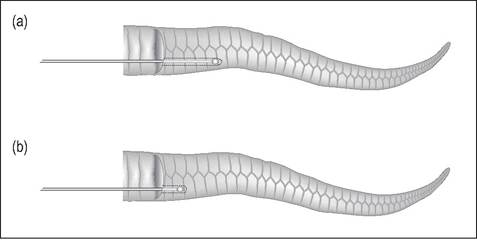
Figure 5.27 • The sex of a snake can be identified by gentle probing distal to the cloaca.
(a) A depth of over six subcaudal scales may be reached if the snake is male.
(b) A depth of less than two to three scales will indicate it is female.
and lie within the ventral tail base (Fig. 2.11). Each hemipenis has a retractor muscle that extends from the tail vertebrae to the tip and sides of the hemipene and large anal glands lie above the hemipenes.
The hemipene, retractor muscle, and anal gland are all surrounded by the larger propulsor muscle. When the hemipene becomes engorged with blood the muscle contracts to evert it out like a finger from a glove. After engorgement has subsided the retractor muscle then works to retract and invert the hemipene (Bellairs 1969g; Evans 1986; Funk 1996) (Fig. 2.11).Female
The ovaries are paired and located asymmetrically near the pancreas. The right ovary is usually larger and more cranial than the left. The left may be reduced or undeveloped. Snakes can be oviparous or viviparous (Palmer et al. 1997; Pough 1998a).
Maternal behavior
Some female Indian pythons (e.g., Python molorus) can generate a 7° C increase in heat by spasmodic contraction of the muscles as they coil around their eggs. This method is unique among reptiles and is facilitated by their large body size and the way they prevent heat loss by coiling tightly around the egg mass. Unlike mammalian shivering the muscles contractions are coordinated. At the same temperature the metabolic rate will be 20 times that of a non-brooding snake (Bartholomew 1982; Bennett & Dawson 1976).
Copulation
The male initiates courtship by moving his body over the female and rubbing his tail against her. If the female is receptive she will dilate her cloaca and raise her tail. Copulation can last from 2 to 20 hours. During copulation one hemipene is evaginated and inserted into the cloaca of the female. The hemipene has spines and ridges that enable it to remain for long periods in the cloaca. It is then withdrawn by the action of the retractor muscle. During multiple matings the male can use the right and left hemipene alternately.
Sperm storage
Some female snakes can store sperm in a cavity lined by mucosa glands near the top of the oviduct where it is kept until conditions are right. This can be stored for months or even years and explains why a snake may suddenly appear fertile in the absence of a male (Bellairs 1969g).