REPRODUCTIVE SYSTEM
Male
The male genital organs consist of the testes, accessory sexual glands, and the perineal and caudal glands. The perineal sac glands are present in both sexes but are more extensive in the male.
They lie on either side of the anus and contain extensive caseous secretions, hair and skin debris (Cooper & Schiller 1975a).The inguinal ring is permanently open. The scrotum contains the testes, epididymis, and caudal spermatic cord. The epididymis lies along the dorsolateral margin and has large fat bodies associated with its head and tail. The distal extremity of the penis contains an os penis that has two horny prongs of equal length lying in a pouch just caudoventral to the urethral opening. During erection this pouch is everted to project the two prongs. Androgen levels decrease rapidly following castration although sexual mounting behavior can last some weeks (Breazile & Brown 1976; Cooper & Schiller 1975d).
Accessory glands
These consist of the prostate gland, coagulating gland, seminal vesicles, and bulbourethral glands (Fig. 9.10). The paired seminal vesicles are large, yellow-white vermiform sacs lying in the caudal peritoneal cavity, dorsal to the bladder, and extending 10 cm cranially into the abdomen. As they are large and filled with semi-solid seminal secretions they could be confused with the female uterus. The coagulating and prostate glands lie close to the base of the vesicles. The bulbourethral glands are oval, paired glands which lie close to the urethra at the ischial arch (Cooper & Schiller 1975d).
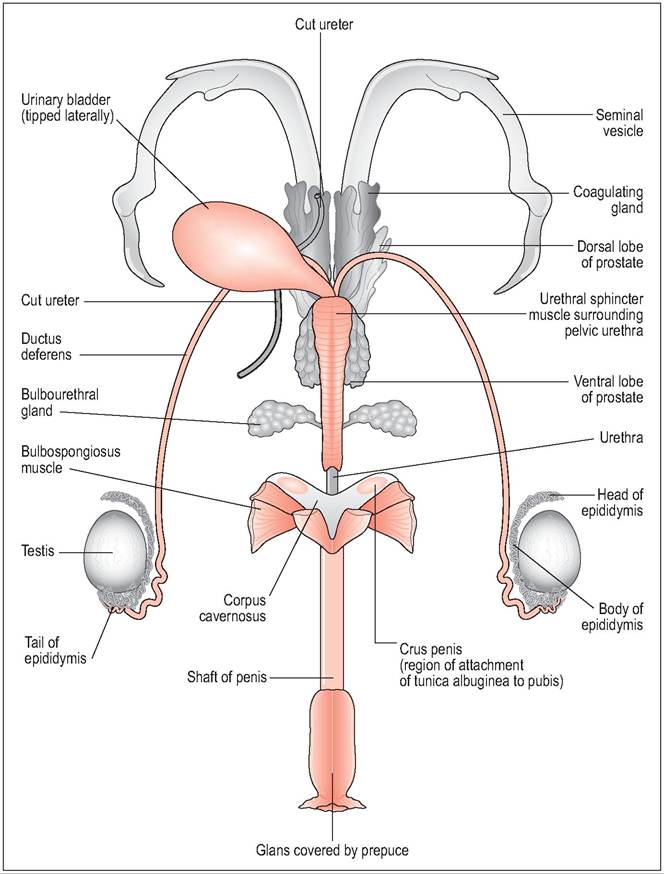
Figure 9.10 • Ventral view of the male genital tract showing large seminal vesicles.
CLINICAL NOTE
Because the male urethra transports copious seminal fluid as well as urine, aged male guinea pigs can develop cystitis and even obstructions due to occlusion of the penile urethra with coagulated seminal secretions or calculi.
Female
The ovaries are located Caudolateral to the kidneys and are supported by a short mesovarium. The oviduct lies in close contact within the ovarian bursa. There is a pink bicornate uterus, a short uterine body, and a single cervix opening into the vagina (Cooper & Schiller 1975d) (Fig. 9.11). The broad ligament (mesovarium, mesosalpinx, and mesometrium) contains a lot of fat, which makes identification of the ovarian pedicle difficult during ovariohysterectomy.
Like in most mammals, an anastomosis between the ovarian artery (a branch of the aorta) and the uterine artery (a branch of the internal iliac) occurs in the uterine mesentery. The uterine artery provides the main blood supply to the ovary (Del Campo & Ginther 1972; Harkness & Wagner 1995).
A unique feature of caviomorphs is the presence of a vaginal membrane. This is a thin, translucent epithelial membrane that seals the vaginal orifice except during copulation and parturition. It closes shortly after estrus or, if copulation has taken place, after expulsion of the vaginal plug (Breazile & Brown 1976; Cooper & Schiller 1975d).
Estrus
Guinea pigs are polyestrous, with an estrous cycle of 15-17 days (Harkness & Wagner 1995; Nowak 1999). Estrus
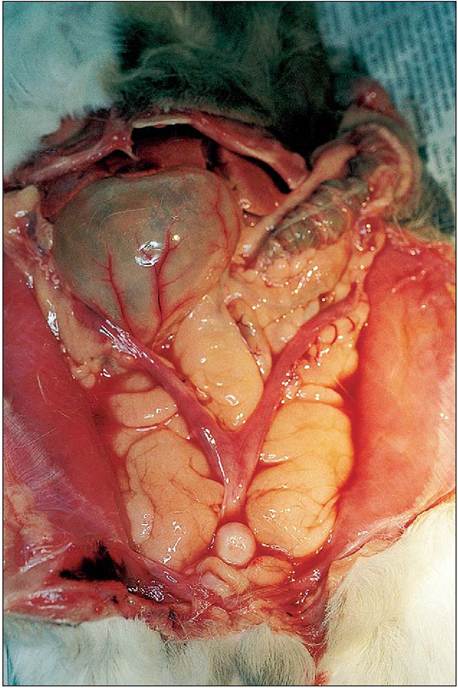
Figure 9.11 • Bicornate uterus of 2-year-old guinea pig sow.
lasts from 6-11 hours during which time the female shows lordosis, elevation of the rump, and dilation of the vulva. The vaginal membrane opens for about 2 days during this time and closes after ovulation. A thick mucus discharge can be seen. Ovulation is spontaneous and usually occurs about 10 hours into the cycle. A fertile post partum estrus lasts from 2-10 hours after parturition.
Mammary glands
There is a single pair of inguinal mammary glands. These are divided into fine lobules, which open via a number of small ducts into one large duct to the exterior.
There are two teats. In pigmented animals these glands are usually dark and hairless. The left and right mammary glands do not have a common blood supply, making mammectomy easier. Although the male has two teats the mammary glands are rudimentary (Breazile & Brown 1976; Cooper & Schiller 1975d).Sexual maturity
Puberty occurs at 2 months in the female and 3 months in the male, although males will show mounting behavior from the age of only 1 month. Females have, however, become pregnant at as early as 4-5 weeks (Nowak 1999).
CLINICAL NOTE
Cystic ovaries are common and have been identified on post mortem in 76% of female guinea pigs from 2-5 years of age (Figs. 9.12 and 9.13). They develop spontaneously and can range in size from 0.5-7.0 cm. Both ovaries are usually affected and may be single or multiloculate, and filled with clear fluid. The most effective treatment is ovariohysterectomy, preceded if necessary by percutaneous ovarian drainage.
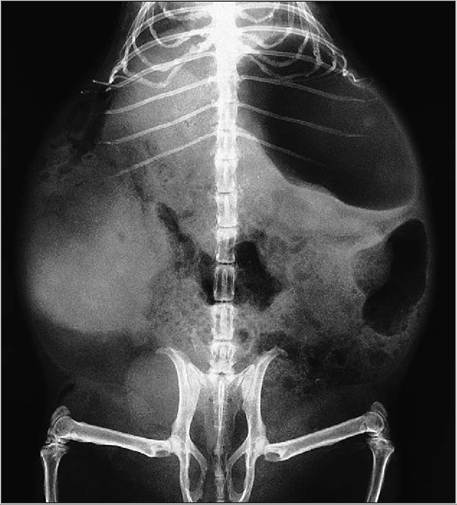
Figure 9.12 • Ventrodorsal radiograph of guinea pig with abdominal distension. Cystic ovaries were diagnosed on ultrasound. Note nonfusion of pubic symphysis.
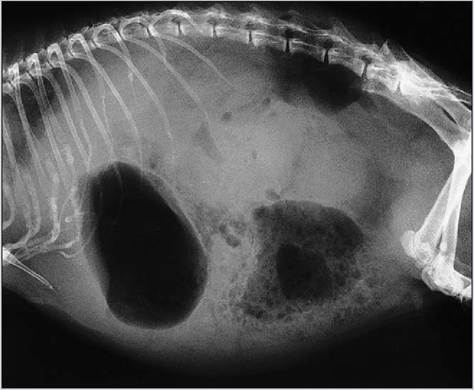
Figure 9.13 • Lateral radiograph of the guinea pig in Fig. 9.12.
Copulatory plugs
These are formed from secretions of the male seminal vesicles and sloughed vaginal epithelium. They help to prevent sperm leakage after copulation and prevent fertilization of the female by subsequent males. This plug will usually fall out of the vagina and can be found as a waxy mass on the floor a few hours post mating.
Gestation
Gestation is 59-72 days and is shorter in primiparous sows and small litters. Implantation occurs on day 6-7. The placenta is hemochorial, meaning that, as in humans, rabbits, and hamsters, the trophoblast is in contact with maternal blood supply.
It is also thought that Kurloff cells may play a role in protection of fetal cells (see Cardiovascular system). The placenta secretes progesterone on day 15 and fetuses can be palpated as early as this. Guinea pigs receive all maternal antibodies from the placenta and not from colostrum (Sisk 1976).In the latter half of the pregnancy the cartilage joining the pubic symphysis begins to dilate under the effects of the hormone relaxin. Two days before parturition the gap widens to 15 mm. By the time of parturition, the cartilage is gone and the pubis widens to about 25 mm (over 50 times its normal width) (Harkness & Wagner 1995; Sisk 1976). bulla which contains the middle and inner ear gives the guinea pig excellent hearing (Harkness & Wagner 1995).
Sight
The eyes are located in the shallow, bony orbits and lie laterally in the mid portion of the skull. They have a combined visual field of 340 degrees. The eye is embedded in fat and glandular tissue. The upper and lower eyelids protect the eye and blinking is only occasional. Unlike the rabbit, there are lacrimal puncta at both the upper and lower eyelids. The nictitating membrane is rudimentary and is just a small pigmented fold.
Orbital contents
The globe is embedded in fat and actually makes up less than half the orbit; the rest is occupied by the extraocular muscles, the lacrimal glands, zygomatic salivary gland, blood vessels, and nerves (Cooper & Schiller 1975e).
The lacrimal gland lies at the caudoventral aspect of the orbit. It drains via two canaliculi into the lacrimal sac at the rostral orbit margin. The nasolacrimal duct is quite wide but narrows near the nasal vestibule where it terminates. A richly venous ophthalmic plexus, made up of branches of the maxillary and ophthalmic veins, surrounds the eyeball (Cooper & Schiller 1975e).
Parturition and lactation
Olfaction
Birth weights vary from 45-115 g and are inversely related to litter size. The placenta is eaten by the dam and other guinea pigs. The young are weaned at a body weight of 180 g, or at 21 days of age. Milk production peaks 5-8 days post partum and ceases between days 18 and 23. Guinea pig milk consists of 4% fat, 8% protein, and 3% lactose (Harkness & Wagner 1995; Sisk 1976).
CLINICAL NOTE
Sows which are bred after 7-10 months of age do not get the same widening of the pubic bones so dystocia commonly results (Huerkamp et al. 1996).