RESPIRATORY CLEARANCE
1. Define respiratory clearance.
2. What are the physical factors that affect particle deposition?
3. What is the moving mucous blanket and what is its rate of moving mucus and contained particles?
4.
What is the size of particles that reach the alveoli?5. What are the mechanisms of alveolar clearance?
The surface area of the inner aspects of the lungs is about 125 times larger than the surface area of the body, and therefore the lungs represent an important route of exposure for many environmental substances. The inhalation of certain agricultural chemicals is a significant health hazard for which precautionary measures to prevent inhalation have been developed. The removal of particles that have been inhaled into the lungs is called respiratory clearance. There are two types, upper respiratory clearance and alveolar clearance, and each depends on the depth to which particles have been inhaled. Inhaled particles that settle out on to a membrane of the respiratory tract are said to have been deposited.
Physical Forces of Deposition
The physical forces that affect deposition are gravity, inertia, and Brownian motion. Gravitational settling (sedimentation) causes deposition of particles simply because of the force of gravity and the mass of the particle. Particles of greater mass settle out more rapidly than those with lesser mass. Inertia accounts for the deposition of particles when, because of their mass, they continue forward as the air in which they are suspended makes a turn. Considering the branching of the bronchioles, there is considerable opportunity for inertial deposition. Brownian motion accounts for the deposition of submicronic particles (less than 0.3 μm), which show a random motion that is imparted by air molecule bombardment. Deposition by Brownian motion is most significant in extremely small airways where the surface area is large relative to the airway diameter.
The percentage of particles deposited according to their size is shown in Figure 10-25.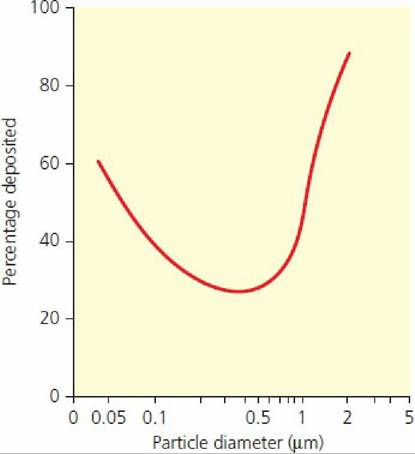
■ FIGURE 10-25 Percentage of inhaled particles of unit density deposited in the lung according to their size. Particles in the range of 0.1 to 1.0 μm are those least affected by combined Brownian motion, sedimentation, and inertial impaction. (Redrawn with permission from Morrow PE. Some physical and.physiological factors controlling the fate of inhaled substances - I. Health Physics. 1960; 2: 372.)
Upper Respiratory Tract Clearance
Removal of particles deposited cranial to the alveolar ducts is accomplished by the moving mucous blanket. This blanket of mucinous fluid is located on the surface of the epithelial cells lining the airways and is derived from alveolar fluid and mucus-secreting cells along the airways (Figure 1026). The mucous blanket contains the deposited particles and is moved toward the pharynx at a rate of about 15 mm/min by cilia of the epithelial cells. Mammals swallow the mucinous fluid and particles after they reach the pharynx.
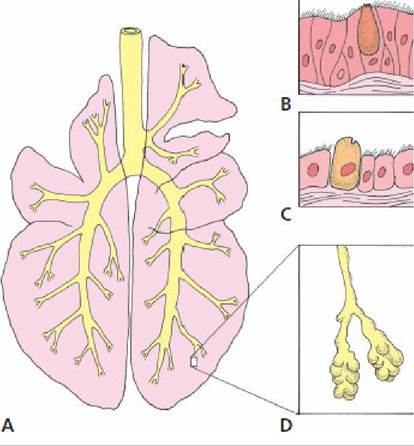
■ FIGURE 10-26 Contributors to the moving mucous blanket of the bronchial tree. The moving mucous blanket is directed toward the pharynx by action of the ciliated cells, and the secretion is provided by the goblet cells of the bronchi, the Clara cells of the bronchioles, and alveolar fluid. A. Outline of the bovine lung superimposed over the bronchial tree. B. Pseudostratified epithelium of the bronchi, composed of secretory (goblet) cells, ciliated cells, and basal cells. C. Cuboidal epithelium of the terminal bronchioles, composed of ciliated cells and secretory (Clara) cells. D. The terminal bronchiole is the most distal air passage free of alveoli.
Alveolar Clearance
Particles can escape gravitational and inertial forces and be deposited in the alveoli.
These particles are usually smaller than 1 μm in diameter. The mechanisms of alveolar clearance of these particles can be summarized as follows:1. After their deposition in the alveoli, they can be phagocytized by a macrophage or can continue as free particles. The “dust”-laden macrophage or free particles might be directed to the moving mucous blanket along with the alveolar fluid film.
2. Particles might enter the interstitial space of the alveoli and be transported to lymph nodes in series with the lungs.
3. Particles might be dissolved and transferred in solution, either into the lymph or into the blood.
4. Some particles might not be phagocytized or might be insoluble. Instead, they could stimulate a local connective tissue reaction and be sequestered (isolated) within the lung. Examples of this include the conditions known as asbestosis and silicosis. Dogs and cats living in highly industrialized areas can show signs,of anthracosis caused by inhalation of coal dust.
The importance of respiratory clearance is apparent when considering the exposure of livestock to the aerosols emanating from feedlot dust or other confinement sources. The aerosols can be combined with bacteria and viruses, so their prompt removal can help to prevent diseases caused by them. Similarly, the removal of irritant substances prevents lung disease and protects lung efficiency.
■