RESPIRATORY SYSTEM
The nasal cavity is involved not only with respiration but with humidifying and filtering incoming air. As in all rodents, it also plays a major role in olfaction. Over 50% of the nasal cavity is lined by olfactory epithelium, giving rats their acute sense of smell.
In contrast, man has only 3% of the nasal cavity lined by olfactory epithelium (Harkema & Morgan 1996). The vomeronasal organ, which lies about 10 mm from the vestibule in the ventral vomer bone, also plays a role in olfaction (Harkema & Morgan 1996; Hebel & Stromberg 1986d).The length of the trachea from first cartilage to bifurcation is 33 mm. It is a flattened oval in cross-section and is 3?2 mm wide (Hebel & Stromberg 1986d). The right lung has a cranial, middle, caudal, and accessory lobe. The left lung is smaller and not divided into lobes. Due to its small size the heart is quite accessible on the left side, so cardiac puncture could be achieved between ribs 3 and 5 (Figs. 10.14 and 10.15).
Steno's gland
The rat has several well-developed nasal glands but the largest is Steno's gland. This lies in the rostral maxillary sinus and its duct empties at the vestibule. This gland is homologous with the salt gland of marine birds. It produces a watery secretion at the nose where it may help to humidify inspired air and regulate mucus viscosity (Bivin et al. 1979; Sharp & LaRegina 1998).
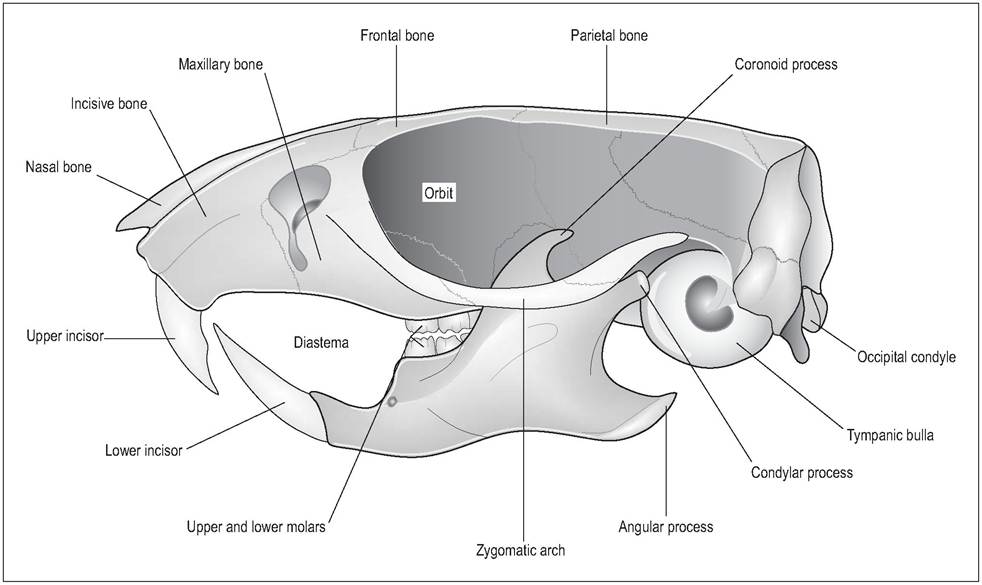
Figure 10.10 • Lateral view of rat skull. From Popesko, P., Rajtova, V., & Horak, J. (1990) A colour atlas of anatomy of small laboratory animals. Vol. 2. Aylesbury, UK: Wolfe with permission.