Rumen Fermentation Is Maintained by Selectively Retaining Actively Fermenting MaterialWhiIeAIIowing Unfermentable Residue to Pass on to the Abomasum
The walls of the reticulorumen are muscular, possess an extensive intrinsic nervous system, and are capable of highly complex and coordinated motility patterns. The selective ruminal retention of fermenting material and the release of Unfermentable residue are accomplished by these motility patterns.
An understanding of reticulorumen anatomy is necessary to appreciate the effects of reticulorumen motility patterns. Figure 31-7 illustrates the division of the reticulorumen into compartments, or sacs. These divisions are created by muscular pillars that project into the lumen of the organ. The reticular fold and rumen pillars, in addition to the walls themselves, are motile. During reticulorumen contractions the pillars alternately elevate and relax, either accentuating or reducing the divisions within the lumen of the reticulorumen. Students accustomed to studying the reticulorumens of embalmed specimens may find it difficult to visualize the extent of rumen movement. At times during contractions, the excursions of the walls and pillars are so great that the total shape of the reticulorumen is distorted; sacs and compartments are almost obliterated, and pillars elevate to the extent that compartmental divisions become nearly complete. When the magnitude of these contractions is recognized, it is not difficult to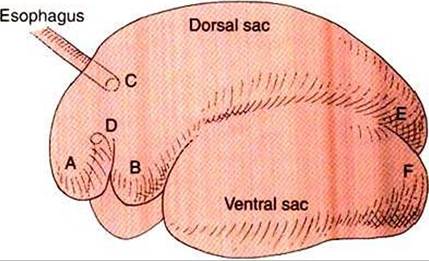
FIGURE 31-7 Rumen anatomy. A, Reticulum; B, cranial sac; C, cardia; Dt reticulo-omasal orifice; Et caudal-dorsal blind sac; Ft caudal-ventral blind sac.
appreciate the tremendous effect that reticulorumen motility has on the flow of rumen ingesta.
Two patterns of reticulorumen motility are generally described: primary (or mixing) contractions and secondary (or eructation) contractions. Primary contractions start with a double, or biphasic, contraction of the reticulum.
In the first phase of this reticular contraction, the organ is reduced to about half its relaxed size, whereas the second contraction is strong, nearly obliterating the lumen of the reticulum. The next action of the primary contraction pattern is a caudal- moving peristaltic contraction of the dorsal sac. On completion of the dorsal sac contraction, a similar caudal-moving contraction of the ventral sac occurs, followed by a cranial- moving contraction of the dorsal sac. The primary contraction pattern is completed by a cranial-moving contraction of the ventral sac (Figure 31-8). The primary contraction pattern serves to mix ingesta and to aid in the separation of large and small particles. Secondary contractions, when they occur, follow immediately after the primary contractions.Secondary contractions consist of a cranial-moving wave that starts in the caudal-dorsal blind sac and continues over the dorsal sac (Figure 31-8). The function of the secondary contraction is to force gas toward the cranial portion of the rumen. As the secondary contraction moves gas toward the cardia, the cranial sac relaxes and the cranial pillar elevates, allowing liquid ingesta to move away from the cardia so that gas can enter the esophagus and be eructated. Secondary contractions are important because large amounts of gas, primarily CO2 and CH4, are formed during fermentation and must be removed rapidly to prevent distention of the rumen.
In general, one to three reticulorumen contractions occur per minute. Contractions occur most frequently during eating and disappear entirely during deep sleep. The rate and strength of contractions depend on the character of the diet: coarse, fibrous feeds stimulate the most frequent and strongest contractions. Secondary contractions usually occur in association with half the primary contractions, although this relationship is variable and depends on the rate of gas formation. Reticulorumen contractions have an important influence on the flow of fluid and particulate matter through the rumen.