Saliva Moistens, Lubricates, and Partially Digests Food
As food is chewed, it is mixed with salivary secretions that allow it to be molded into well-lubricated boluses that facilitate swallowing. In addition, saliva may have antibacterial, digestive, and evaporative cooling functions, depending on the species.
The antibacterial activity of saliva results from antibodies and antimicrobial enzymes known as lysozymes. Initially, you may think that the antibacterial properties of saliva are inefficient because the mouth normally contains a large, thriving population of bacteria. However, saliva aids in keeping this population in check, and animals with impaired salivary function are prone to infectious diseases of the oral cavity.
In omnivorous animals, such as rats and pigs, saliva contains a starch-digesting enzyme known as salivary amylase. This enzyme is usually absent from the saliva of carnivorous animals, such as cats. The saliva of some species also contains a fat-digesting enzyme known as lingual lipase. This enzyme is frequently present in young animals, such as calves, while they are on a milk diet; the enzyme disappears as they mature.
Salivary enzymes probably have their major digestive effect in the proximal stomach, because food is not retained in the mouth long enough to permit extensive digestion. The lack of mixing activity in the proximal stomach may be essentia) for the starch-digesting function of saliva. This is because the amylase enzyme is functional at neutral to slightly basic pH, which characterizes saliva. The low pH of the distal stomach probably inactivates the enzyme; therefore it may be important that food entering the stomach initially not be mixed with gastric secretions, so as to allow the salivary enzymes some time to work before being inactivated by gastric acid. Some birds have salivary amylase that is active in the environment of the crop.
The evaporative cooling function of saliva is covered in Chapter 53.
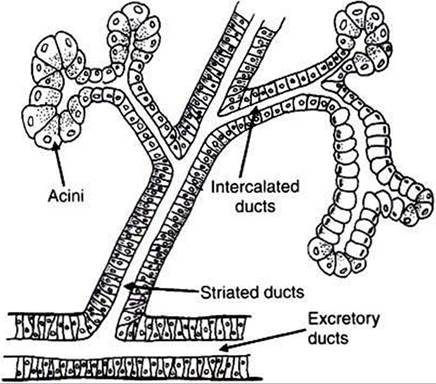
FIGURE 29-1 Schematic illustration of the salivary gland. Saliva is initially secreted by the acinar cells and is then modified as it passes through the intercalated, or collecting, ducts. Modification of acinar secretions by duct epithelia is a physiological phenomenon common among several types of glands, including the pancreas.