SENSES
Parietal eye
The parietal eye (sometimes incorrectly called the pineal eye because the nerve connecting the parietal gland to the brain enters at the base of the pineal gland) is well developed in some species like the Green iguana (Iguana iguana).
It is located on the dorsal midline of the head, beneath the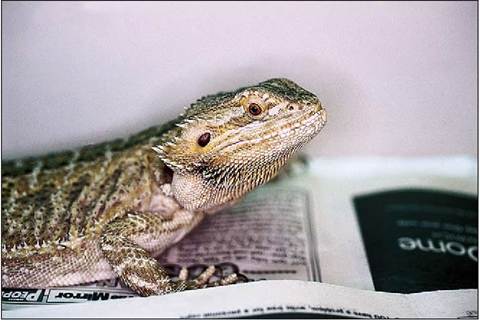
Figure 4.30 • Bearded dragon (Pogona vitticeps) showing lack of external
ear.
External adnexa
Eyelids are present, except in some gecko species. [The very popular Leopard gecko (Eublepharis macularis) does have movable eyelids.] As in birds, the eyelids are unequal in size. The upper lid has little mobility so it is the lower lid which moves upward to cover the majority of the surface of the eye. In some species this can be transparent so some vision is possible even when the eye is closed. A nictitating membrane is present with a Harderian gland opening medially. Two lacrimal canaliculi are present at the rostromedial margins of the lower lid (Bellairs 1969f; Underwood 1970).
The pupil is usually round and relatively immobile in diurnal species but slit-like in nocturnal species. Many geckos have a serrate pupillary opening that results in a series of small holes when the pupil is completely closed. The retina of diurnal lizards has only cones, whilst nocturnal geckos have more rods. The highly vascular conus papillaris (similar to the pecten of birds) originates from the head of the optic nerve (Williams 1996). A fovea centralis, a depression in the retina, gives acute vision and is often present in diurnal species (Barten 1996).
CLINICAL NOTE
Some lizards like the Tokay gecko (Gekko gecko) and the oscellated skinks (Ablepharus spp.) have fused eyelids that form a spectacle, as in snakes (Bellairs 1969f; Williams 1996).
In these species the lacrimal glands secrete into the subspectacular space, which is then drained by the nasolacrimal duct. Infections here can lead to subspectacular abscesses where the fluid cannot drain away.Olfaction
The Jacobson’s organ located in the roof of the mouth is highly sensitive and innervated by a branch of the olfactory nerve. The tongue is used as an organ of both taste and smell (Parsons 1970).
provides the water-conserving properties. In some species like skinks (Scincidae spp.) the scales are attached to underlying dermal bony plates called osteoderms, which give added protection and support and which are identifiable on radiographs (Bellairs 1969e; Lillywhite & Maderson 1982).
CLINICAL NOTE
These osteoderms can appear like radiopaque densities on radiographs and should not be confused with lung metastases.
Scales can be modified into crests, sharp spines, dewlaps and shields for sexual display or territorial conflict. In between the scales, the skin is thin and folded to allow for expansion (hinges or scale pockets). The dermis contains the chromatophores, which provide the elaborate range of skin coloration, most particularly notable in the chameleon.
Ecdysis
At ecdysis, scales are shed piecemeal and many lizards will rub against hard objects to shed the molting layer. Many show altered behavior like hiding away, cessation of eating, and fading of color (Fig. 4.31). Many lizards also use a swell mechanism to help the dead skin slough off. This is when venous return to the heart is restricted by muscles constricting the internal jugular vein. This causes the head to bulge, particularly around the eyes which have large venous sinuses. Other lizards are also capable of inflating their bodies with air (Bellairs 1969e; Evans 1986; Perry & Duncker 1978; White 1976).
Skin glands
The skin has few glands but many lizards like the Green iguana have femoral pores in a single row on the ventral aspect of the thigh. These are not true glands but are tubular skin invaginations that produce a waxy secretion. They are larger and more developed in the male and can be helpful in sexual determination. Many gecko species also have precloacal pores, which lie in a v-shaped row anterior to the cloaca and are more pronounced in males.
KEY POINTS
• Large ventral abdominal vein
• Acrodont or pleurodont teeth
• Herbivorous species have large colon and slower gut transit times
• Good hearing and vision