REPRODUCTIVE SYSTEM
CLINICAL NOTE
Breeding season
In many lizards from temperate climates the gonads reach maximum size on emergence from hibernation and are smallest during the summer months.
In tropical climates the breeding season coincides with the start of the wet season, so there is moisture for egg incubation and an abundant food supply for hatchlings (DeNardo 1996).Male
Nephromegaly can result in obstruction of the colon as it passes between the kidneys. This is quite common in aged green iguanas (Barten 1996).
The testes are located cranial to the kidneys and attached to the dorsal wall by a mesorchium. In some species of male lizard, the kidney has a posterior sexual segment that becomes swollen
SEXUAL DETERMINATION
• Sexual dimorphism - Many adult species are sexually dimorphic with males being more brightly colored and often possessing crests, throat fans, etc. The male iguana has taller dorsal spines and larger dewlaps; male chameleons have elaborate horns, crests, and plates on their head. Femoral or pre-cloacal pores are also more prominent
in the males (DeNardo 1996) (Fig. 4.27).
• Sexual probes - These can be used but are not as accurate as in snakes.
• Eversion of the hemipenes - This can be done by injecting saline into the cloaca in species like monitors, tegus, and large skinks, which are difficult to sex (DeNardo 1996).
• Endoscopy - This can be used to examine the gonads.
• Radiography - The hemipenes of some male monitor lizards can calcify and be seen on radiographs.
• Ultrasonagraphy - This can be used to examine the hemipenes or ovaries/follicles.
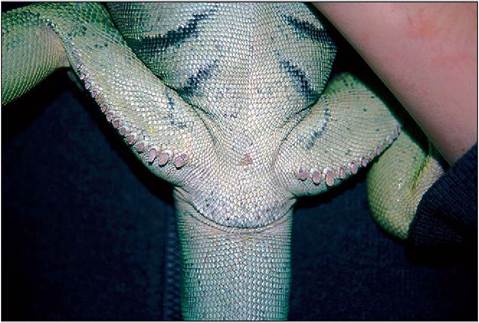
Figure 4.27 • View of medial hindlimbs of Green iguana (Iguana iguana) showing prominent femoral pores in the male.
CLINICAL NOTE
The adrenal glands are suspended in the mesovarium and mesorchium so must be carefully avoided during neutering.
The right testis is intimately associated with the vena cava so ligation is best achieved with surgical hemoclips.during the breeding season and contributes to seminal fluid. The right testis lies cranial to the left and is intimately connected with the vena cava by short blood vessels of 1-2 mm. The left testis has its own testicular blood vessels which lie close to the left adrenal gland (Bennett & Mader 1996) (Fig. 4.28).
The male has paired hemipenes, which are stored in the tail base and can be visualized externally by bulges at the ventral proximal tail. Only one hemipene is used during copulation. The organ is erected by vascular engorgement and muscular action and everted to protrude through the
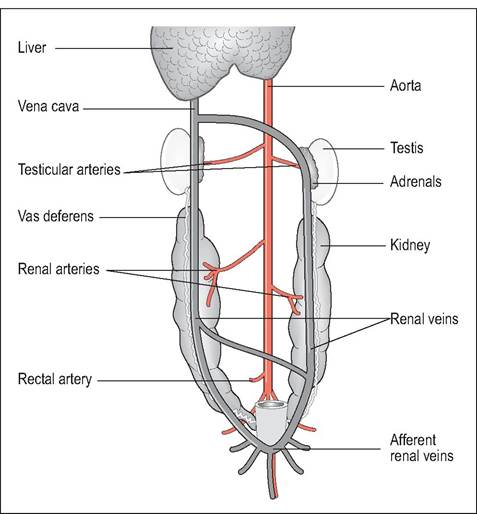
Figure 4.28 • Location of testes and kidneys in the male lizard.
cloaca. Sperm passes from the vas deferens into the male urodeum and is then carried in a groove down the hemipene to be deposited into the female cloaca (Bellairs 1969g).
CLINICAL NOTE
The hemipene is solely an organ of reproduction; hence, amputation of prolapsed hemipenes is possible if they are non viable and cannot be replaced internally (Fig. 2.12).
Female
The female has paired ovaries and oviducts, which lie at the same level cranial to the kidneys (Fig. 4.29). The ovary consists of a cluster of oocytes lines by a thin mesovarium. The oviduct is pleated and has a wide infundibulum. As with the testes, the right ovary lies close to the vena cava and is attached to it by tiny blood vessels. The left ovarian blood supply lies close to the left adrenal gland (Bennett & Mader 1996).
CLINICAL NOTE
When ovulation does not occur the mature follicle remains causing preovulatory retention or follicular stasis. Postovulatory retention is when the ova lies within the oviduct and the lizard is egg bound (Barten 1996).
Oviparity
In oviparous species the eggs are retained within the mother until birth.
This is the more usual state for lizards and is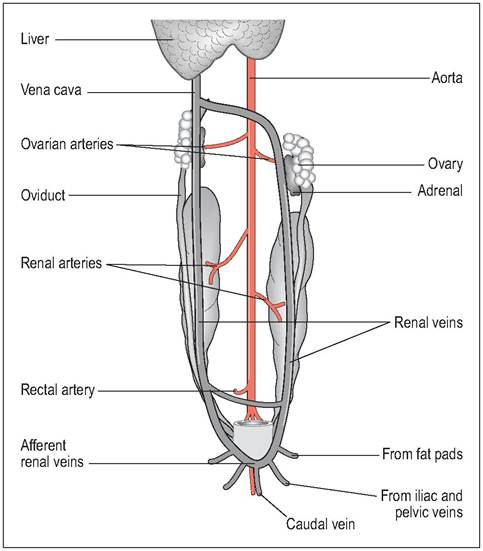
Figure 4.29 • Location of ovaries and kidneys in the female lizard.
skin in the parietal foramen, and consists of a degenerate eye containing a lens and retina. Although it does not form images it connects with the pineal gland and may play a role in thermoregulation, reproduction, and basking time (Evans 1986; Firth & Turner 1982).
Hearing
There is no external ear apart from a fold of skin in some species (Fig. 4.30) and the tympanic membrane is usually visible in a shallow depression on the side of the head (Murray 1996). In some species it is covered with a thin transparent membrane, the outer layer of which is shed during ecdysis. Airborne vibrations are picked up by these membranes and transmitted via the columella to the inner ear. Hearing is better than in snakes and chelonians but sensitive to only a narrow range of low-frequency sounds. Geckos have the best hearing of all lizards, which may fit in with the fact that they are also the most vocal. Some burrowing lizards have no external or middle ear but, like snakes, transmit sound by bone conduction (Baird 1970; Bellairs 1969f; Murray 1996).
Some gecko species (Phelsuma spp.) store calcium in endolymphatic sacs which can appear as white swellings on either side of the neck. This calcium can be mobilized for egg laying.
seen in Gekkonidae and Iguanidae. The normal clutch size is from 3 to 15. Eggs are covered by a leathery shell and can appear a bit shrunken when laid (Bellairs 1969g; DeNardo 1996; Palmer et al. 1997; Pough 1998b; Thompson 1997).
Viviparity
About one fifth of lizards are viviparous. The fetus is retained within the oviduct where there is a primitive placental type of circulation. The common European lizard (Lacerta fragilis) is viviparous (Bellairs 1969g; DeNardo 1996; Palmer et al. 1997; Thompson 1997).
Sight
The majority of lizards are insectivorous so need keen eyesight to catch prey. Lizards have good color vision but only a narrow binocular field, so this is why they typically cock their head to one side to get the best monocular vision. Chameleons have the best vision of all, having excellent binocular and monocular vision (Bellairs 1969f).
A thin interorbital septum separates the large orbits. As in chelonians the sclera is supported by a ring of small bones called ossicles. This allows for attachment of ciliary muscles and keeps the shape of the globe (Underwood 1970).
GENERAL INTEREST
A few species of lizards are parthenogenic. These lay unfertilized eggs that produce only female young, genetically identical to the parent. This “virgin birth” can occur in some Asian lacertids (Lacerta spp.) and North American whiptails (Aspidoscelis, prev. Cnemidophorus) (Evans 1986).