SENSES
The rat, being mainly nocturnal, has a well-developed sense of hearing, touch, and smell, but vision is poor (Sharp & LaRegina 1998). Albinos have especially poor eyesight due to retinal degeneration.
Sight
The eyes are small and placed laterally. Although it can see through 360 degrees the rat has a blind spot in front of its nose. The cornea is large and the large lens is round, with little power of accommodation. The retina is rod dominated (as would be expected in nocturnal species) and holan- giotic, with radial vessels and a centrally located optic disk. Although the rat does not move its eye, the ocular muscles are quite well developed. Unlike other rodents, a venous orbital sinus is not developed but there is a venous plexus formed by the anastomoses of the dorsal and ventral ophthalmic veins (Hebel & Stromberg 1986f). role in ocular lubrication and pheromone behavior and are spread over the skin during grooming. This hypersecretes when the rat is stressed, creating a red-brown deposit around the eyes and nose known as chromodacryorrhea (Harkness & Wagner 1995; Hebel & Stromberg 1986f) (Fig. 10.25).
Lacrimal gland
The rats has two pairs of lacrimal glands: the extraorbital and the infraorbital. The extraorbital is located at the base of the ear, rostrodorsal to the parotid gland. It is flattened and disklike. The infraorbital gland is located at the caudal orbit. The duct of both glands join to open into the conjunctiva at the lateral canthus of the eye (Bivin et al. 1979; Hebel & Stromberg 1986f; Komarek et al. 2000b; Sharp & LaRegina 1998).
Hearing
Rats can hear sounds of high frequency (60-80 kHz) and use ultrasound frequencies for social vocalizations. They have a high pitched squeak with two types of call: one above 20 kHz (the limit of human hearing) and one at 50 kHz. Both males and females use the 50 kHz sound during copu- latory behavior.
Ultrasonic vocalizations (80 kHz) are used for maternal-young interactions, sexual-territorial interactions or as a warning signal. Rats can produce this noise by a whistling associated with respiration (Koolhaas 1999).Eyelids
The palpebral fissure opens between the 14th and 17th days after birth. The eyelids are covered by hair. Two lacrimal ducts open at the puncta located at the medial canthus of the eye and these join to form the 22 mm long nasolacrimal duct, which opens just caudal to the nostril in the vestibule (Hebel & Stromberg 1986f).
Harderian gland
This conical, red-brown gland lies behind the eye and fills a large part of the orbit. It is larger than the eye itself and its excretory ducts fuse to form one single duct that empties into the medial canthus of the eye behind the nictitating membrane (Bivin et al. 1979; Komarek et al 2000b). This gland secretes lipids and a porphyrin red pigment which fluoresces under ultraviolet light. These secretions play a
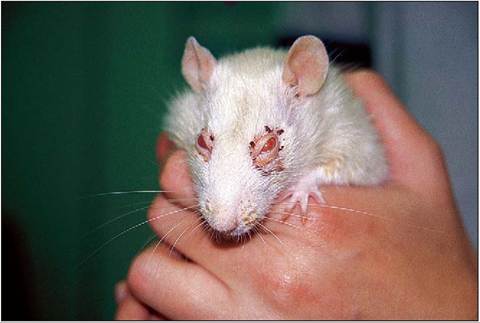
Figure 10.25 • Chromodacryorrhea in an aged rat. Stress or illness causes the Harderian gland to hypersecrete a porphyrin red pigment creating the impression of red tears.
Ears
The pinna is covered by thin, short hairs. The tympanic cavity is large, as in most rodents. A gland called the zymbal gland lies at the ear base (Hebel & Stromberg 1986f).
CLINICAL NOTE
As humans cannot hear high frequencies care should be taken with high pitched and ultrasound noises emitted from equipment like televisions, video recorders, and computers. Fire alarms have been found to affect estrous cycles in rats, so makes of lower frequencies have been designed for use in laboratories (Gamble 1976). Rats are less sensitive than humans to noises below 1000Hz so will be less affected by noises like air conditioning (Baker 1979).
Olfaction
The olfactory lobes of the brain are large and over 50% of the nasal cavity is lined by olfactory epithelium, giving rats their acute sense of smell.
Rats, like all rodents, use their scent glands, feces, urine, and vaginal secretions for olfactory communication.CLINICAL NOTE
Rats, like all rodents, are obligate nose breathers and rely on healthy nares not only for respiration but also for olfaction and feeding. Hence, the rapid debilitating effects of respiratory disease (Harkema & Morgan 1996).
The epidermis is thin and mostly covered with hairs. The dorsal skin has a higher water content but less lipid than the abdominal skin. Numerous mast cells are found throughout the dermis and subcutis (except the tail). The subcutis should only contain moderate amounts of white fat. Brown fat is deposited between the scapulae, ventral neck and axillae in the thoracic inlet and inguinal region (Hebel & Stromberg 1986e; Komarek et al 2000b).
Skin glands
The sebaceous glands are found around the hair follicles. Modified sebaceous glands are found in the region of the oral commissure, the anus and prepuce, and around the teats. Auditory sebaceous glands, called Zymbal's glands open into the external ear canal (Hebel & Stromberg 1986e).
Sweat glands are only found around the footpad where they help in creating friction. The epithelium of these glands has only one cell type and so are unique among comparable species (Hebel & Stromberg 1986e). Rats have no specialized scent glands but produce pheromones through urine, feces, milk, and skin. These affect reproductive behavior, dominance, and territorial behavior.
Zymbal's gland
These are large modified sebaceous glands that surround the base of the ear. Tumors of this gland can occur as an ulcerated mass within the external ear canal and these may become so large as to involve the whole face and neck (Altman & Goodman 1979).
CLINICAL NOTE
Touch
The vibrissae are extremely sensitive to touch and are as sensitive as the fingertips of primates. These, combined with the acute sense of smell, compensate for the lack of vision. They are used continually in order to gauge distance and in locomotion (Koolhaas 1999).