ENDOCRINE ORGANS
Pituitary gland
This reddish-brown organ is located in a bony cavity, the sella turcica, ventral to the diencephalon, and caudal to the optic chiasma.
CLINICAL NOTE
Tumors of the pituitary glands are extremely common in ageing rats, with more females than males being affected (Altman & Goodman 1979; Percy & Barthold 2001).
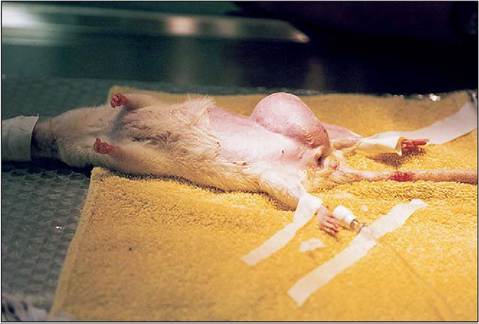
Figure 10.24 • Rat undergoing surgery to remove large inguinal tumor. Histopathology revealed a benign fibroadenoma.
Thyroid gland
The thyroid lobes lie ventrolateral to the first 4 to 5 tracheal rings and consists of two pinkish lobes connected by a delicate isthmus (Komarek et al 2000).
Parathyroid
The rat has only one pair of parathyroid glands, which usually lie at the cranial aspect of the thyroid gland. They are circular and paler in color.
Adrenal glands
These are brown and beanlike and lie in the retroperitoneal fat close to the cranial pole of each kidney and attached to
Table 10.1 Interpretation of vaginal smears in the rat (Sharp 1998; Baker 1979)
| Phase of cycle | Length (hours) | Vaginal cytology | Presence of Leukocytes |
| Proestrus | 12 | Nucleated epithelial cells | Small number |
| Estrus | 12 | Cornified cells, no nuclei | Small number |
| Metestrus | 21 | Cornified epithelial cells | Large numbers |
| Diestrus | 57 | Few epithelial cells | Large numbers |
the ventral sublumbar muscles. The right adrenal is covered by the caudate lobe of the liver. The left adrenal lies nearer to the midline than the right. The adrenal gland is larger in the female than the male. Wild rats also have larger adrenals than domesticated laboratory rats (Bivin et al. 1979; Percy & Barthold 2001).