SENSORY RECEPTOR RESPONSES
1. Do sensory receptors respond to more than one energy type?
2. Does a sensory receptor have only one level of response?
3. Differentiate between a phasic and a tonic receptor.
Are muscle spindles tonic or phasic receptors?A sensory receptor is the peripheral component of an afferent axon and the centrally located nerve cell body of that axon. Some examples of sensory receptors are shown in Figure 5-1. Sensory receptors convert different types of energy into action potentials; these include sound, light, chemical, thermal, and mechanical energy. Generally, the receptors are specific in that they respond more readily to one form of energy than another. For example, a Golgi tendon organ (responding to tension) would not generate an action potential if light touch were applied; in such a case, Meissner corpuscles would respond.
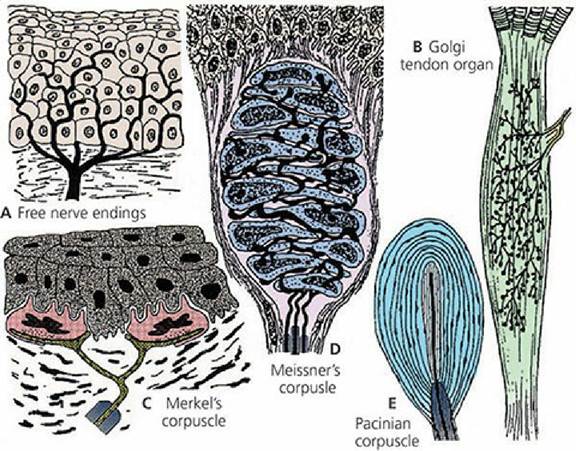
■ FIGURE 5-1 Schematic drawings of five sensory receptors. A. Free nerve endings branch among the cells of the epidermis. B. Golgi tendon organs (a neurotendinous spindle) splay among the collagen bundles of a tendon and are activated by tension. C. Merkel’s corpuscle that ends in epidermis are pressure-sensitive touch receptors. D. Meissner’s corpuscle in dermis. These are highly sensitive for light touch. E. Pacinian corpuscle in dermis are extremely sensitive to transitory pressure such as vibratory stimuli. (From Eurell JA, Frappier BL. Dellmann’s Textbook of Veterinary Histology. 6th edn. Ames, IA: Blackwell Publishing, 2006.)
Graded Responses
Sensory receptors are subject to graded responses, depending on the intensity of the stimulus. The receptor can be regarded as a generator in which the amount of voltage produced is determined by the stimulus. If the voltage generation reaches threshold for the receptor, a nerve impulse (afferent) is created.
As the intensity (amplitude) of the stimulus increases, the frequency of firing increases.Adaptation
Receptors might not continue to fire at a rate consistent with the intensity of the stimulus, but they are subject to adaptation. The response to a prolonged stimulus might at first show a burst of action potentials at a high frequency, followed by a decrease in rate that quickly returns to zero. Receptors vary as to the degree of their adaptation. The previous response, in which the rate of discharge returns to zero, is characteristic of pacinian corpuscles (sensitive to pressure). This is an example of a phasic receptor organ - that is, one that quickly accommodates to prolonged stimulation. A rapidly adapting receptor is best suited for signaling sudden changes in the environment or vibratory fluctuations. The muscle spindle, which responds to stretch, is an example of a tonic receptor organ with regard to its adaptation. The application of a prolonged stimulus to the muscle spindle elicits a brief volley of action potentials at a high frequency, followed by an action potential rate that slows to a lower level and that is maintained throughout the duration of stimulus. This is known as a tonic receptor organ in the same sense that muscle tone (the result of muscle spindle stimulation) represents a continuous state of low-level muscle tension.
■