PAIN
1. What is the name for receptors specific for pain?
2. Can a receptor for cold or heat send an afferent impulse to the cerebral cortex to be recognized as pain?
3. What are the most sensitive visceral structures that produce pain?
4.
How is pain that arises from the intestines produced?5. What is a good example of referred pain in cattle?
Pain is a protective mechanism. Its sensation is aroused by damaging or noxious stimuli from almost all parts of the body, with the exception of the central nervous system (unless there is damage to the pain pathways). The specific receptors for pain are called nociceptors. Pain sensation does not arise from overstimulation of receptors that subserve a different sensation. The receptors are bare nerve endings (see Figure 5-1) of sensory neurons (pain neurons) that respond to all intense stimuli. The nerve endings are essentially chemoreceptors and the pain stimulus (e.g., thermal, chemical, mechanical) produces cell injury, which produces a chemical reaction and causes the nerve to fire. Pain fibers are either myelinated or unmyelinated. The myelinated fibers have a short lag time between stimulus and reaction, and the pain has a so-called bright quality, whereas unmyelinated fibers have a longer lag time and the pain is more diffuse, with an aching, throbbing quality. Pain fibers, as are the fibers for other sensory modalities, are grouped in a specific tract of the spinal cord.
The reaction threshold for pain is highly variable among individuals. What is painful to one animal might not be so in another. Furthermore, the diversion of attention from a pained part or painful situation reduces pain perception. This can be demonstrated when a twitch (a handle with a rope loop at one end) is applied to the upper lip of a horse and tightened. The attention to discomfort of the twitch detracts from pain or manipulation of other body parts.
Visceral Pain
Pain does arise from the viscera (the organs within the abdominal, thoracic, and pelvic cavities); the most sensitive parts are the peritoneal and pleural linings of the abdominal and thoracic cavities, respectively. Peritonitis and pleuritis (inflammation of the peritoneum and pleura) evoke severe pain. Some of the thoracic viscera (the heart) might be a source of pain, whereas other viscera (the lungs) might not. Pain from hollow viscera (the intestines) within the abdomen is evoked by severe distention or powerful contractions (spasms). Normal distensions or contractions can be innocuous, but an inflammation can cause these to become painful.
Referred Pain
Referred pain is pain that is felt on the surface of the body. It usually has its source within the thoracic or abdominal viscera. It is caused by a convergence of cutaneous and visceral pain afferent fibers on the same neuron at some point in the sensory pathway (Figure 5-2). The pain can be identified consciously as cutaneous (referring to the skin) because a previous cutaneous pain was actually seen and perceived as being cutaneous. When the pain source is of visceral origin, however, it is mistakenly perceived as coming from the site of the relevant cutaneous fibers (referred) because their common neuron has the same cerebral projection. Traumatic pericarditis (inflammation of the pericardium caused by perforation from the reticulum) in cattle is a form of referred pain. Pressure applied to the withers causes a painful response in cattle with traumatic pericarditis, whereas a minimal response would be noted in normal cattle. The cutaneous stimulation is additive to that coming from the inflamed heart sac because of the convergence of the nerve fibers.
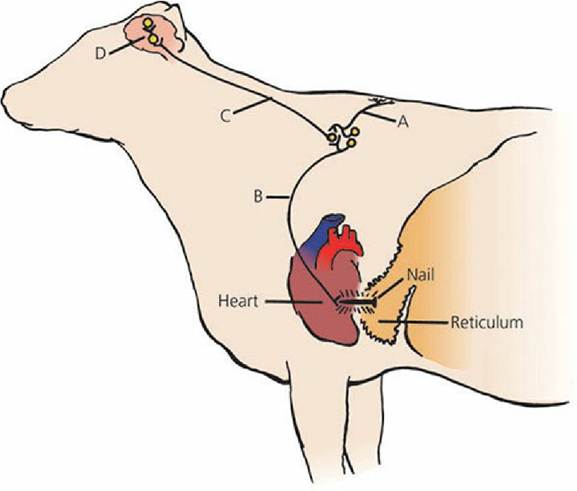
■ FIGURE 5-2 The sensory pain pathway. A cutaneous pain afferent fiber (A) and a visceral pain afferent fiber (B) converge on a common neuron (C). Neuron (D) conveys the pain impulse from the thalamus to the cerebral cortex.
■