Sensory Receptors
sensory experiences begin at receptors, specialized cells or nerve endings that detect a particular aspect of the internal or external environment. They are the mechanism by which the nervous system changes some sort of environmental energy (e.g., heat, pressure, light) into the electrical activity of neurons, a process called transduction.
in somatosensory systems, the receptor is usually a specialized peripheral terminal of the primary afferent neuron (the sensory neuron extending from the central nervous system [CNs] to the periphery); for the special senses, the receptor is usually a separate specialized neural cell that synapses with the primary afferent. As described earlier, sensory receptors may be described by the origin of the stimulus: exteroceptors (external environment), intero- ceptors (visceral organs), and proprioceptors (position and movement sense). They may also be described on a structural basis as encapsulated and nonencapsulated types. Nonencapsulated, or free (naked) nerve endings are widely distributed and are sensitive primarily to painful stimuli. Encapsulated receptors, which vary widely in structure, are primarily concerned with touch sensations; these receptors are invested with specialized connective tissue capsules that impart modality specificity to the receptor (Fig. 11-1).
The most functionally relevant classification scheme for receptors is based on the type of stimulation to which a receptor best responds. in this system, there are five general types of receptors: (1) mechanoreceptors, which respond to physical deformation; (2) thermo
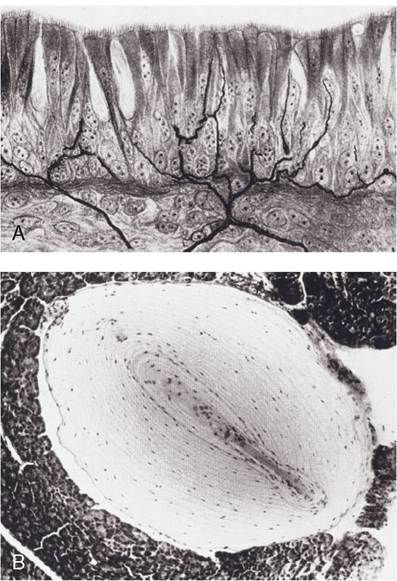
Figure 11-1. Encapsulated and nonencapsulated receptors. A) Naked nerve endings with Golgi stain in respiratory epithelium. These receptors transmit information about pain.
B) Pacinian corpuscle, a type of touch receptor, has a connective tissue capsule surrounding the terminus of the primary afferent neuron.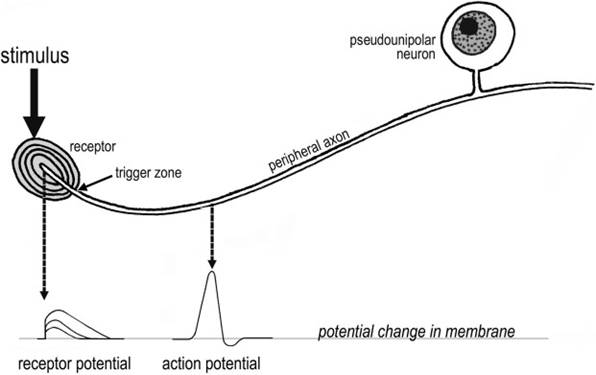
Figure 11-2. Somatosensory neurons are pseudounipolar in nature, with the cell body located in a sensory ganglion. The adequate stimulus will produce a receptor potential that is proportional to the strength of the stimulus. Once threshold is reached at the trigger zone, an action potential of uniform amplitude and duration is generated and conducted in the axon toward the CNS.
receptors, which respond to both heat and cold; (3) nociceptors, which respond to stimuli that are potentially injurious to tissue (noxious stimuli'); (4) photoreceptors, which are the light receptors of the retina; and (5) chemoreceptors, which respond to chemical changes associated with taste, smell, blood pH, and carbon dioxide concentrations in the blood. In normal circumstances, each receptor is preferentially sensitive to one type of stimulus; the unique stimulus to which a given receptor is most sensitive is called the adequate stimulus for that receptor.
Receptors transduce environmental energy into changes in membrane potential. The adequate stimulus produces a local change in membrane potential of the receptor, a voltage change known as the receptor potential or generator potential. The receptor potential is usually depolarizing, brought about by the opening of cation channels permeable to Na+ and K+.
The receptor potential is a graded event that spreads passively over the local membrane of the receptor; the amplitude of the potential change and the distance along the membrane that the receptor potential travels are proportional to the strength of the stimulus. When the change in membrane potential reaches a critical level, the threshold, an action potential begins in the trigger zone of the sensory neuron’s peripheral process. This signal is conducted along the axon into the CNS (Fig. 11-2).
Many encapsulated receptors exhibit a physiologic characteristic called adaptation. With sustained stimulation, the receptors cease firing after their initial burst of activity. When the stimulus is withdrawn, the receptor again responds with a volley of action potentials. In doing so, the adapting receptor signals the beginning and end of the stimulus, rather than firing throughout its duration. Typically, touch receptors adapt rapidly; naked nerve endings— nociceptors—as a rule do not adapt but fire continuously throughout application of a noxious stimulus.