SKELETAL-MUSCLE HARNESSING
1. Differentiate between epimysium, perimysium, and endomysium. Which of these is most intimately associated with individual muscle fibers?
The harness for skeletal muscle fibers is composed of connective tissue elements (epimysium, perimysium, endomysium) that are continuous from the individual muscle fibers to the connective tissue of the structure to which the muscle attaches and on which it exerts its pull when it contracts.
Often the connective tissue of the structure to which it is attached is a tendon (Figure 8-5). A broad connective tissue sheet that fulfills a similar function is an aponeurosis. The connective tissue elements of skeletal muscle are as follows:1. Muscle fibers that compose a muscle bundle (also called fascicles) are attached by their cell covering (sarcolemma).to a connective tissue division, the endomysium.
2. The endomysium is continuous with connective tissue that envelops muscle bundles, the perimysium.
3. The perimysium is continuous with connective tissue that envelops the muscle (collection of muscle bundles), the epimysium.
4. The epimysium is continuous with the tendon or aponeurosis, which can travel some distance for its attachment.
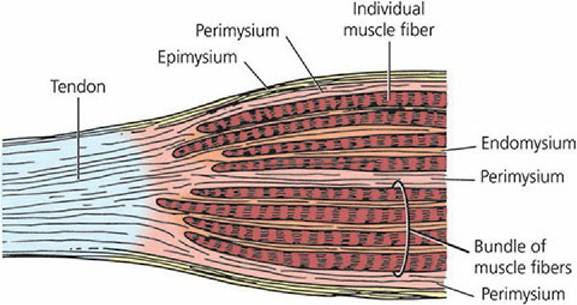
■ FIGURE 8-5 Longitudinal section of a muscle. The connective tissue elements of muscle are continuous with a tendon. (Adapted from Ham AW. Histology. 7th edn. Philadelphia, PA: JB Lippincott, 1974.)
Some muscles seem to arise directly from a bone, and their attachment could be considered a fleshy attachment. These muscle cells, however, do have a short tendinous attachment to the periosteum of the bone.
■