Species Variations
7.5.1 Horse (Figure 7.2)
The cranial surface of the liver is closely applied to the diaphragm, mostly to the right of the midline. Its most dorsal part is at the level of the right kidney, and its most ventral part is 7-10 cm from the abdominal floor opposite the seventh or eighth rib.
Its most cranial part is at the level of the ventral third of the sixth or seventh rib. The horse does not have a gall bladder.7.5.2 Ruminants (Figure 7.3)
The liver of the domestic ruminants lies to the right of the midline, except a small part of which lies ventral to the oesophageal notch. The diaphragmatic surface is in extensive contact with the diaphragm. The visceral surface is related to the atrium of the rumen and to the reticulum, omasum and the cranial part of the duodenum. Dorsally the liver is embedded against the right kidney.
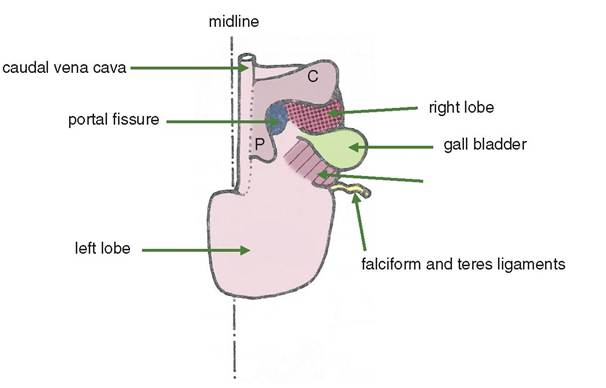
Figure 7.3 The liver of ruminants. The liver is almost entirely displaced to the right. The umbilical fissure is deeper in the sheep than the ox and the gall bladder does not project so far. The caudate lobe is smaller in the sheep than in the ox.
7.5.3 Pig (Figure 7.4)
The parietal surface of the liver fits the dome of the diaphragm. The visceral surface is in contact with the stomach. Unlike all the other domestic mammals there is no contact with the right kidney. There is therefore no renal impression.
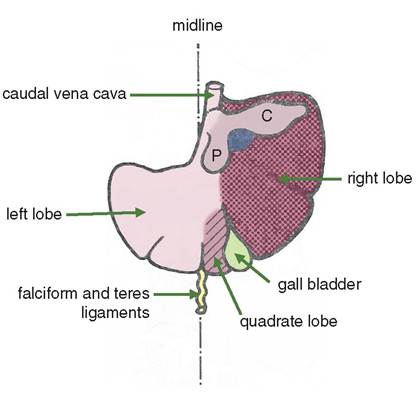
Figure 7.4 Diagram of the liver of the dog, cat and pig. The right and left lobes are subdivided into medial and lateral lobes.
7.5.4 Dog and Cat (Figure 7.4)
The liver lies almost entirely within the thoracic cage. Cranially its parietal surface is in contact with the diaphragm. Caudally its visceral surface is related on the left to the stomach and on the right to the duodenum, right kidney and pancreas.
7.6