In Spontaneously Ovulating Animals, Ovarian Cycles Have Two Phases: Follicular and Luteal; Animals That Require Copulation for Ovulation Can Have Only a Follicular Phase
An ovarian cycle in a nonpregnant animal is defined as the interval between successive ovulations. The cycle is composed of two phases, an initial follicular phase and a subsequent luteal phase, with ovulation separating the phases.
In most domestic animals and primates, the ovulatory process is governed by internal mechanisms; estrogen from the antral follicle initiates the ovulatory release of gonadotropins. These animals are called spontaneous ovulators.Fundamental differences exist among animals regarding the relationship of the follicular and luteal phases of the cycle. In higher primates, there is complete separation of follicular and luteal phases, with no significant follicle growth occurring until Iuteolysis is complete. In large domestic animals, significant follicle growth does occur during the luteal phase of the cycle. For example, in the cow a large antral follicle is present at the onset of Iuteolysis, and in the mare, follicle growth can even result in ovulation of follicles during the luteal phase (about 5% of cycles). Thus, in large domestic animals, much of the follicle growth is telescoped into the luteal phase. This situation results in shorter cycles in large domestic animals versus primates (17-21 days versus 28 days); the interval of Iuteolysis to ovulation is shorter in large domestic animals (5-10 days) than in primates (12-13 days). The period of antral follicle growth leading to ovulation is not appreciably different, however, with the final progression of antral follicle growth requiring about 10 days in large domestic animals and about 12 to 13 days in primates.
Animals that require copulation for ovulation are known as induced ovulators. They include cats, rabbits, ferrets, mink, camels, llamas, and alpacas. Copulation replaces estrogen as the stimulus that induces the ovulatory release of gonadotropins. However, these animals require exposure to elevated estrogen concentrations before they can respond to copulation by the release of gonadotropins.
Induced ovulators have follicle growth patterns (in the absence of coitus) in which cohorts of follicles develop, are maintained in a mature state for a few days, and then regress. Follicle growth patterns can be distinctly separated, as in the cat, in which follicles develop and regress over 6 to 7 days, with a minimum of 8 to 9 days between follicle growth waves. Follicle waves can also have some overlap, as in llamas and alpacas (Figure 36-6), or can closely overlap, as in the rabbit.
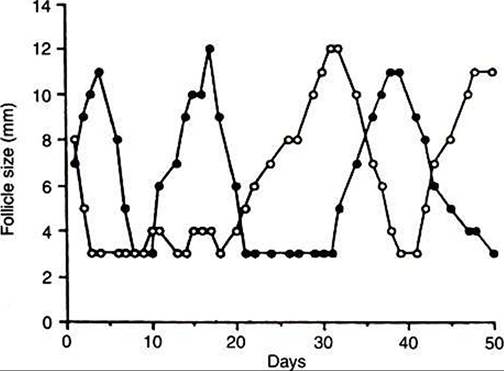
FIGURE 36-6 ■ Ovarian follicular activity over a period of 50 days in a llama, indicating follicle growth alternating between the left (open circles) and the right (solid circles) ovaries. (From Bravo PW, Fowler ME, Stabenfeldt GH, et al: Ovarian follicular dynamics in the llama, Biol Reprod 43:579, 1990.)