TAXONOMY
Order Carnivora
The order of carnivores consists of ten families with over 270 species and are found naturally everywhere, apart from Australia, New Zealand, Antarctica and many oceanic islands.
They range in size from the tiny Least weasel (Mustela nivalis) which weighs 35-70 g to the grizzly brown bear (Urus arctos) which can weigh up to 780 kg (Nowak 1999a).The term carnivore derives from the Latin carnis (flesh) and vorare (devour) in keeping with the fact that most species are meat eaters. However many bears are omnivorous and the Giant Panda is in fact a strict herbivore.
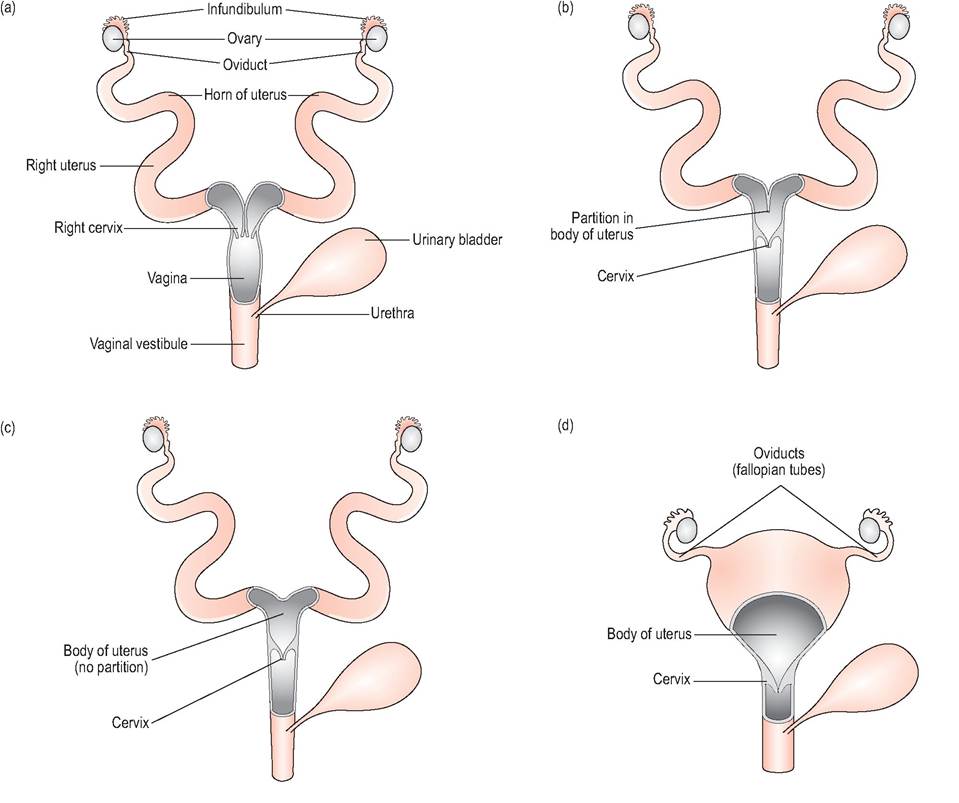
Figure 7.1 • Types of uterus found in placental mammals.
(a) Duplex (rabbit, hamster, rat)
(b) Bipartite (some carnivores and ungulates)
(c) Bicornuate (cat, dog, ferret, and ungulates)
(d) Simplex uterus (primates)
The heavy skull has a conspicuous saggital crest with well- developed temporal muscles and a large braincase (Fig. 7.2). The jaw articulation is in the dorso-ventral plane with limited transverse movement and no rotary movement. All teeth are rooted. Most species have 3/3 incisors with large conical canines and a variable amount of shearing and crushing premolar and molars. In most carnivores the fourth upper premolar and first lower molar are carnassial teeth that work together to provide the specialized shearing action for tearing at prey when feeding (Vaughan 1986a; Nowak 1999a).
Unlike lagomorphs and rodents, carnivores are typical predators and most species have excellent hearing, vision and smell for hunting. They have large auditory bullae and well-developed turbinates and olfactory epithelium.
They have 4-5 clawed digits on each limb. The first digit is not opposable and is often absent. Many, like canids and felids are digitigrade walking on their toes while Ursids, or bears, are plantigrade walking on the soles with heels touching the ground.
Young are born blind and helpless but with a covering of fur and there is usually a high level of parental care (Vaughan 1986a; Nowak 1999a).Order Lagomorpha and Rodentia
Rodents comprise the largest mammalian order with over 1800 species (40% of all mammals) (Hurst 1999). They can be found worldwide from the Arctic to tropical and temperate regions (Nowak 1999b, 1999c). Lagomorphs
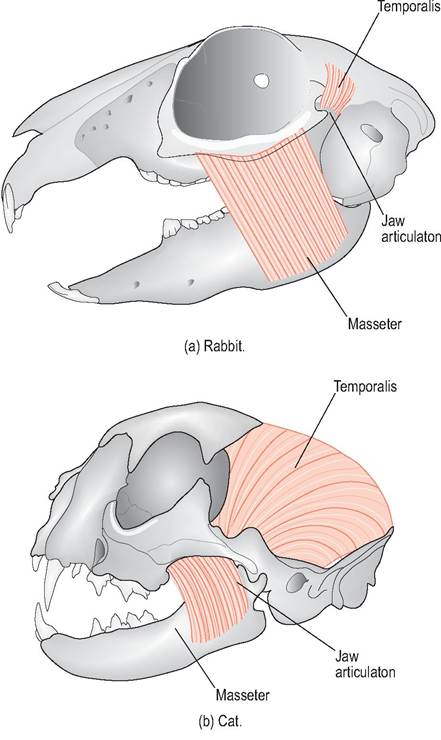
Figure 7.2 • Comparison of muscles of mastication between herbivores and carnivores. In herbivores the masseter is the main muscle of mastication and the jaw articulation lies dorsal to the occlusal surfaces of the teeth.
(a) Rabbit
(b) Cat
differ from rodents in that they have four upper incisors (Vaughan 1986c) and a different jaw structure, but otherwise they share many similar behavioral and anatomical characteristics and will be included with rodents for this introductory section (Table 7.1).
Table 7.1 Classification of Lagomorphs and Rodents
| Order | Suborder | Description | Species examples |
| Lagomorpha | Rabbits, hares, cottontails | ||
| Rodentia | Myomorpha | Mouse like | Rats, mice, hamsters |
| Caviomorpha | Cavy like | Guinea pigs, chinchilla | |
| Sciuromorpha | Squirrel like | Squirrels, chipmunks, prairie dogs |
Lagomorphs
Rabbits belong to the order Lagomorpha, which contains two families: the Ochotonidae, which includes the pikas (Ochotona), and the Leporidae, containing rabbits and hares (Lepus) and cottontails (Sylvilagus) (Nowak 1999c).
Lagomorphs differ from rodents in both dentition and jaw structure.
Unlike rodents they have two rows of upper incisors and the upper maxillary arcades lie further apart than the mandibular arcades, meaning that only one side of the cheek teeth can be occluded at a given time. Up until the mid-twentieth century they were classified as a suborder of the order Rodentia but it is now thought that their different dentition and jaw structure makes them more similar to artiodactyls, such as cows and horses (Crossley 2003; Nowak 1999b).Rabbits differ from hares in having a short gestation period (28-33 days) and giving birth to altricial young in burrows underground. Hares are generally larger than rabbits, have a gestation period of 40 to 50 days, and give birth over ground to precocious young (Harkness & Wagner 1995; Nowak 1999c).
Rodents
Traditionally the order Rodentia was divided into the suborders Myomorpha, Sciuromorpha and the Caviomorpha (Hystricomorpha) based on skull and jaw musculature (Hurst 1999; Nowak 1999b) (Fig. 7.4). The classification of rodents is always in flux, however. More recent research on mandibular anatomy has suggested classifying rodents into just two suborders: Sciurognathi (sciuromorphs and myomorphs) and Hystricognathi (caviomorphs) (D'Erchia et al. 1996; Nowak 1999b; Vaughan 1986b).
Myomorphs
The Myomorpha, or mouse-like rodents, are the biggest suborder and include the rat, hamster, and gerbil (Fig. 7.5). They have a total of 16 teeth with no premolars, and rooted molars. Famous for their gnawing ability, a feature of this suborder is that part of the medial masseter muscles inserts not only on the lower jaw but runs through the infraorbital foramen to insert on the rostral muzzle. This unique architecture allows a more forward thrust of the jaw and more effective gnawing (King & Custance 1982; Nowak 1999b; Vaughan 1986b).
Two families from the order of Myomorpha will be featured in this book: the family Muridae, which includes rats and mice, and the family Cricetidae, which includes gerbils and hamsters.
The main anatomical characteristics distinguishing these two families is that the Cricetidae have molar cusps arranged in two parallel longitudinal rows while the Muridae have cusps arranged in three rows.Sciuromorphs
These are the squirrel-like rodents and include the chipmunk, squirrel, and prairie dog (Fig. 7.6). They have 20-22
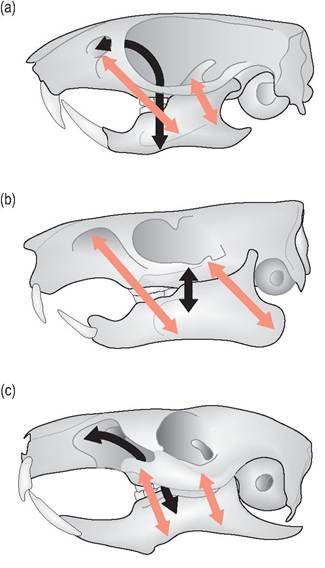
Figure 7.4 • Differing action of lateral and medial masseter muscles in rodents. Black = medial masseter. Red = lateral masseter.
(a) Myomorph - the medial masseter muscles insert not only on the lower jaw but run through the infraorbital foramen to insert on the rostral muzzle. This allows greater gnawing power
(b) Sciuromorph - these have the lateral masseter muscle extending cranially to aid gnawing. The medial masseter muscle is only involved in closing the jaw
(c) Caviomorph - the medial masseter muscles provide the gnawing action while the lateral masseter serves to close the jaw.
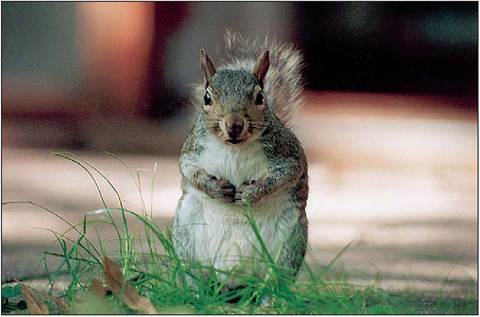
Figure 7.6 • Sciuromorph - Gray squirrel (Sciurus carolinensis).
mainly diurnal. The tail varies from short to long and is usually haired and bushy, with long hairs that project at right angles from the tail (Nowak 1999b).
Caviomorphs (Hystricomorphs)
The suborder Caviomorpha include the guinea pig and chinchilla, which eat a highly abrasive herbivorous diet (Fig. 7.7). They have 20 teeth in total and their open rooted (aradicular) molars make them especially prone to dental disease. They also produce precocious young and have a long gestation period. In contrast to the sciuromorphs, the medial masseter muscles provide the gnawing action while the lateral masseter serves to close the jaw (Hurst 1999; Nowak 1999b).