The Cerebrocerebellum Helps with Planning Coordinated, ProperIyTimed Movement Sequences
The Cerebrocerebellum occupies the lateral cerebellar hemispheres (Figures 12-5 and 12-6). This region also receives input from the primary motor cortex, but more important, receives a substantial input from premotor and supplementary motor cortices.
These cortical inputs reach the cerebellum by way of the corticopontine-cerebellar system. This area of the cerebellum does not have direct access to information from peripheral receptors as does the spinocerebellum. Its outputs return to the motor cortices by way of the thalamus. Therefore the Cercbrocerebellum is part of a communication loop with regions of motor cortex that are involved in the planning of, and preparation for, movement. Whereas the spinocerebellum helps coordinate the execution of movement, it appears that the Cerebrocerebellum helps the motor cortices with planning ahead for the next appropriate movement so that there will be smooth and appropriately timed transitions between components of a movement sequence. The dramatic growth of the Cerebrocerebellum and cerebral cortex was the major phylogenetic addition to the brain during primate evolution, and thus it is often called the neocerebellum. Presumably this is linked to the primates ability to perform graceful» intricate, appropriately timed voluntary movements, such as coordinatedSECTION Il Neurophysiology
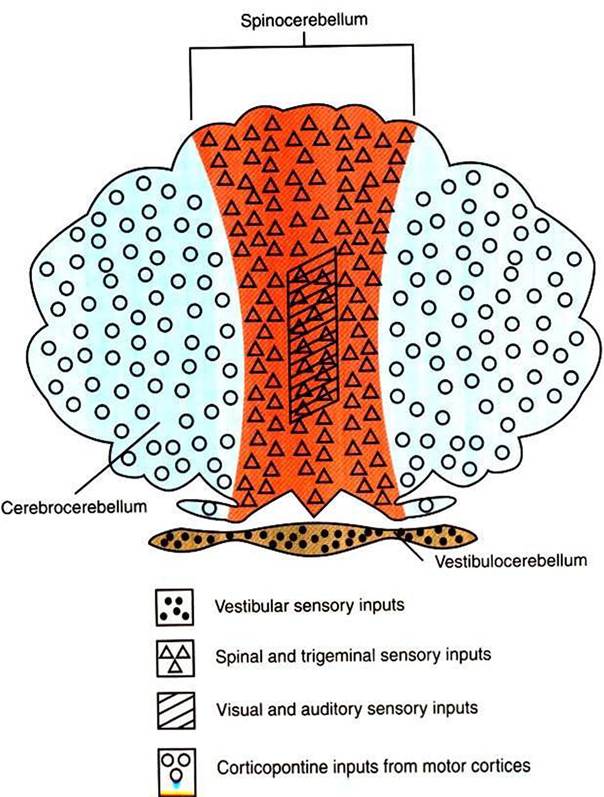
FIGURE 12-5 The cerebellum can be divided into three distinct regions, illustrated here with their respective major inputs, from both a functional perspective and a phylogenetic perspective. (Modified from Kandel ER1 Schwartz JH: Principles of neural Science, ed 2, NewYork, 1985, Elsevier Science Publishing.)
finger movements and the mouth and tongue movements
necessary for speech.
The Cerebellum Plays a Role in Motor Learning
Several lines of evidence suggest that the cerebellum plays a significant role in motor learning.
For example, functional magnetic resonance imaging (fMRI) studies have shown that the cerebellum is very active when learning a new sequence of movements, but it is not as active once the movement becomes relatively automatic. This suggests that the cerebellum is likely involved in the transition from having to concentrate on learning of a new motor skill, such as where to place the individual fingers on the piano keys to form a chord, to being able to perform that skill automatically, with limited thought. Some reflex behaviors, such as the vestibulo-ocular reflex (see Chapter 11), although automatic, need to be fine-tuned or adjusted (e.g. with respect to the amount of eye rotation necessary to counteract a given amount of head rotation to keep the gaze fixed on a target) as the proportions of the head change during growth. Damage to certain regions of the cerebellum can prevent this type of adaptive adjustment. In addition, some forms of associative learning, such as some classically conditioned responses, can be abolished after cerebellar lesions. The ability to make motor adaptations after alterations of the visual world, such as learning to throw darts accurately after wearing prism glasses, can also be severely impaired in individuals with cerebellar damage.Structural and functional changes in cerebellar circuitry have also been observed during motor learning. For example, increases in the number of parallel fiber and climbing fiber synaptic contacts on Purkinje cells have been observed following the learning of complex motor behavior. Furthermore, simul-
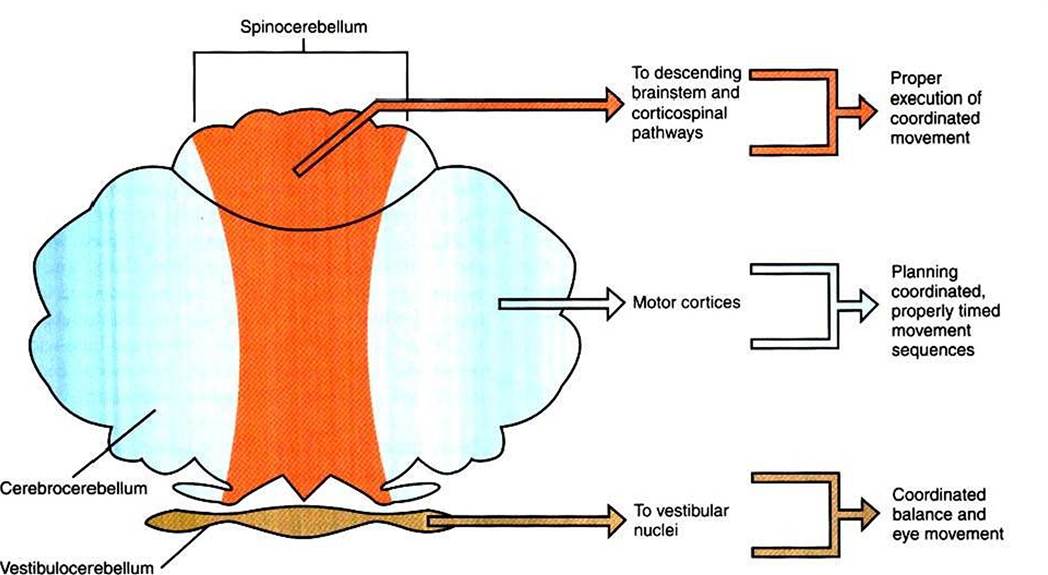
FIGURE 12-6 Major output targets and general roles of the three functional regions of the cerebellum. (Modified from Kandel ER, Schwartz JH: Principles of neural science, ed 2, NewYork, 1985, Elsevier Science Publishing.)
taneous activation of these Uvo types of fibers synapsing on a Purkinje cell can produce a long-term depression of Purkinje cell activity. Such depression can have a profound effect on the activity of neurons of the deep cerebellar nuclei that leave the cerebellum to control components of the motor hierarchy.