The Collecting Duct Can Secrete Bicarbonate and Generate Alkaline Urine
The proximal tubule reabsorbs HCO5" and secretes H4, regardless of the plasma HCO5 concentration and the blood pH. In fact, as the plasma HCO5- concentration increases, the concentration of HCO5- in the glomerular filtrate increases, and the amount of HCO5 reabsorption by the proximal tubule epithelium also increases.
The amount of H4 secretion and HCO5- reabsorption in this segment is generally determined by the concentration of intraluminal buffers rather than by the need for conserving or excreting acid or base.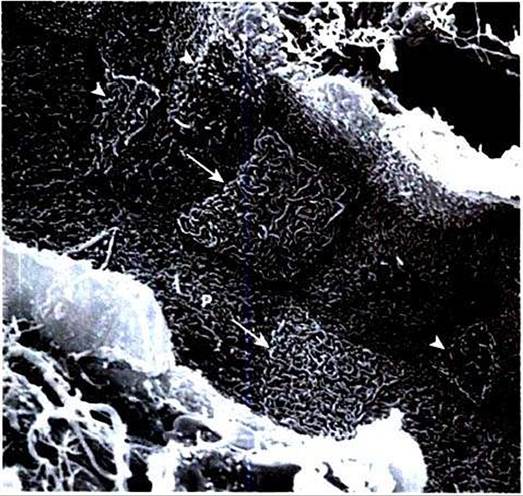
FIGURE 44-5 Scanning electron micrograph of rat cortical collecting duct viewed from the tubule lumen. Three cell types are evident.The principal cells Ware large, with a single central cilium and few apical surface microprojections.The type A (acid-secreting) intercalated cells (arrows) have a large apical surface covered with extensive membrane folds (microplicae). The type B (bicarbonate-secreting) intercalated cells (arrowheads) have a small apical surface area covered with sparse microprojections, either microvilli or a mixture of microvilli and microplicae. (Magnification ?4000.)
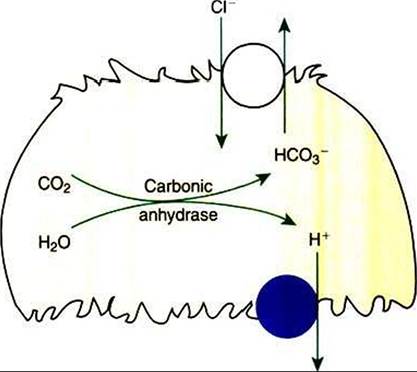
FIGURE 44-6 Schematic illustration of the proposed mechanism of HCO3 secretion (H* reabsorption) in the type B intercalated cell of the cortical collecting duct.These cells contain H+-ATPase in the basolateral plasma membrane and are rich in cytoplasmic carbonic anhydrase. Functional immunocytochemical evidence indicates that a CI7HCO3^ exchanger is present in the apical plasma membrane.
However, the collecting duct is capable of net HCO5- secretion in response to alkalosis. Net HCO5' secretion is a function of the connecting segment and the cortical collecting duct in mice, rats, and rabbits.
A distinct subset of intercalated cells (type B intercalated cells) is present in these segments (Figure 44-5). These cells are rich in carbonic anhydrase, secrete HCO5' by an apical Cl-ZHCO3- exchanger, and have a basolateral electrogenic proton pump. Although the apical Cl ZHCO5 exchanger is distinct from the basolateral CΓ7HCO5" exchanger in acid-secreting intercalated cells, bicarbonate-secreting cells functionally represent a mirror image of acid-secreting cells, with active H, reabsorption and exchange of CΓ in the tubule fluid for intracellular HCO5- (Figure 44-6).I he regulation of bicarbonate secretion is an area of active research. Bicarbonate secretion is stimulated not only by models of alkalosis, but also by aldosterone analogues and by dietary Cl restriction. In Cl depletion, however, the amount of CI delivered to the type B intercalated cells may fall so low that bicarbonate secretion is blocked because not enough CΓ is available for exchange with intracellular HCO5-. For this reason, CΓ depletion may produce metabolic alkalosis.
Little is known about the comparative physiology of renal control of acid-base balance in domestic animals, although proximal tubules and collecting ducts exist in all mammals examined to date, and intercalated cells have been observed at least in cat, dog, and horse collecting ducts. However, it is likely that considerable anatomical and functional differences exist among species, particularly between carnivores, which usually excrete acid urine, and ruminants, which usually excrete neutral or alkaline urine.